Loading…

Loading…
Hosted by Jason Edwards · 🇺🇸 US · EN · 51 episodes
Established thought leaders with verified media credentials.
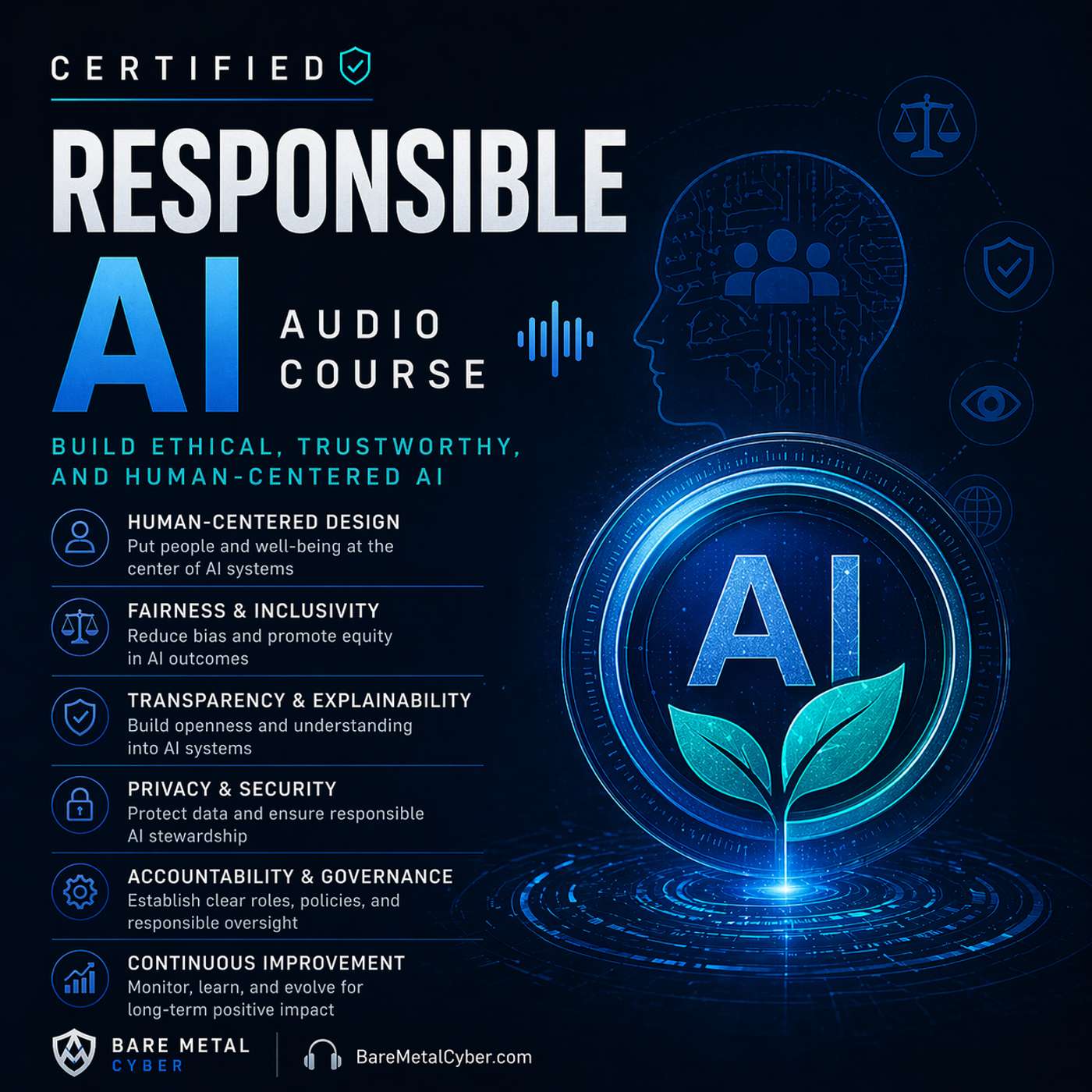
The **Responsible AI Audio Course** is a 50-episode learning series that explores how artificial intelligence can be designed, governed, and deployed responsibly. Each narrated episode breaks down complex technical, ethical, legal, and organizational issues into clear, accessible explanations built for audio-first learning—no visuals required. You’ll gain a deep understanding of fairness, transparency, safety, accountability, and governance frameworks, along with practical guidance on implementing responsible AI principles across industries and real-world use cases.The course examines emerging global standards, regulatory frameworks, and risk-management models that define trustworthy AI in practice. Listeners will explore how organizations can balance innovation with compliance through ethical review processes, impact assessments, and continuous monitoring. Key topics include algorithmic bias mitigation, explainability, data stewardship, AI auditing, and stakeholder accountability. E
Jason Edwards hosts Certified - Responsible AI Audio Course, a education show with 51 episodes published.
Policies and technical safeguards succeed only when embedded within an organizational culture that values responsibility. This episode introduces culture as the shared norms and behaviors shaping AI use, and change manag
External assurance and audits provide independent validation that AI systems meet ethical, legal, and operational standards. This episode explains how audits examine governance structures, data practices, model performan
Most organizations rely on third-party AI systems and services, creating exposure to risks outside their direct control. This episode introduces procurement and vendor risk management as critical components of responsibl
A Responsible AI (RAI) function provides organizations with the structure to oversee and guide AI use. This episode explains how to establish an RAI office or committee with clear roles, charters, and mandates. Key respo
AI systems in the public sector and law enforcement operate under intense scrutiny because of their potential to affect entire populations and fundamental rights. This episode explains applications such as welfare eligib
AI tools are transforming education through adaptive learning platforms, tutoring systems, and automated grading. This episode introduces opportunities for personalization, increased accessibility, and efficiency for edu
Human resources and hiring processes increasingly use AI to manage recruitment, screening, and workforce analytics. This episode highlights benefits such as reduced recruiter workload, improved efficiency in handling lar
AI systems in finance and insurance carry significant opportunities and risks. This episode introduces applications such as credit scoring, fraud detection, underwriting, and claims processing. Learners explore ethical c
Healthcare and life sciences present some of the most promising but also most sensitive applications of AI. This episode explores opportunities such as diagnostic imaging, predictive analytics for patient care, and AI-dr
AI systems consume significant resources, from the energy needed to train large models to the materials required for specialized hardware. This episode introduces environmental sustainability as minimizing ecological imp
Choice architecture refers to how options are presented to users, while dark patterns are manipulative designs that steer users toward decisions not in their best interest. This episode explains the difference between et
Inclusivity and accessibility ensure AI systems serve all users equitably, regardless of background, language, or ability. This episode defines inclusivity as designing for cultural, linguistic, and demographic diversity
Provenance and watermarking are methods for tracking and identifying AI-generated content. Provenance refers to capturing the history of data or outputs, often through metadata, cryptographic signatures, or blockchain-ba
Generative AI raises complex intellectual property questions about both training data and outputs. This episode introduces copyright as legal protection for creators and licensing as the framework governing permissions.
Even with strong safeguards, AI systems inevitably experience failures or incidents that create harm or expose vulnerabilities. This episode defines incidents as unplanned events where AI causes unexpected outcomes and p
Monitoring ensures AI systems continue to perform as intended after deployment, while drift refers to changes in data or environments that degrade accuracy and fairness. This episode introduces three forms of drift: data
Human-in-the-loop describes oversight models where people remain actively involved in AI decision-making. This episode explains three main approaches: pre-decision oversight, where humans review outputs before they are f
Effective evaluation frameworks are essential to ensuring AI systems perform reliably and responsibly. This episode introduces task-grounded evaluations, which measure performance in domain-specific contexts, and benchma
Large language models frequently generate outputs that sound convincing but are factually incorrect, a phenomenon known as hallucination. This episode introduces hallucinations as systemic errors arising from statistical
Sponsor detection runs nightly. Check back soon.
No public pitch examples yet for this show.
Generate your own personalised pitchBased on semantic analysis of episode topics and host coverage, this show is a strong guest fit for executives in:
Industry fit is computed by PitchCentric using vector embeddings of the show's episode catalog.
Shows with the most semantically similar episode content. Pitch one, pitch all; producers cluster.






Certified - Responsible AI Audio Course has a verified contact on file. Create a free PitchCentric account to access it and generate a personalised pitch in seconds. Research at least 3 recent episodes first and lead with a specific angle that serves their education audience.
Certified - Responsible AI Audio Course is hosted by Jason Edwards. The show is categorised under education (courses) and has published 51 episodes.
Certified - Responsible AI Audio Course has published 51 episodes.
Certified - Responsible AI Audio Course regularly covers education, courses, technology. It sits in the education category, with a courses focus.
Certified - Responsible AI Audio Course is accessible for guests with genuine education expertise. A personalised, episode-aware pitch will still outperform a generic one every time.
Certified - Responsible AI Audio Course hasn't explicitly signalled guest openness in recent episodes. That doesn't rule out pitching. your hook just needs to be especially compelling and relevant to their recent content.
Episodes of Certified - Responsible AI Audio Course average 22 minutes. a focused format where a clear narrative arc and tight preparation matter most.
Our data rates Certified - Responsible AI Audio Course's guest bar at 80/100 (Premium tier). Established thought leaders with verified media credentials. Sign in to PitchCentric to see how your own Pod Score compares against this show.
Methodology. Booking Probability™ blends Listen Score, 30-day Virality, open-to-guests detection, and Apple ratings. Data refreshed every 60 minutes. Listen Score and Booking Probability are calculated by PitchCentric. Last enriched 2 days ago.