
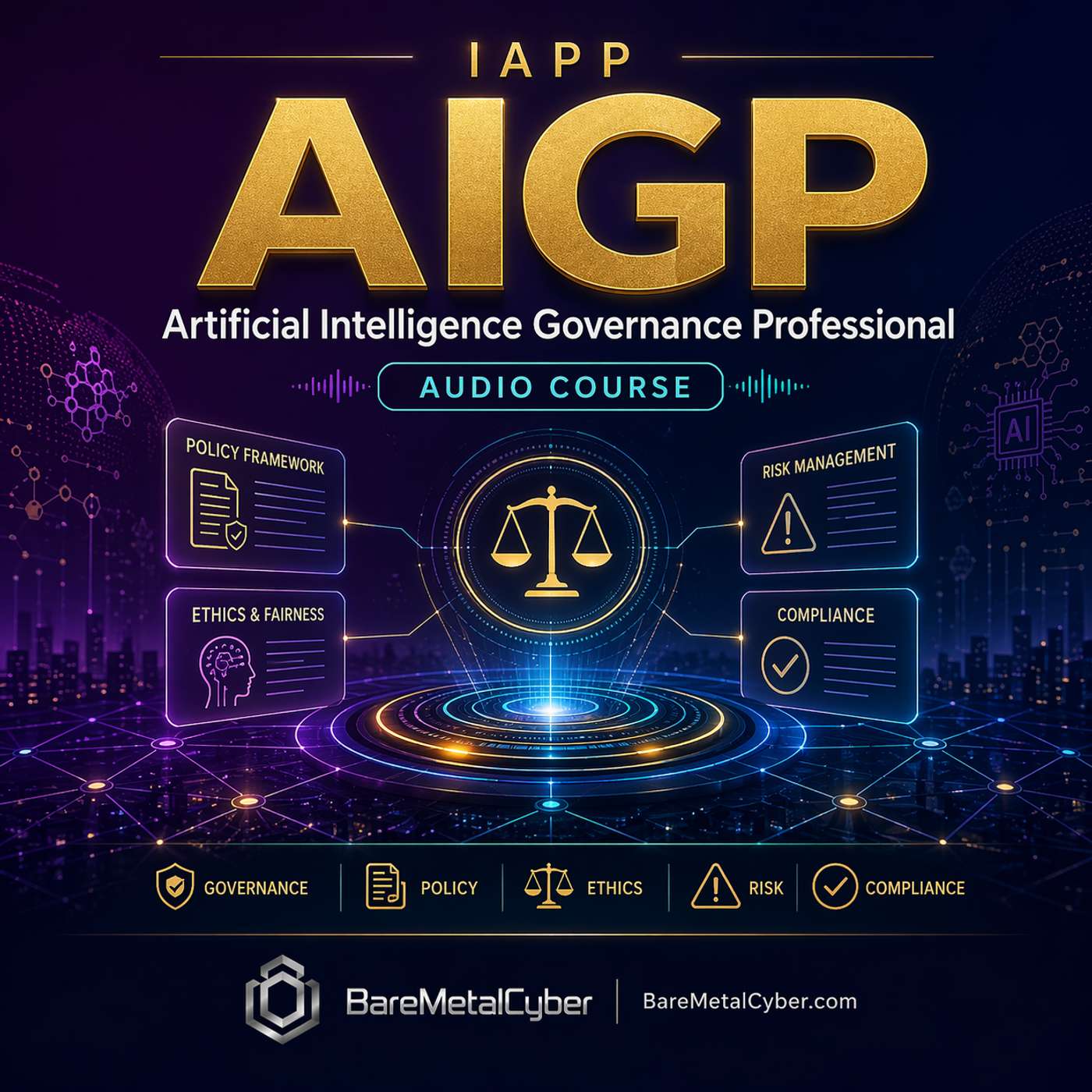
Welcome to the AIGP Course!
Welcome to The Bare Metal Cyber AIGP Audio Course—your practical companion for preparing for the IAPP Artificial Intelligence Governance Professional (AIGP) certification. Built for busy professionals who need a clear un

Hosted by Jason Edwards · 🇺🇸 US · EN · 59 episodes
Established thought leaders with verified media credentials.
Certified: The IAPP AIGP Audio Course is built for professionals who need a practical path into AI governance without having to stop their day job to get there. It is a strong fit for privacy professionals, compliance teams, risk managers, security leaders, legal and policy staff, product managers, consultants, and anyone else who now has AI oversight in their role. The course assumes you are motivated and capable, but not necessarily deep in technical machine learning work. It starts from clear foundations and then moves into the governance, risk, accountability, and decision-making issues that matter in real organizations. If you are trying to understand how responsible AI programs are structured, how governance connects to business use, and how to prepare for the AIGP certification in a way that feels manageable, this course gives you a steady and usable learning path.You will learn the language, concepts, and operating mindset behind modern AI governance in a format designed for
Jason Edwards hosts Certified: The IAPP AIGP Audio Course, a technology show with 59 episodes published.

Welcome to The Bare Metal Cyber AIGP Audio Course—your practical companion for preparing for the IAPP Artificial Intelligence Governance Professional (AIGP) certification. Built for busy professionals who need a clear un

This episode brings the full course together by showing how development governance and deployment governance should operate as one connected decision-making framework rather than as separate bodies of work. You will lear

This episode explains why deployment governance must include plans for what the organization will say externally and what technical or operational controls it can use if the system must be limited, localized, or shut dow

This episode focuses on the governance work that follows deployment when organizations must document incidents, sustain post-market monitoring, and control how AI systems are used beyond their original approved purpose.

This episode explains how deployed AI systems should be verified through deliberate assurance activities that test more than routine business performance. You will learn how audits confirm whether policies, controls, and

This episode focuses on post-deployment stewardship, which is essential because AI systems continue to change in effect even when their code appears stable. You will learn why ongoing monitoring must track performance, f

This episode explains how deployment governance becomes real through operational controls that shape how data is handled, how risks are tracked, how issues are escalated, and how users are prepared to interact with the s

This episode focuses on proprietary AI systems, which can offer performance, customization, or competitive advantage while also creating governance demands that differ from open or broadly shared tools. You will learn ho

This episode explains why AI governance must include careful review of vendor contracts and licensing terms before deployment, because legal and operational exposure often hides in clauses that technical teams overlook.

This episode explains why organizations should conduct focused impact reviews before deployment even after a system has already been selected, because choosing a tool is not the same as proving it is safe and appropriate

This episode explains how deployment architecture shapes governance by affecting data exposure, control boundaries, latency, integration complexity, and responsibility allocation. You will learn how cloud deployment can

This episode focuses on comparing model types so organizations choose an approach that fits the use case, risk profile, explainability needs, and operational environment instead of defaulting to whatever is popular. You

This episode explains why a technically capable AI system can still be a poor deployment decision if the surrounding business and operational context are not ready for it. You will learn how to evaluate the deployment se

This episode pulls together the development lifecycle by showing how governance starts with early impact assessments and continues through design reviews, testing evidence, approval decisions, and, when required, public-

This episode explains how transparency becomes operational through documentation, user-facing instructions, and monitoring plans that make an AI system understandable enough to govern and use responsibly. You will learn

This episode focuses on incident investigation when an AI system behaves unexpectedly, causes harm, or fails under real-world conditions. You will learn why AI incidents often require cross-functional analysis involving

This episode explains how organizations should examine AI systems in production using methods that go beyond routine monitoring and basic performance checks. You will learn how audits provide structured reviews of whethe

This episode focuses on what happens after launch, when an AI system must be monitored and maintained as a living system rather than treated as a finished product. You will learn why continuous monitoring matters for per

This episode explains how organizations determine whether an AI system is ready to move from testing into real use without treating release as a guess or a deadline-driven compromise. You will learn how model cards can s

This episode explains how organizations should handle problems discovered during training and testing without losing traceability or governance discipline. You will learn why issue management matters when models show bia
Sponsor detection runs nightly. Check back soon.
No public pitch examples yet for this show.
Generate your own personalised pitchBased on semantic analysis of episode topics and host coverage, this show is a strong guest fit for executives in:
Industry fit is computed by PitchCentric using vector embeddings of the show's episode catalog.
Shows with the most semantically similar episode content. Pitch one, pitch all; producers cluster.


Certified: The IAPP AIGP Audio Course has a verified contact on file. Create a free PitchCentric account to access it and generate a personalised pitch in seconds. Research at least 3 recent episodes first and lead with a specific angle that serves their technology audience.
Certified: The IAPP AIGP Audio Course is hosted by Jason Edwards. The show is categorised under technology (education) and has published 59 episodes.
Certified: The IAPP AIGP Audio Course has published 59 episodes.
Certified: The IAPP AIGP Audio Course regularly covers technology, education, courses. It sits in the technology category, with a education focus.
Certified: The IAPP AIGP Audio Course is accessible for guests with genuine technology expertise. A personalised, episode-aware pitch will still outperform a generic one every time.
Certified: The IAPP AIGP Audio Course hasn't explicitly signalled guest openness in recent episodes. That doesn't rule out pitching. your hook just needs to be especially compelling and relevant to their recent content.
Episodes of Certified: The IAPP AIGP Audio Course average 17 minutes. a focused format where a clear narrative arc and tight preparation matter most.
Our data rates Certified: The IAPP AIGP Audio Course's guest bar at 80/100 (Premium tier). Established thought leaders with verified media credentials. Sign in to PitchCentric to see how your own Pod Score compares against this show.
Methodology. Booking Probability™ blends Listen Score, 30-day Virality, open-to-guests detection, and Apple ratings. Data refreshed every 60 minutes. Listen Score and Booking Probability are calculated by PitchCentric. Last enriched yesterday.