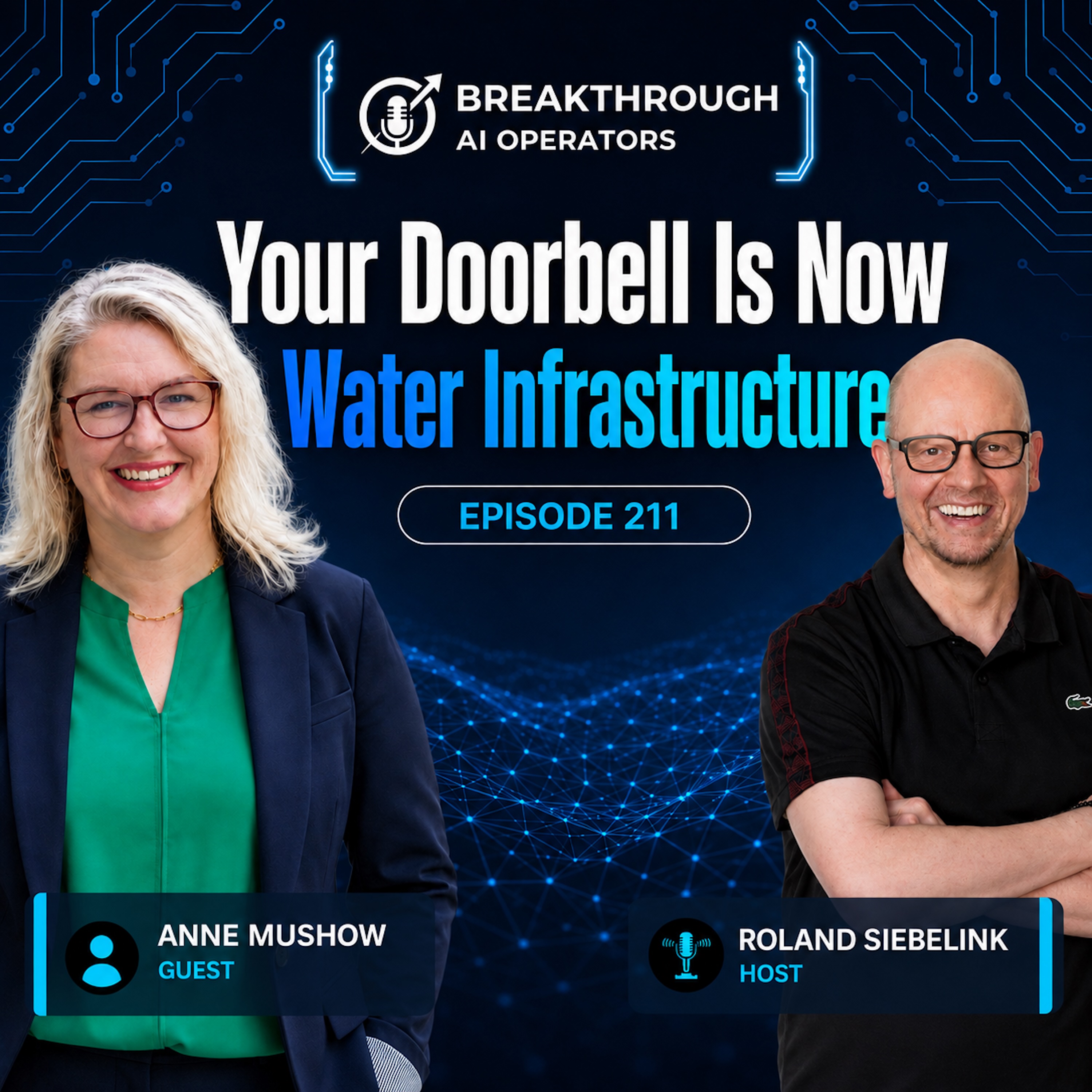
Episode #211
Your Doorbell Is Now Water Infrastructure | Subeca | Anne Mushow | EP 211
What does it look like when the person best positioned to disrupt an industry is the one who used to run the process about to become obsolete? One founder managed a 90-person team deploying water meters the slow, decades-old way, watched a hyperscaler quietly ship a piece of infrastructure almost nobody in her industry noticed, and knew instantly her old job wouldn't exist much longer. Anne Mushow is CEO of Subeca, a water-metering company she built after running Xylem's smart-meter deployment team and a stint inside Amazon Web Services, where she watched Amazon Sidewalk launch and recognized what it would mean for the industry she'd just left. Subeca's device clips onto a water meter already in the ground in under a minute and turns it into a connected one, no rip and replace, no dedicated network to build or maintain. The path there took several pivots. Mushow originally imagined utilities and customers sharing usage data directly, until she learned most utilities didn't have granular data to share in the first place. An early version ran on LoRaWAN alone, until Sidewalk's infrastructureless model, running through Ring cameras and Echo devices already sitting in millions of homes, became what she calls the real unlock. Subeca now runs both as a belt-and-suspenders setup. Revenue grew 10x from 2024 to 2025, and the company is on pace for another 10x this year. The team behind that growth is seven technical people. Mushow estimates the same work would have needed 20 to 25 people fifteen years ago, mostly because AI now lets her team iterate on small, deeply tested pieces of code instead of building everything by hand. AI also does a chunk of lead generation, scanning public municipal and HOA meeting records for the exact language that signals a utility is close to a buying decision. Her clearest competitive edge isn't technical, though. Established meter manufacturers have been slow and skeptical about Sidewalk, and Mushow's own history helping launch it from inside Amazon gave Subeca roughly a two-year head start nobody else could easily copy. She's also chosen to stay a point solution on purpose, happily plugging into partners' existing systems as the last-mile connector instead of trying to own the entire stack. Roland flags the headcount comparison as one of the clearest AI-leverage numbers he's heard on the show: a team of seven doing what took 20 to 25 people a decade and a half ago is the kind of benchmark SaaS founders at the $1M to $50M stage should be measuring themselves against, not vague claims of "using AI more." Key Moments: 02:31 — Why Subeca calls itself the data layer AI needs, without calling itself an AI company 04:14 — The three market pressures forcing utilities to finally modernize 06:47 — Seven technical people doing work that would have needed 20 to 25 people fifteen years ago 08:10 — Scanning municipal board minutes with AI to catch a utility right before it's ready to buy 11:36 — The 2016 idea that failed once utilities admitted they didn't even have the data 13:25 — Why Amazon Sidewalk became "the ultimate game changer" over LoRaWAN and cellular 21:55 — The unexpected moat: being the one who helped launch Sidewalk from inside Amazon 23:42 — Choosing to be the "last mile" connector instead of building a walled-garden platform If the AI-leverage math behind your own team isn't as clear as Mushow's seven-person build, Roland works through exactly that kind of benchmarking with SaaS founders inside Midstage. mdstg.ac/drag-erase #SmartWaterMetering #AmazonSidewalk #IoTWaterInfrastructure #FounderGrowth #BreakthroughAIOperators