Oct 25, 202639 min
World records are going to have to start specifying which world we're talking about with all the activity on the Moon and Mars these days. NASA's Perseverance rover just set a new distance record for Mars, and it may be...


An irreverent and informative tour of the latest, greatest, and most interesting discoveries in astronomy.
Required Pod Score for this podcast. PitchCentric checks your profile against host openness, topical fit, and audience signals before you generate a pitch.
Contact path
Verified email
Booking probability
38%
Guest openness
Selective
Sign up to generate a grounded pitch for Walkabout the Galaxy.
Signup to Generate a PitchRecent episodes include "Adventures on the Moon and Mars with a Rover Record and a New Crater" (25 October 2026, 39 minutes), "The Oldest Radio Burst and Chariklo's Rapidly Changing Rings" (17 October 2026, 38 minutes), and "Backwards Exoplanet and Shrinking Mercury" (26 September 2026, 41 minutes).
Walkabout the Galaxy publishes roughly weekly, with episodes averaging 42 minutes across 379 episodes.
Booking probability for Walkabout the Galaxy is 38%, and the host is rated Selective on guests. Walkabout the Galaxy requires a Pod Score of 80 or higher. Walkabout the Galaxy's contact route on record: verified email.
The strongest fits for Walkabout the Galaxy are Scientific Research & Development. Walkabout the Galaxy has a science audience.
Walkabout the Galaxy is a science podcast with 379 episodes published.
Our AI reads these to draft pitches. Use them as grounding for a pitch that cites a real guest and a specific topic.
World records are going to have to start specifying which world we're talking about with all the activity on the Moon and Mars these days. NASA's Perseverance rover just set a new distance record for Mars, and it may be...

A new distance record has been set with the help of the JWST, spotting the distant (and therefore ancient) galaxy that produced an enigmatic fast radio burst or FURBY, detected by radio telescopes in 2024. This opens a...

Episode #434
An exoplanet has been discovered orbiting its star in the opposite direction of its star's rotation, a phenomenon that previously has only been observed in the presence of another star or massive sub-stellar object that...

Episode #433
An intriguing detection from a dark matter experiment may be the first direct detection of a dark matter particle. This detection would mean dark matter is made of WIMPs: Weakly-Interacting Massive Particles. There's a...

The Nancy Grace Roman Space Telescope sees 100 times more sky than the Hubble Space Telescope and has the ability to directly image planets around other stars like those in our own solar system. Learn about this...

Episode #431
What do you call a very-but-not-so-supermassive black hole completely encased in a warm dense cloud of hydrogen? A hot mess? How about "black hole star", a new category of crazy astronomical object that can explain some...

Episode #430
Strange and Top are at it again with a deep dive on the physics, psychology, and philosophy of the big questions: is there technologically advanced life out there in the galaxy, and if so, we will ever know? Will we...

Supermassive have such voracious appetites that they create an energetic mess when eating which has a tendency to shoot their food off at very high speeds. New observations show the second course for these monsters as...

Episode #428
Quasars, the energetic engines driven by the voracious appetite of supermassive black holes, have been observed in the very early universe, upending ideas about how long it took to form these behemoths in the first...

Episode #427
The astroquarks examine the oft-asked question of why the Moon sometimes looks huge and other times, not so much, and we take a look at the cool mission to grapple and boost the NASA Swift space telescope into a higher...

Episode #426
OG Top Quark Tracy Becker joins us with an update on water plumes from Jupiter's moon Europa, plus intriguing new data of interstellar comet 3I shows it is even older than we thought, with an age approaching that of the...

Exquisitely detailed measurements of the ripples in spacetime from the mergers of black holes now show that some of these merging black holes were, themselves, created by an earlier black hole merging event. While this...
<p>Exquisitely detailed measurements of the ripples in spacetime from the mergers of black holes now show that some of these merging black holes were, themselves, created by an earlier black hole merging event. While...

<p>Mysterious bright blue flashes from relatively empty parts of the universe have a new possible explanation involving, what else, black holes. We explore this new idea to explain Luminous Fast Blue Optical Transients...

<p>A Plutino, an object that shares Pluto's orbit but which is much smaller than Pluto, appears to have a very thin global atmosphere. We discuss the detection and how such a small body could hold onto even a thin...

Episode #422
<p>Gravitational waves and light combine to reveal what is suspected to be a superkilonova which is much cooler than the name suggests. Cool in the cool way, not the temperature way. Learn about splitting neutron stars...

<p>Gravitational Wave observatory LIGO has seen a signature that looks like the merger of primordial (pre-stellar, big bang (not big band!) era) black holes. If confirmed with future observations, this would tell us a...
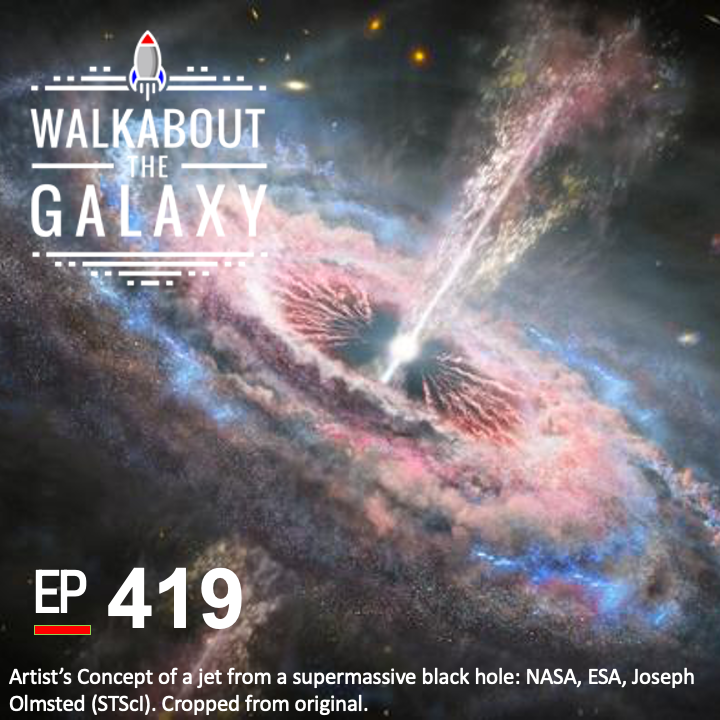
<p>Supermassive black holes can be terrible neighbors. New research shows that their powerful jets of charged particles can shut down star formation in neighboring galaxies within the galaxy cluster, which is just plain...

<p>The Earth spent some crazy amounts of time (tens of millions of years) completely frozen over. And not, in the grand scheme of things, all that long ago. New research shows the ocean was salty and super-cold. How did...
<p>There's always been a fuzzy line between asteroids and comets, and new observations of asteroids in the vicinity of Jupiter provide a hint to the origin of the mysterious active asteroids that look like asteroids but...
PitchCentric classifies Walkabout the Galaxy under these industries. Guests from them are the closest fit, and each links to the best podcasts in that industry.
Shows with the most semantically similar episode content. Pitch one, pitch all; producers cluster.
Is this podcast yours and you'd like to remove or correct details? Request removal or email privacy@pitchcentric.com.
Questions about the free trial? See the pricing FAQ