What makes an idea spread in healthcare and what actually lasts? Viral Healthcare is a short-form podcast hosted by Bruce Spurlock , CEO of Convergence Health, exploring the ideas, policies, innovations, and narratives that go viral across healthcare, separating what’s noise from what truly changes care. In episodes under 20 minutes, Bruce breaks down: Why certain healthcare ideas, trends, and stories go viral Whether those ideas actually improve quality, safety, and outcomes How leaders can tell the difference between hype and lasting impact What healthcare executives should pay attention to before it becomes mainstream The podcast features candid conversations with healthcare leaders, clinicians, policymakers, and improvement experts who are shaping the future of care in real time. Viral Healthcare is provocative, thoughtful, and pract
Pitch Analysis
Required Pod Score for this show. PitchCentric checks your profile against host openness, topical fit, and audience signals before you generate a pitch.
Contact path
Verified email
Booking probability
32%
Guest openness
Selective
Verified email on file
80/100
Required Score
Sign up to generate a grounded pitch for Viral Healthcare.
Viral Healthcare is a health podcast hosted by Bruce Spurlock, with 52 episodes on record and a Required Pod Score of 80. PitchCentric scores this show on Booking Probability, Listen Score, and live audience signals refreshed every 24 hours.
About the host
Bruce Spurlock hosts Viral Healthcare, a health show with 52 episodes published.
Our AI reads these to draft pitches. Use them as grounding for a pitch that cites a real guest and a specific topic.
Episode #29
Ep. 29: Haven Healthcare Part 4 — What Actually Failed?
Sep 15, 202621 min
On January 4, 2021, Haven Healthcare announced it was shutting down. After less than three years, the ambitious venture created by Amazon, Berkshire Hathaway, and JPMorgan Chase was coming to an end. The easy conclusion is that Haven failed. But is that the whole story? In the final episode of this four-part series, Dr. Bruce Spurlock looks beyond the binary question of success versus failure to ask something more useful: What exactly failed—and what survived? Bruce brings together the lessons from the entire Haven Healthcare story, from the challenge of turning an ambitious vision into a clearly defined problem to the difficulty of creating accountability without clear decision rights. He explores the warning signals leaders can miss, the value of pre-mortems and tripwires, and why failure only becomes learning when it changes what we do next. Most importantly, Bruce challenges the assumption that an innovation has to survive intact in order for something valuable to spread. Organizations can disappear while their ideas, knowledge, people, tools, and lessons continue to influence what comes next. In this episode: Why leaders must define the problem before trying to transform the system The danger of becoming a "solution-first" organization Why authority and accountability must align How decision rights affect implementation Using pre-mortems and tripwires to recognize problems earlier The difference between failure and learning Why innovation doesn't always spread through direct replication Four questions leaders should ask about any major healthcare initiative Haven set out to transform healthcare. Instead, healthcare transformed Haven. The lessons from that experience may be more valuable than a simple verdict of success or failure. Hosted on Acast. See acast.com/privacy for more information.
Ep. 28 Reflection: When Is a Setback Actually a Warning?
Sep 11, 20267 min
Productivity may decline. Resistance can grow. Unexpected problems emerge. Sometimes performance even gets worse before it gets better. But when does normal implementation friction become evidence that something is actually wrong? In this reflection on Part 3 of the Haven Healthcare series, Dr. Bruce Spurlock explores one of the hardest challenges in leading change: separating noise from signal. Looking back at Haven’s leadership turnover, competing initiatives, and other warning signs, Bruce asks what healthcare leaders can learn about recognizing trouble before hindsight makes it obvious. The key may be deciding what failure looks like before implementation begins—using pre-mortems, milestones, measures, and predefined tripwires to challenge assumptions before sunk costs make changing direction even harder. Viral Healthcare — Real change lasts. Theater doesn’t. Hosted on Acast. See acast.com/privacy for more information.
Ep. 28: Haven Healthcare Part 3: When Does a Setback Become a Warning?
Sep 8, 202625 min
Then the warning lights started appearing. A senior executive departed. Employee turnover followed. A promising pilot struggled with engagement. Amazon began developing healthcare initiatives of its own. Eventually, CEO Atul Gawande stepped away. But none of those events, on its own, necessarily meant Haven was failing. In Part 3 of the Haven Healthcare series, Dr. Bruce Spurlock examines one of the hardest challenges leaders face during implementation: how do you distinguish normal turbulence from a meaningful warning signal? Rather than judging Haven with hindsight, Bruce follows the evidence as it accumulated and explores how tools like pre-mortems, leading indicators, milestones and predefined “trip wires” can help leaders recognize when persistence is warranted—and when it may be time to adapt, narrow or stop. Because innovation rarely comes with one unmistakable moment when someone tells you the strategy isn't working. More often, leaders receive pieces of evidence and have to decide when those pieces have become a pattern. Topics / Keywords Haven Healthcare, healthcare innovation, healthcare leadership, implementation science, change management, pre-mortem, leading indicators, healthcare strategy, Amazon healthcare, Berkshire Hathaway, JPMorgan Chase, Atul Gawande, sunk cost fallacy, organizational change, healthcare transformation Hosted on Acast. See acast.com/privacy for more information.
Ep. 27 Reflection: Where Do You Start When Everything Needs Fixing?
Sep 4, 20267 min
Where would you start? In this reflection on Part 2 of the Haven Healthcare series, Dr. Bruce Spurlock looks at the choices Haven made once it moved from ambition to implementation. In Ohio, the organization experimented with benefit design and easier navigation. In Seattle, it explored technology-enabled access to primary care. Different populations, different approaches, and—most importantly—something that could finally be measured. Bruce explores a fundamental challenge of healthcare innovation: eventually, leaders have to stop designing the perfect strategy and put a foot down somewhere. That first decision creates consequences, produces information, and gives an organization the opportunity to learn. The question isn’t whether your first decision will be perfect. It’s whether you have built a process that allows you to recognize what is working and adopt, adapt, or abandon as you learn. Show Notes In this reflection: Why unlimited resources don't eliminate implementation risk Haven's experiments in Ohio and Seattle Simplifying benefit design and healthcare navigation Using technology to improve access to primary care Why changing physicians can become a major adoption barrier The value of segmenting populations before scaling Why a pre-mortem can reveal problems before implementation begins Turning implementation into something measurable Knowing when to adopt, adapt, or abandon Making decisions without the benefit of hindsight Why every implementation decision creates consequences The question every healthcare leader eventually faces: Where do we start? Hosted on Acast. See acast.com/privacy for more information.
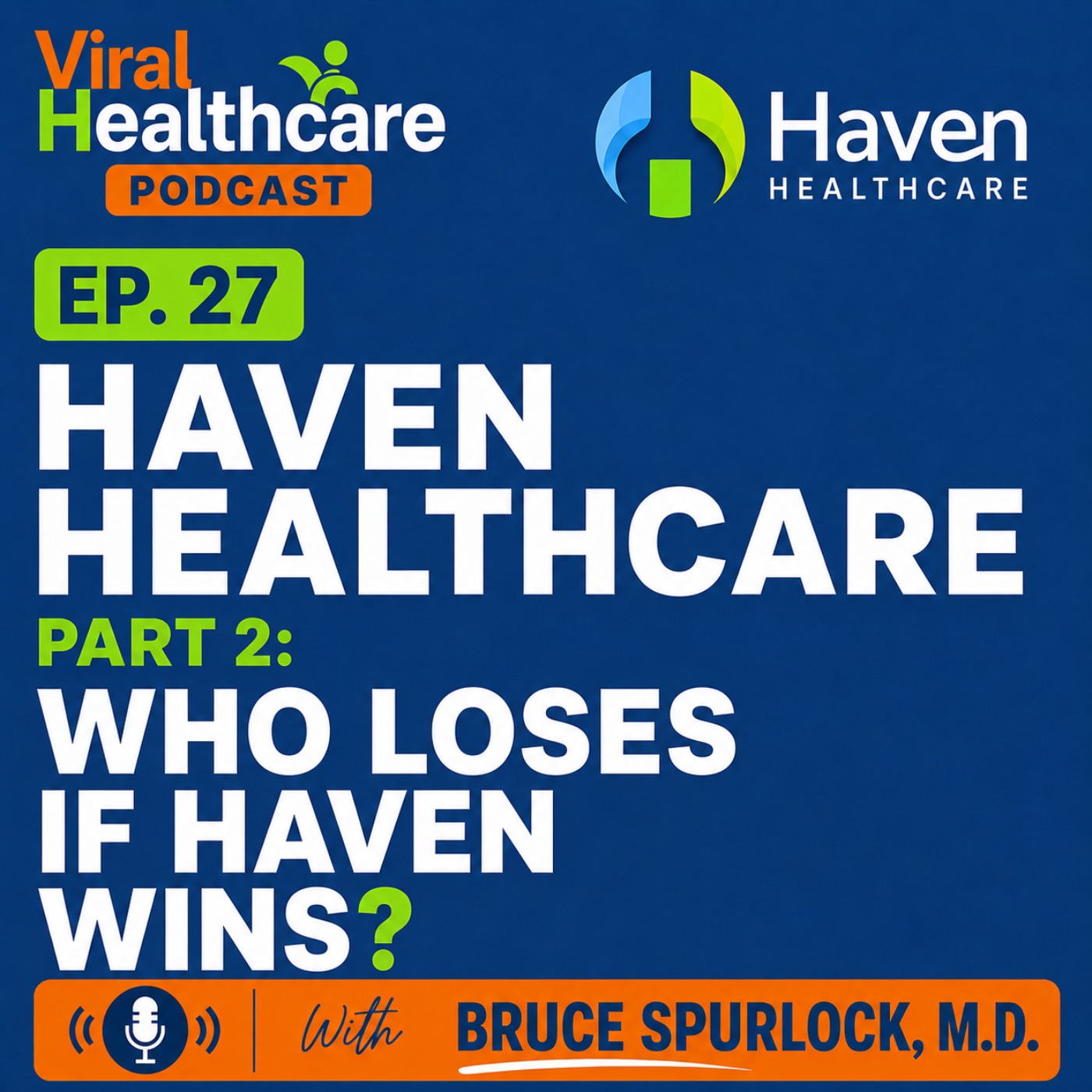
Ep. 27: Haven Healthcare Part 2: Who Loses If Haven Wins?
Sep 1, 202626 min
What happens if Haven Healthcare actually succeeds? Employees get healthier. Prescription drug spending falls. Primary care becomes easier to access. Unnecessary emergency department visits and hospital stays decline. Amazon, Berkshire Hathaway, and JPMorgan Chase spend less on healthcare. It sounds like success. But in healthcare, lower spending for one organization often means lost revenue for another. In Part 2 of the four-part Haven Healthcare series, Bruce Spurlock moves beyond Haven's ambitious launch and into the realities of implementation. Haven wasn't entering a blank healthcare system. It was entering an enormous network of hospitals, physicians, insurers, pharmacy benefit managers, pharmaceutical companies, brokers, technology companies, employers, and patients, all operating with different incentives and definitions of value. Bruce explores the uncomfortable economics behind healthcare transformation and then follows Haven as its broad mission begins turning into actual experiments. New health plan designs are tested. Primary care models are explored. Technology becomes part of the strategy. Employees begin interacting with these ideas in the real world, sometimes differently than expected. And another challenge begins to emerge. While Haven was developing new approaches, its founding companies remained capable of pursuing their own healthcare strategies. Amazon Care, for example, was developing alongside Haven's work, raising a much larger question about alignment, independence, governance, and who ultimately controlled the strategy. None of these developments meant Haven was failing. But together, they were beginning to form a pattern. In Part 3, Bruce asks: When does a setback become a warning? Hosted on Acast. See acast.com/privacy for more information.
Every question we get asked before someone starts their trial.
If you have a concern about deliverability, AI quality, data privacy, or whether this will actually work for your specific situation, it's probably answered below.
What is the difference between Founder Solo and Founder Pro?
Founder Solo gives you 50 AI pitches per month using the credit model (Standard pitches cost 1 credit, Enriched pitches cost 2). Founder Pro raises that to 200 credits per month and adds full Booking Probability access, unlimited Magic Match, Apollo enrichment credits, and data export capabilities. Both plans use the same credit system, so you can stretch your monthly budget further by using Standard-mode drafting.
How do agency tiers work?
Agency tiers have no base fee. You pay per managed client and per talent profile. Agency Standard is $199 per client per month; Agency Pro is $399 per client per month. Both add $39 per talent profile per month. Your own team's user seats are always free.
What is a talent profile?
A talent profile represents one person (founder, executive, or spokesperson) you are booking onto podcasts. It includes their bio, topics, headshots, and outreach history. Team plans include 5 profiles; agency plans are pay-as-you-go.
Can I switch plans later?
Yes, at any time. Upgrades take effect immediately; downgrades apply at the end of the current billing period. Contact support if you need help migrating between plan families.
Do you offer a free trial?
Every paid plan includes a 15-day free trial. Your card is saved at signup but you will not be charged until day 16. Cancel any time from your dashboard.
What happens if I cancel?
You keep access until the end of your current billing period. No charges after that. Your data is retained for 30 days in case you reactivate.
Is the 20% annual discount automatic?
Yes. Select Annual on the pricing toggle and the discounted price is applied automatically at checkout. The annual price shown is the full year cost.
What if I have more than 50 profiles or 20 clients?
That is our Enterprise tier. Contact our sales team and we will build a custom plan with volume pricing, a dedicated account manager, and SLA guarantees.