Unified Theistic Naturalism (UTN)
Unified Theistic Naturalism™: The State of the Work
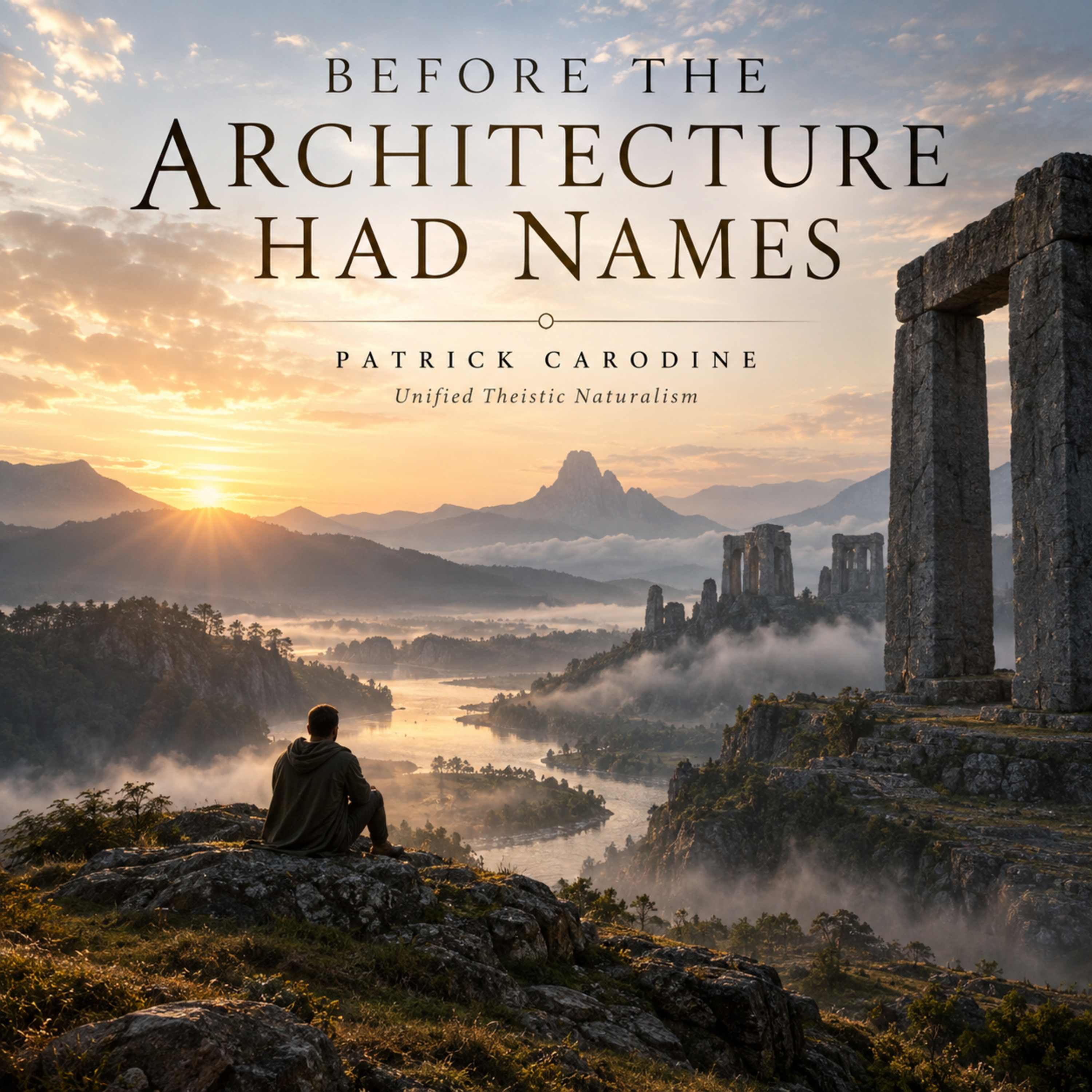
Before the Architecture Had Names explores a question that sits beneath philosophy, religion, psychology, identity, and even language itself: what was present before we began naming, organizing, defining, and building systems around human experience? Unified Theistic Naturalism did not begin as a doctrine, a diagram, a list of axioms, or a formal philosophical system. It began much closer to the ground. Life was happening. Relationships were happening. Loss was happening. Desire, fear, love, uncertainty, suffering, stillness, and movement were already present long before they were arranged into categories. This episode returns to that beginning. Rather than starting with a finished framework and working backward, Before the Architecture Had Names traces the lived experience that came first. It examines the difference between reality as directly encountered and reality as interpreted, structured, labeled, inherited, and projected through systems of thought. At the center of the episode is a simple but difficult question: what remains when the architecture of interpretation is temporarily removed? What remains before religion tells us what an experience means? Before philosophy classifies it? Before psychology diagnoses it? Before culture names it? Before identity claims it? Before memory turns it into a story? Before fear projects what it may become? The episode explores how human beings often mistake the structure built around experience for the experience itself. We inherit names, roles, categories, expectations, moral frameworks, social scripts, and explanatory systems so early that the architecture begins to feel indistinguishable from reality. Unified Theistic Naturalism approaches this differently. It begins with observation. It asks whether reality can first be encountered before it is interpreted. Whether presence can be recognized before the mind turns it into movement. Whether suffering intensifies not only because of what happens, but because of the structures we rapidly build around what happens. Whether communion becomes visible when conditioned interpretation temporarily loses its authority. This episode also follows the emergence of the language that would later become central to Unified Theistic Naturalism: Truth, Observation, Perfect Action, Movement, Freedom, Unconditional Love, Compassion, Stillness, Truthfulness, Non-duality, and Wholeness. But these ideas are not presented as rules imposed upon experience. They are examined as names that came afterward—language developed in an attempt to describe what had already been observed. That distinction matters. A map is not the landscape. A name is not the thing named. A philosophy is not the reality from which the philosophy emerged. Before the Architecture Had Names invites the listener to move beneath explanation for a moment and consider the possibility that reality does not require our conceptual permission to exist. Life was already moving before we described its movement. Consciousness was already observing before we developed theories of consciousness. Love was already experienced before we debated its definition. Loss was already felt before we created doctrines about suffering. And perhaps paradise was never something that had to be constructed. Perhaps it was obscured by the architecture. This is not an argument against knowledge, language, religion, science, philosophy, or systems. Architecture can be useful. Names can help us communicate. Models can help us investigate. The question is whether we remember that every structure is secondary to the reality it attempts to describe. What happens when we recognize that distinction? What happens when the observer sees the architecture without becoming trapped inside it? What happens when interpretation quiets? Before the Architecture Had Names is an exploration of origin—not the historical origin of the universe, but the experiential origin of a philosophical framework.