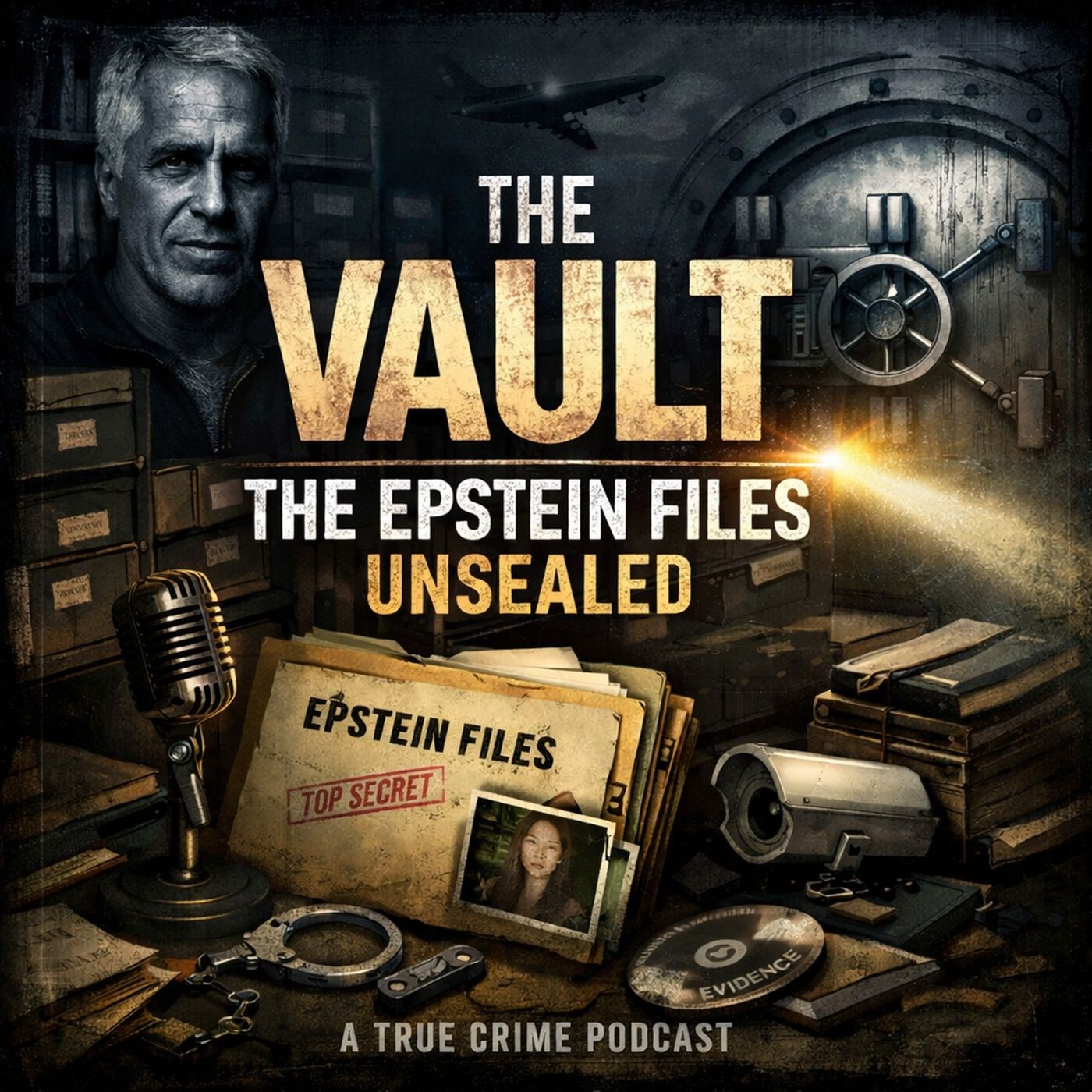
The Vault: The Epstein Files Unsealed is a deep-dive investigative podcast that pulls back the curtain on one of the most protected criminal networks in modern history. This series is built from the ground up on the actual paper trail—unsealed court records, depositions, exhibits, emails, and filings that were never meant to be read by the public. No pundit panels. No spin. Just the documents themselves, examined line by line, name by name, connection by connection—paired with precise, document-driven analysis that explains what the record truly shows. Each episode opens the vault on newly unsealed or long-buried Epstein files and walks listeners through what they actually reveal about power, money, influence, and the systems that failed survivors at every turn. Alongside the filings themselves, informed commentary breaks down the legal strategy, the institutional behavior, the contradictions, and the implications hiding between the lines. From judges’ orders and sealed exhibits to sworn testimony and back-channel communications, the show connects the dots the media often won’t—or can’t. Patterns emerge. Timelines collapse. Excuses fall apart. The Vault is a working archive in audio form, a living record of the Epstein case as told by the courts themselves—supplemented by rigorous analysis that provides context, challenges official narratives, and exposes where the record has been distorted, sanitized, or deliberately ignored. Every claim is grounded in filings. Every episode is anchored to the record. Listeners aren’t told what to think—they are shown what exists, what was said under oath, and what the commentary reveals about how those facts were buried, softened, or misrepresented. If you want to understand how Jeffrey Epstein was protected, who circled him, how institutions closed ranks, and why accountability keeps slipping through the cracks, The Vault: The Epstein Files Unsealed is where the record finally speaks for itself—and where the commentary ensures the documents do what no press release ever will.
Pitch Analysis
Required Pod Score for this show. PitchCentric checks your profile against host openness, topical fit, and audience signals before you generate a pitch.
Contact path
Verified email
Booking probability
40%
Guest openness
Selective
Verified email on file
80/100
Required Score
Sign up to generate a grounded pitch for The Vault: The Epstein Files.
The Vault: The Epstein Files is a commentary podcast hosted by Unknown Host, with 0 episodes on record and a Required Pod Score of 80. PitchCentric scores this show on Booking Probability, Listen Score, and live audience signals refreshed every 24 hours.
About the host
Unknown Host hosts The Vault: The Epstein Files, a commentary show with 0 episodes published.
Our AI reads these to draft pitches. Use them as grounding for a pitch that cites a real guest and a specific topic.
The Vault: The Epstein Files
Tyler Robinson Preliminary Hearing Transcripts (Day 1 Part 20) (9/15/26)
Sep 15, 202614 min
Day one of Tyler Robinson’s preliminary hearing on July 6, 2026, largely centered on prosecutors beginning to construct a timeline of Charlie Kirk’s killing at Utah Valley University and establishing the authenticity of the surveillance footage and investigative records they intended to use against Robinson. Former UVU police officer Chris Bagley described the moment the gunshot rang out during Kirk’s September 10, 2025 event and the chaos that followed, while Utah State Bureau of Investigation agent David Hull walked the court through the enormous video-review effort undertaken after the shooting. Hull testified that investigators examined hundreds of hours of surveillance footage and ultimately tracked a person they believed was Robinson moving around the UVU campus at several different points that day. Prosecutors introduced surveillance recordings from multiple locations as they attempted to connect the person seen approaching the campus, moving toward the area surrounding the Losee Center, and later leaving the area to Robinson. Three separate videos depicting Kirk being shot were admitted, although Judge Tony Graf determined that their graphic nature warranted restricting their display to the attorneys’ and judge’s monitors rather than broadcasting them throughout the courtroom. Kirk’s widow, Erika, and his parents left the courtroom while the videos were reviewed. Prosecutors also introduced Kirk’s autopsy report through Hull, which listed his cause of death as a gunshot wound to the neck and the manner of death as homicide The defense spent much of the first day attacking the manner in which the prosecution was getting its evidence into the record rather than attempting to disprove the entire prosecution theory at that stage. Kathryn Nester and Robinson’s attorneys repeatedly raised hearsay, foundation and authentication objections, arguing that investigators were being permitted to introduce reports, statements and records created by other people without those individuals appearing personally to testify. Judge Graf overruled most of those objections, reflecting the substantially lower evidentiary threshold governing a Utah preliminary hearing, whose purpose was only to determine whether probable cause existed to send Robinson to trial rather than whether prosecutors could prove guilt beyond a reasonable doubt. One significant exception involved an edited compilation of surveillance footage, which Graf declined to admit in that form and required prosecutors to replace with the underlying unedited material. Hull’s testimony also revealed the scope of the prosecution’s surveillance theory: investigators claimed Robinson had appeared on or around the UVU campus multiple times on September 10 and that they were attempting to stitch those appearances together into a continuous identification of the alleged shooter. By the end of day one, prosecutors had established the killing itself, the medical cause of Kirk’s death, the existence and authenticity of substantial video evidence and the beginnings of their effort to identify Robinson as the person captured in that footage. They had not yet presented many of the pieces expected to become more consequential later in the hearing, including the rifle and DNA evidence, Robinson’s alleged communications and admissions, and testimony concerning his roommate Lance Twiggs. to contact me: bobbycapucci@protonmail.com
Hillary Clinton And The Transcript From Her Epstein Related Talk With Congress (Part 6) (9/15/26)
Sep 15, 202613 min
Hillary Clinton’s February 26, 2026 deposition before the House Oversight Committee centered on how much she knew about Jeffrey Epstein, Ghislaine Maxwell and Bill Clinton’s relationship with them. Clinton repeatedly testified that she had never met Epstein, never flew on his plane, never visited Little St. James and knew nothing about his crimes before they became public. She described Maxwell as no more than a “casual acquaintance,” said she did not consider her a friend and attributed Maxwell’s presence around the Clinton family largely to her relationship with longtime Clinton friend Ted Waitt. Clinton acknowledged that Maxwell attended Chelsea Clinton’s 2010 wedding, but said she had no specific recollection of speaking with her there and believed Maxwell attended as Waitt’s guest. She also said she did not remember Maxwell visiting the Clintons’ Chappaqua home, despite Maxwell later saying she had been there several times, and said she had no knowledge of Epstein having connections to American or foreign intelligence services. The questioning became much more contentious when lawmakers turned to Bill Clinton’s documented relationship with Epstein. Hillary characterized her husband’s relationship with Epstein as “limited” and primarily connected to his use of Epstein’s airplane, said she had no knowledge of Bill visiting Little St. James and maintained there was no evidence connecting him to Epstein’s crimes. When lawmakers pressed her about photographs showing Bill Clinton with Epstein, Maxwell and young women during trips, Clinton acknowledged seeing some of those photographs but said she had not become curious enough to investigate the circumstances herself, calling it simply “unfortunate” that her husband ever had dealings with Epstein. She also denied personally soliciting money from Epstein and said she was unaware of anyone doing so on her behalf, while acknowledging she knew little about whether Epstein played any role around Clinton Foundation or Clinton Global Initiative activities. The transcript therefore presented a consistent Clinton defense: she said she personally had essentially no relationship with Epstein and only a peripheral relationship with Maxwell, while repeatedly separating herself from questions about Bill Clinton by telling lawmakers that he would have to answer for his own conduct. to contact me: bobbycapucci@protonmail.com
Epstein and the Blurred Line Between Government and Influence (Part 1) (9/16/26)
Sep 15, 202611 min
Recent disclosures have raised new questions about how the federal government and politically aligned online influencers respond to damaging developments involving Jeffrey Epstein. Released messages show FBI Director Kash Patel pressing bureau communications officials to counter Epstein-related criticism on social media, demonstrating that senior federal officials are actively monitoring and attempting to shape the online conversation. At the same time, it became public that Jennica Pounds, the operator of the influential DataRepublican account, was serving as a special government employee with the Department of Defense. There is no public evidence proving that DataRepublican was directed or funded by the government to promote Epstein-related messaging, but the overlap between federal employment and a major political influence operation raises legitimate questions about disclosure, independence, and whether other prominent accounts have similar undisclosed government relationships. Those questions have become more urgent following the removal of journalist Tara Palmeri and three Epstein survivors from a Republican political convention after Palmeri questioned a congressional candidate about the Epstein files. The episode was followed by another familiar wave of social-media attacks and pro-administration messaging, adding to a recurring pattern in which Epstein controversies are quickly met by large political accounts defending the government, attacking critics, or diminishing survivors. None of that, by itself, proves a coordinated propaganda network, but the Patel messages and the DataRepublican revelation provide enough documented evidence to justify a deeper investigation into who these influencers work for, who pays them, whether they communicate with federal officials, and whether taxpayer-funded government personnel are helping shape supposedly independent political messaging surrounding Epstein. to contact me: bobbycapucci@protonmail.com
Mega Edition: How Ghislaine Maxwell Planned On Dealing With Government Experts At Her Trial (9/15/26)
Sep 15, 20261h 3m
Ghislaine Maxwell’s defense planned to deal with the prosecution’s expert witnesses by attacking both their admissibility and the assumptions behind their opinions, while bringing in its own experts to give jurors competing explanations. The government’s most important expert was psychologist Dr. Lisa Rocchio, who was prepared to explain grooming, delayed disclosure, secrecy, trauma and the way another adult could help facilitate the sexual abuse of minors. Maxwell’s lawyers first tried to keep Rocchio’s testimony out under the federal rules governing expert evidence, arguing that concepts such as grooming risked turning ordinary behavior into proof of criminal intent and could effectively tell jurors how to interpret the accusers’ testimony. When Judge Alison Nathan allowed much of Rocchio’s testimony, the defense planned to counter her with forensic psychiatrist Dr. Park Dietz, who argued that “grooming” lacked a settled scientific definition and could be applied retrospectively in a way that transformed innocent conduct into evidence of predatory intent. Nathan allowed Dietz to criticize those limitations but barred him from simply telling the jury that there was insufficient evidence Maxwell herself intended to groom anyone. The defense also intended to use renowned memory expert Dr. Elizabeth Loftus to challenge the reliability of decades-old recollections, including how memory can be altered by suggestion, repeated interviews and the passage of time. More broadly, Maxwell noticed eight experts for trial, covering subjects ranging from memory and psychology to other specialized areas, while simultaneously moving to prevent law-enforcement witnesses from slipping expert opinions into the case under the label of ordinary factual testimony. Her strategy was therefore twofold: keep as much prosecution expert testimony away from the jury as possible, and where exclusion failed, surround it with competing experts who could undermine the government’s interpretation of grooming, trauma and memory. It fit neatly with Maxwell’s larger defense theory that prosecutors were asking jurors to reinterpret decades-old interactions through the lens of Epstein’s later-established crimes, while the defense wanted jurors to see ambiguity, memory problems and innocent explanations where the government saw grooming and facilitation. to contact me: bobbycapucci@protonmail.com
Tyler Robinson Preliminary Hearing Transcripts (Day 1 Part 18) (9/14/26)
Sep 14, 202614 min
Day one of Tyler Robinson’s preliminary hearing on July 6, 2026, largely centered on prosecutors beginning to construct a timeline of Charlie Kirk’s killing at Utah Valley University and establishing the authenticity of the surveillance footage and investigative records they intended to use against Robinson. Former UVU police officer Chris Bagley described the moment the gunshot rang out during Kirk’s September 10, 2025 event and the chaos that followed, while Utah State Bureau of Investigation agent David Hull walked the court through the enormous video-review effort undertaken after the shooting. Hull testified that investigators examined hundreds of hours of surveillance footage and ultimately tracked a person they believed was Robinson moving around the UVU campus at several different points that day. Prosecutors introduced surveillance recordings from multiple locations as they attempted to connect the person seen approaching the campus, moving toward the area surrounding the Losee Center, and later leaving the area to Robinson. Three separate videos depicting Kirk being shot were admitted, although Judge Tony Graf determined that their graphic nature warranted restricting their display to the attorneys’ and judge’s monitors rather than broadcasting them throughout the courtroom. Kirk’s widow, Erika, and his parents left the courtroom while the videos were reviewed. Prosecutors also introduced Kirk’s autopsy report through Hull, which listed his cause of death as a gunshot wound to the neck and the manner of death as homicide The defense spent much of the first day attacking the manner in which the prosecution was getting its evidence into the record rather than attempting to disprove the entire prosecution theory at that stage. Kathryn Nester and Robinson’s attorneys repeatedly raised hearsay, foundation and authentication objections, arguing that investigators were being permitted to introduce reports, statements and records created by other people without those individuals appearing personally to testify. Judge Graf overruled most of those objections, reflecting the substantially lower evidentiary threshold governing a Utah preliminary hearing, whose purpose was only to determine whether probable cause existed to send Robinson to trial rather than whether prosecutors could prove guilt beyond a reasonable doubt. One significant exception involved an edited compilation of surveillance footage, which Graf declined to admit in that form and required prosecutors to replace with the underlying unedited material. Hull’s testimony also revealed the scope of the prosecution’s surveillance theory: investigators claimed Robinson had appeared on or around the UVU campus multiple times on September 10 and that they were attempting to stitch those appearances together into a continuous identification of the alleged shooter. By the end of day one, prosecutors had established the killing itself, the medical cause of Kirk’s death, the existence and authenticity of substantial video evidence and the beginnings of their effort to identify Robinson as the person captured in that footage. They had not yet presented many of the pieces expected to become more consequential later in the hearing, including the rifle and DNA evidence, Robinson’s alleged communications and admissions, and testimony concerning his roommate Lance Twiggs. to contact me: bobbycapucci@protonmail.com
Every question we get asked before someone starts their trial.
If you have a concern about deliverability, AI quality, data privacy, or whether this will actually work for your specific situation, it's probably answered below.
What is the difference between Founder Solo and Founder Pro?
Founder Solo gives you 50 AI pitches per month using the credit model (Standard pitches cost 1 credit, Enriched pitches cost 2). Founder Pro raises that to 200 credits per month and adds full Booking Probability access, unlimited Magic Match, Apollo enrichment credits, and data export capabilities. Both plans use the same credit system, so you can stretch your monthly budget further by using Standard-mode drafting.
How do agency tiers work?
Agency tiers have no base fee. You pay per managed client and per talent profile. Agency Standard is $199 per client per month; Agency Pro is $399 per client per month. Both add $39 per talent profile per month. Your own team's user seats are always free.
What is a talent profile?
A talent profile represents one person (founder, executive, or spokesperson) you are booking onto podcasts. It includes their bio, topics, headshots, and outreach history. Team plans include 5 profiles; agency plans are pay-as-you-go.
Can I switch plans later?
Yes, at any time. Upgrades take effect immediately; downgrades apply at the end of the current billing period. Contact support if you need help migrating between plan families.
Do you offer a free trial?
Every paid plan includes a 15-day free trial. Your card is saved at signup but you will not be charged until day 16. Cancel any time from your dashboard.
What happens if I cancel?
You keep access until the end of your current billing period. No charges after that. Your data is retained for 30 days in case you reactivate.
Is the 20% annual discount automatic?
Yes. Select Annual on the pricing toggle and the discounted price is applied automatically at checkout. The annual price shown is the full year cost.
What if I have more than 50 profiles or 20 clients?
That is our Enterprise tier. Contact our sales team and we will build a custom plan with volume pricing, a dedicated account manager, and SLA guarantees.