The Texas Court Drama — From the Non-Boring View of a Neutral Party
Hosted by Unknown Host · General · EN · 0 episodes
About this Podcast:
Disclaimer – AI-Generated Content & Liability Waiver The Texas Court Drama — From the Non-Boring View of a Neutral Party The episodes in this podcast are generated with the assistance of artificial intelligence (AI) tools and are based on publicly available Texas and United States Supreme Court opinions. This podcast is intended for informational and educational purposes only . Nothing in any episode constitutes legal advice, and no attorney-client relationship is created by listening to or relying on this content. While every effort is made to accurately summarize court opinions, AI-generated content may contain errors, omissions, or mischaracterizations of legal holdings, facts, or reasoning. Listeners should always read the original court opinion and consult a licensed attorney before making any legal decisions. The host and producer of The Texas Court Drama : Make no warranties, express or implied, regarding the accuracy, completeness, or timeliness of any content Are not responsible for any actions taken or not taken based on the content of any episode Do not represent any party, court, or government agency Are not affiliated with the Texas judiciary or any court featured in an episode By listening to this podcast, you acknowledge and agree that you assume full responsibility for how you use the information presented, and you waive any claims against the host, producer, or any affiliated parties arising from your reliance on AI-generated content. For legal advice specific to your situation, please consult a licensed Texas attorney.
Pitch Analysis
Required Pod Score for this show. PitchCentric checks your profile against host openness, topical fit, and audience signals before you generate a pitch.
Contact path
Public web form
Booking probability
19%
Guest openness
Selective
80/100
Required Score
Sign up to generate a grounded pitch for The Texas Court Drama — From the Non-Boring View of a Neutral Party.
What is The Texas Court Drama — From the Non-Boring View of a Neutral Party?
The Texas Court Drama — From the Non-Boring View of a Neutral Party is a general podcast hosted by Unknown Host, with 0 episodes on record and a Required Pod Score of 80. PitchCentric scores this show on Booking Probability, Listen Score, and live audience signals refreshed every 24 hours.
About the host
Unknown Host hosts The Texas Court Drama — From the Non-Boring View of a Neutral Party, a general show with 0 episodes published.
Our AI reads these to draft pitches. Use them as grounding for a pitch that cites a real guest and a specific topic.
Episode #7
The Altered Label: How Attorney Fees Became “Spousal Support” to Reach a 401(k)
Jun 11, 202638 minS26
This episode examines federal court filings alleging that an attorney-fee award was altered into “spousal support” to obtain access to retirement funds protected by ERISA. According to the appellant, the alteration was not a harmless wording change: it was the central mechanism used to characterize an attorney-fee extraction as a domestic-relations payment. The episode traces the disputed timeline, explains the conflict between ERISA’s anti-alienation protections and state-court domestic-relations labels, and examines the appellant’s argument that the federal district court reframed the case without directly addressing the alleged alteration. It also discusses the appellant’s Younger-abstention arguments, the asserted RICO and antitrust theories, and the defendant-specific issues involving immunity and dismissal. The allegations remain disputed and unresolved. This episode uses AI to summarize court filings for educational purposes only. It is not legal advice and may contain errors. Read the original filings before drawing conclusions.
The White Tiger Hall: Power, Discovery, and the Trap
Jun 4, 202619 minS26
In the Chinese classic Water Margin , Lin Chong is lured into the White Tiger Hall and punished after powerful people create the conditions for his downfall. This episode examines a modern courtroom conflict through that same lens. Samuel Randles was found in direct contempt of court after a volatile April 2026 hearing in Tarrant County, Texas. According to the court record and hearing transcript, Randles used profanity and threw a water bottle toward the bench after his efforts to record the proceeding and address a motion to compel were curtailed. He was sentenced to 179 days in jail. But the water bottle is not the entire story. Randles contends that the confrontation occurred against the backdrop of a broader dispute over discovery. He alleges that evidence was withheld and that the withheld material could expose serious misconduct involving judicial actors. Those allegations remain disputed and are presented in this episode as claims, not established facts. The central question is not whether a courtroom must maintain order. It must. The deeper question is whether the focus on a defendant’s outburst can become a distraction from the unresolved discovery dispute that preceded it. Was the water bottle the whole case—or merely the most visible part of a much larger conflict? Using court records, transcripts, and the White Tiger Hall analogy from Water Margin , this episode explores power, discovery, contempt, and the danger of allowing the final moment of a confrontation to obscure everything that came before it. Educational disclaimer: This episode discusses public court records and disputed allegations for educational and commentary purposes. Allegations are not findings of fact. Listeners should review the original records and reach their own conclusions.
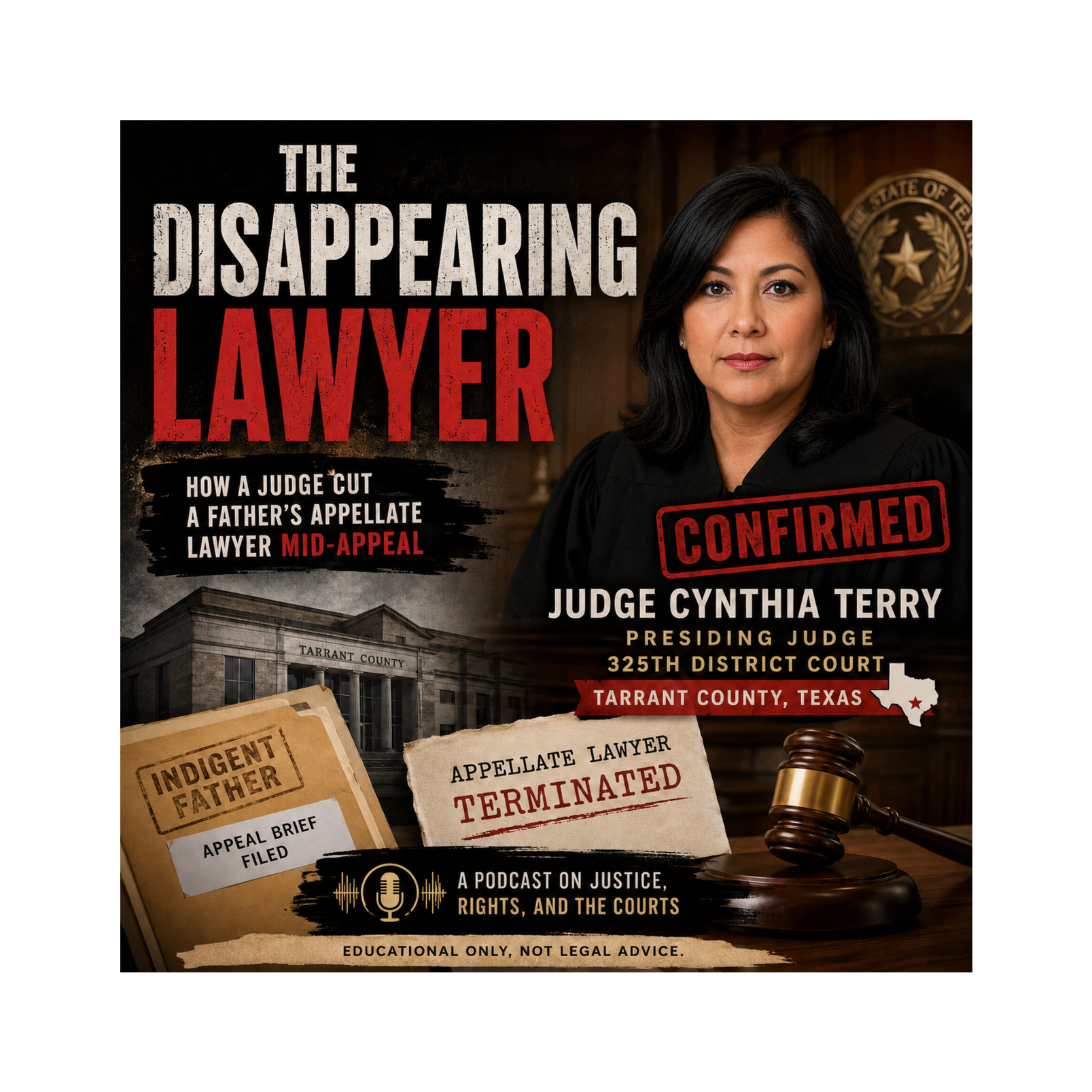
A Texas appeals court takes on Judge Cynthia Terry of Tarrant County's 325th District Court, who fired an indigent father's court-appointed appellate lawyer mid-appeal—after his opening brief was already filed. The problem? The Family Code lets only three people ask the court to revisit a parent's indigency, and Judge Terry and the grandmother who pushed for it weren't among them. We break down how the Second District Court of Appeals at Fort Worth conditionally granted mandamus and ordered the father's counsel reinstated, and why depriving a parent of a lawyer at a critical stage risks making the whole appeal a "toothless exercise." Educational only, not legal advice. One caveat worth flagging: the opinion itself never names the trial judge—it refers only to "the trial court." I've matched the court to its current presiding judge based on public records, which is a reasonable inference, but if this case was heard by an associate judge or visiting judge rather than Judge Terry herself, the attribution could be off. You may want to confirm against the trial court docket before publishing her name.
Constitutional Limits of Texas No-Fault Divorce Statutes
Jun 3, 202648 minS26
This episode examines a constitutional challenge to Texas Family Code § 6.001, the statute permitting a court to grant a divorce when a marriage has become “insupportable” because of discord or conflict of personalities. The challenge, brought by Jeffrey Stephen Morgan, argues that the statute allows one spouse to dissolve a marriage unilaterally without proving misconduct or obtaining the other spouse’s consent. The filings raise questions involving due process, religious liberty, the contractual nature of marriage, and the constitutional limits of legislative power. They also question whether the statute improperly restricts judicial discretion by requiring a divorce decree based largely on one party’s subjective opinion. This episode summarizes the arguments presented in the filings. It does not state that any court has accepted those arguments or declared the statute unconstitutional. The discussion is for educational purposes only and is not legal advice.
They jailed three Texans using judges nobody approved
May 31, 202620 minS26
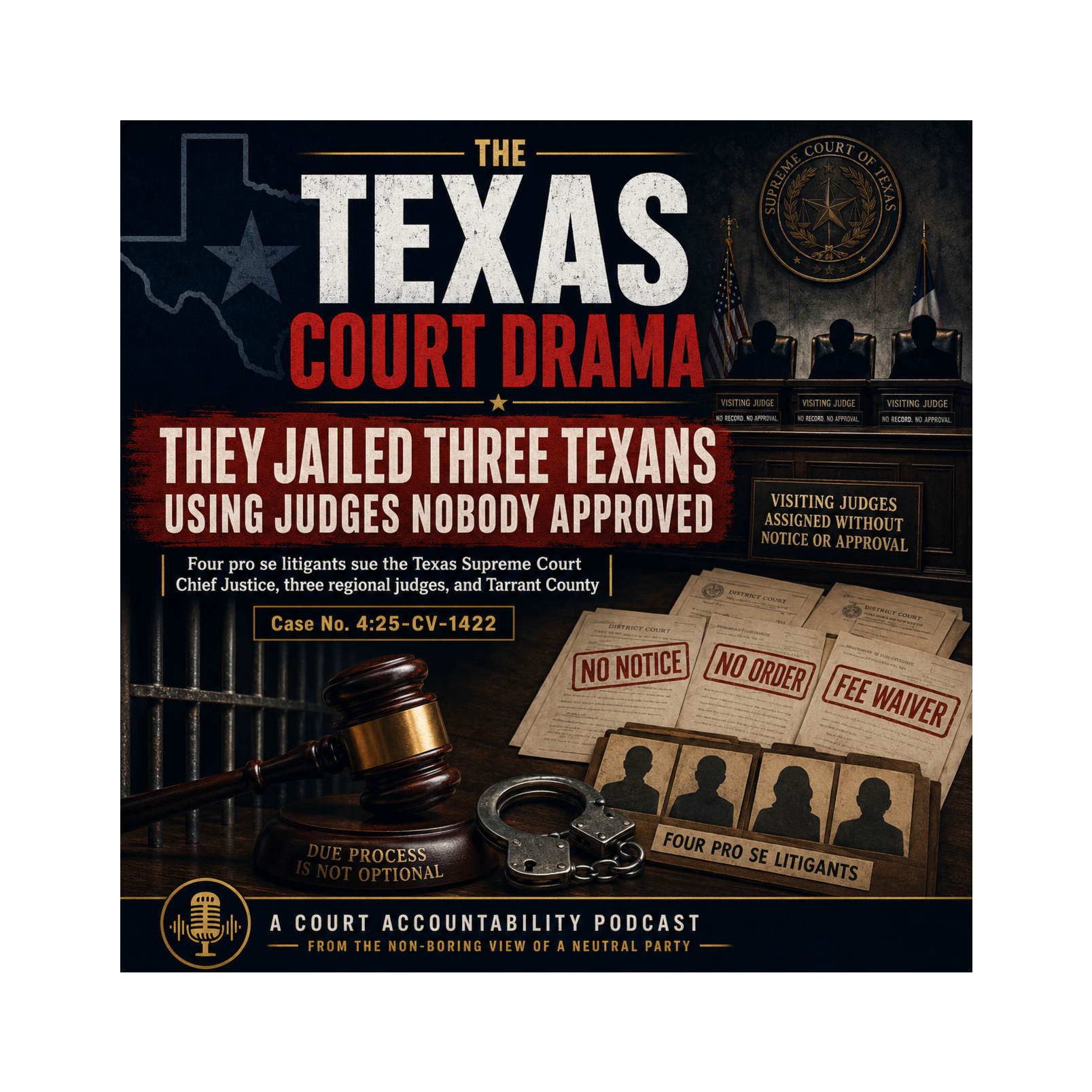
Ep. 26-003 — Texas citizens sue the shadow bench Case No. 4:25-CV-1422 · N.D. Tex., Fort Worth · ~9 min · Pending — no final ruling What this episode covers Four pro se litigants challenge the way Texas assigns visiting judges to family court cases — arguing they were jailed, denied notice, and stripped of indigency protections through a system that shields judicial insiders from scrutiny. When they took it to federal court, the dismissal itself became another example of the problem. The plaintiffs & what happened to them Randles — jailed June 2025, no notice, no assignment order, elected judge available. Ross — jailed May 2024; couldn't exercise her objection right until December 2025. Tuter — jailed fall 2024 by a judge whose wife was paid $1,400 to mediate the same case. Yan — missed a hearing over an illegible notice date; fee waiver stripped in his absence. Key legal issues 14th Judges running mediation businesses can't earn referral fees from the same attorneys appearing before them. 14th Visiting judges are only lawful when the elected judge is absent — that wasn't documented here. 14th · 1st Stripping a fee waiver after someone files an appeal, using DA resources, looks like retaliation. The number that matters ~56 elected judges, ~44 visiting judges in one region — a shadow bench with no electoral accountability. At least 10 also appear on the county's approved mediator list. How the federal court misapplied the law Used one defendant's motion to dismiss every claim across all plaintiffs. Tarrant County was dismissed March 11 — and served March 24. Distinct claims (Yan's clerk issues, Ross's family claims, Tuter's spouse-mediator conflict) swept out under a single unrelated motion. Younger abstention misapplied: court ignored Texas § 30.017, which bars the exact path it told plaintiffs to take. Rule 59(e) motion pending — the final order ignored ECF 35, 58, 59, and 60. Practical takeaway In any Texas family court hearing: ask whether a written assignment order is on the docket before the visiting judge speaks. If a Rule 145 contest is filed against you, demand to see the sworn evidence before any hearing proceeds. "A judge's wife gets paid to mediate — he jails the client. A coordinator sends an illegible notice and ignores the follow-up. A clerk waives fees for a contestant with no sworn evidence. Each looks like a mistake. Together they look like a system."
Every question we get asked before someone starts their trial.
If you have a concern about deliverability, AI quality, data privacy, or whether this will actually work for your specific situation, it's probably answered below.
What is the difference between Founder Solo and Founder Pro?
Founder Solo gives you 50 AI pitches per month using the credit model (Standard pitches cost 1 credit, Enriched pitches cost 2). Founder Pro raises that to 200 credits per month and adds full Booking Probability access, unlimited Magic Match, Apollo enrichment credits, and data export capabilities. Both plans use the same credit system, so you can stretch your monthly budget further by using Standard-mode drafting.
How do agency tiers work?
Agency tiers have no base fee. You pay per managed client and per talent profile. Agency Standard is $199 per client per month; Agency Pro is $399 per client per month. Both add $39 per talent profile per month. Your own team's user seats are always free.
What is a talent profile?
A talent profile represents one person (founder, executive, or spokesperson) you are booking onto podcasts. It includes their bio, topics, headshots, and outreach history. Team plans include 5 profiles; agency plans are pay-as-you-go.
Can I switch plans later?
Yes, at any time. Upgrades take effect immediately; downgrades apply at the end of the current billing period. Contact support if you need help migrating between plan families.
Do you offer a free trial?
Every paid plan includes a 15-day free trial. Your card is saved at signup but you will not be charged until day 16. Cancel any time from your dashboard.
What happens if I cancel?
You keep access until the end of your current billing period. No charges after that. Your data is retained for 30 days in case you reactivate.
Is the 20% annual discount automatic?
Yes. Select Annual on the pricing toggle and the discounted price is applied automatically at checkout. The annual price shown is the full year cost.
What if I have more than 50 profiles or 20 clients?
That is our Enterprise tier. Contact our sales team and we will build a custom plan with volume pricing, a dedicated account manager, and SLA guarantees.