The Occult Rejects
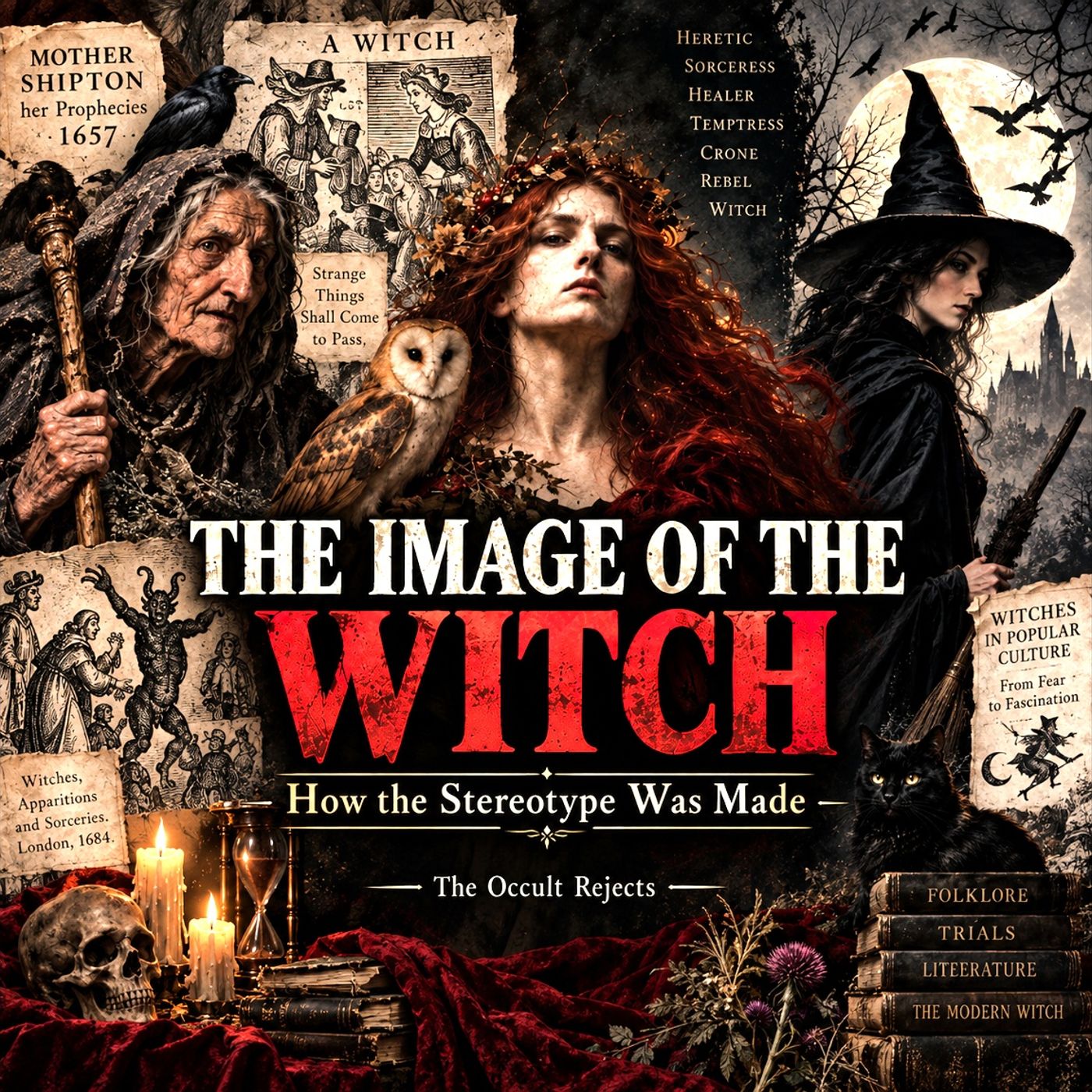
The Image of The Witch: How the Stereotype Was Made
Links For The Occult Rejects https://linktr.ee/theoccultrejects Occult Research Institute https://www.occultresearchinstitute.org/ Substack https://substack.com/@theoccultrejects?r=7auau0&utm_campaign=profile&utm_medium=profile-page Cash App https://cash.app/$theoccultrejects Venmo @TheOccultRejects Patreon https://www.patreon.com/TheOccultRejects BibliographyCore Academic Scholarship - Bailey, Michael D. Battling Demons: Witchcraft, Heresy, and Reform in the Late Middle Ages. Pennsylvania State University Press, 2003. Essential for Nider and the emergence of diabolical witchcraft before the Malleus. (https://www.psupress.org/books/titles/978-0-271-02225-3.html?utm_source=chatgpt.com) - Briggs, Robin. Witches and Neighbours: The Social and Cultural Context of European Witchcraft. HarperCollins, 1996. - Clark, Stuart. Thinking with Demons: The Idea of Witchcraft in Early Modern Europe. Clarendon Press, 1997. Excellent for inversion, natural/unnatural, Christian/anti-Christian logic. - Davies, Owen. Cunning-Folk: Popular Magic in English History. Hambledon and London, 2003. Useful for distinguishing actual magical practitioners from the demonological witch stereotype. (https://academic.oup.com/ehr/article-abstract/119/482/801/499798?utm_source=chatgpt.com) - Gaskill, Malcolm. Witchfinders: A Seventeenth-Century English Tragedy. John Murray, 2005. - Hults, Linda C. The Witch as Muse: Art, Gender, and Power in Early Modern Europe. University of Pennsylvania Press, 2005. Major source for Dürer, Baldung, sexuality, gender, and visual construction. - Kors, Alan Charles, and Edward Peters, eds. Witchcraft in Europe, 400–1700: A Documentary History. 2nd ed. University of Pennsylvania Press, 2001. Excellent collection of primary documents. (https://www.pennpress.org/9780812217513/witchcraft-in-europe-400-1700/?utm_source=chatgpt.com) - Levack, Brian P. The Witch-Hunt in Early Modern Europe. 4th ed. Routledge, 2016. Best general backbone for chronology, prosecution patterns, regional variation, gender, and numbers. (https://www.routledge.com/link/link/p/book/9781138808096?utm_source=chatgpt.com) - Levack, Brian P., ed. The Witchcraft Sourcebook. 2nd ed. Routledge, 2015. Includes trial documents, demonology, sermons, literature, and visual representations. (https://www.routledge.com/The-Witchcraft-Sourcebook-Second-Edition/Levack/p/book/9781138774971?utm_source=chatgpt.com) - Purkiss, Diane. The Witch in History: Early Modern and Twentieth-Century Representations. Routledge, 1996. Particularly useful for later feminist, historical, literary, and modern witch reconstructions. (https://www.routledge.com/The-Witch-in-History-Early-Modern-and-Twentieth-Century-Representations/Purkiss/p/book/9780415087629?utm_source=chatgpt.com) - Roper, Lyndal. Witch Craze: Terror and Fantasy in Baroque Germany. Yale University Press, 2004/2006. Essential for crones, fertility, motherhood, interrogation, sexuality, cannibalism, and aging. (https://yalebooks.yale.edu/book/9780300119831/witch-craze/?utm_source=chatgpt.com) - Stephens, Walter. Demon Lovers: Witchcraft, Sex, and the Crisis of Belief. University of Chicago Press, 2002/2003. Important for demonic sex, bodily reality, flight, infanticide, and the Malleus. (https://press.uchicago.edu/ucp/books/book/chicago/D/bo3628714.html?utm_source=chatgpt.com) - Zika, Charles. The Appearance of Witchcraft: Print and Visual Culture in Sixteenth-Century Europe. Routledge, 2007. Probably the most important book for this episode’s thesis. (https://www.routledge.com/The-Appearance-of-Witchcraft-1st-Edition/Zika/p/book/9780203713921?utm_source=chatgpt.com) - Davies, Owen, ed. The Oxford History of Witchcraft and Magic. Oxford University Press, 2023. Broad updated survey from antiquity through modern popular culture. (https://academic.oup.com/book/45627?utm_source=chatgpt.com) Fifteenth-Century Origins and Demonology - Nider, Johannes. Formicarius, Book V, c. 1436–1438. Key source for the emerging diabolical witch sect before the Malleus; available in Levack and Kors/Peters. (https://sourcebooks.web.fordham.edu/source/witches1.asp?utm_source=chatgpt.com) - Errores Gazariorum, c. 1430s. One of the earliest texts describing an organized diabolical witch sect; see Georg Modestin, “The Metamorphoses of the Anti-Witchcraft Treatise Errores Gazariorum.” (https://www.taylorfrancis.com/chapters/edit/10.4324/9781003007296-2s/metamorphoses-anti-witchcraft-treatise-errores-gazariorum-15th-century-georg-modestin?utm_source=chatgpt.com) - Le Franc, Martin. Le Champion des Dames. Written c. 1440–1442; illuminated manuscript, 1451. The manuscript includes the famous Vaudoises image, widely identified as the earliest known witch depicted flying on a broomstick. (https://www.guinnessworldrecords.com/world-records/722313-oldest-depiction-of-a-witch-on-a-broomstick?utm_source=chatgpt.com) - Kramer, Heinrich [Institoris]. Malleus Maleficarum, first printed 1486–1487. Use Christopher S. Mackay, trans., The Hammer of Witches: A Complete Translation of the Malleus Maleficarum. Cambridge University Press, 2009. Mackay also discusses authorship and Jacob Sprenger’s disputed role. (https://www.cambridge.org/core/books/hammer-of-witches/F8A8CC710EB1AEB13D9B91530AC0EAF3?utm_source=chatgpt.com) - Molitor, Ulrich. De Lamiis et Pythonicis Mulieribus, 1489. Important for early printed imagery of flight, transformation, weather magic, and cauldrons. - Hopkins, Matthew. The Discovery of Witches. London, 1647. Important for familiars, bodily examinations, and names including Pyewacket, Vinegar Tom, Grizzel Greedigutt, Sack and Sugar, and others. Art and Visual Sources - Dürer, Albrecht. Witch Riding Backwards on a Goat, c. 1500. British Museum. The Museum connects the reversed composition with witchcraft’s supposed reversal of natural order. (https://www.britishmuseum.org/collection/object/P_1868-0822-188?utm_source=chatgpt.com) - Baldung Grien, Hans. Early-sixteenth-century witch imagery and Weather Witches (1523). The British Museum discusses Baldung’s fascination with witches and female sexuality. (https://www.britishmuseum.org/collection/object/P_1834-0712-73?utm_source=chatgpt.com) - Davidson, Jane P. The Witch in Northern European Art, 1470–1750. Luca Verlag, 1987. - Rosa, Salvator. Witches at their Incantations, c. 1646. National Gallery, London. The Gallery documents both its witch imagery and the report that it hung behind a curtain for dramatic reveal. (https://www.nationalgallery.org.uk/paintings/salvator-rosa-witches-at-their-incantations?utm_source=chatgpt.com) Trials, Gender, and Historical Accused - Apps, Lara, and Andrew Gow. Male Witches in Early Modern Europe. Manchester University Press, 2003. Useful for dismantling the assumption that witches were universally female. - Rowlands, Alison. Witchcraft Narratives in Germany: Rothenburg, 1561–1652. Manchester University Press, 2003. - English Heritage / Diane Purkiss. “Witchcraft: Eight Myths and Misconceptions.” Useful for hanging versus burning, execution estimates, male witches, the Spanish Inquisition, and the herbalist-midwife myth. Purkiss gives a mainstream scholarly estimate of roughly 30,000–60,000 executions, rather than the old “nine million” figure. (https://www.english-heritage.org.uk/learn/histories/eight-witchcraft-myths?utm_source=chatgpt.com) Fairy Tale and Literary Witch - Shakespeare, William. Macbeth, c. 1606. Especially Act IV, scene 1, for the influential cauldron scene. - Grimm, Jacob and Wilhelm. “Hansel and Gretel,” in Kinder- und Hausmärchen, first published 1812. Useful for the forest dwelling, old woman, food, children, and cannibalistic witch. - Purkiss, Diane. The Witch in History. Particularly useful for witch representation in drama, domesticity, children, and later reinvention. (https://www.routledge.com/The-Witch-in-History-Early-Modern-and-Twentieth-Century-Representations/Purkiss/p/book/9780415087629?utm_source=chatgpt.com) Victorian Costume, Salem, and Halloween - Holt, Ardern. Fancy Dresses Described; or, What to Wear at Fancy Balls. 4th ed., 1884. Source for the witch costumes involving brooms, cats, toads, serpents, frogs, bats, lizards, an owl, and a black cat on the shoulder. The surviving scan identifies it as the fourth edition from March 1884. (https://commons.wikimedia.org/wiki/File%3AThe_Witch1884.png?utm_source=chatgpt.com) - Holt, Ardern. Fancy Dresses Described. 5th ed. Debenham & Freebody, 1887. Public-domain copy preserved by the Smithsonian. ( Also want to remind people about the website, if you're into reading we have tons of information by multiple contributors, and we got t-shirts up on the site if you're interested. Fun fact, the art is all based on the eyeball.