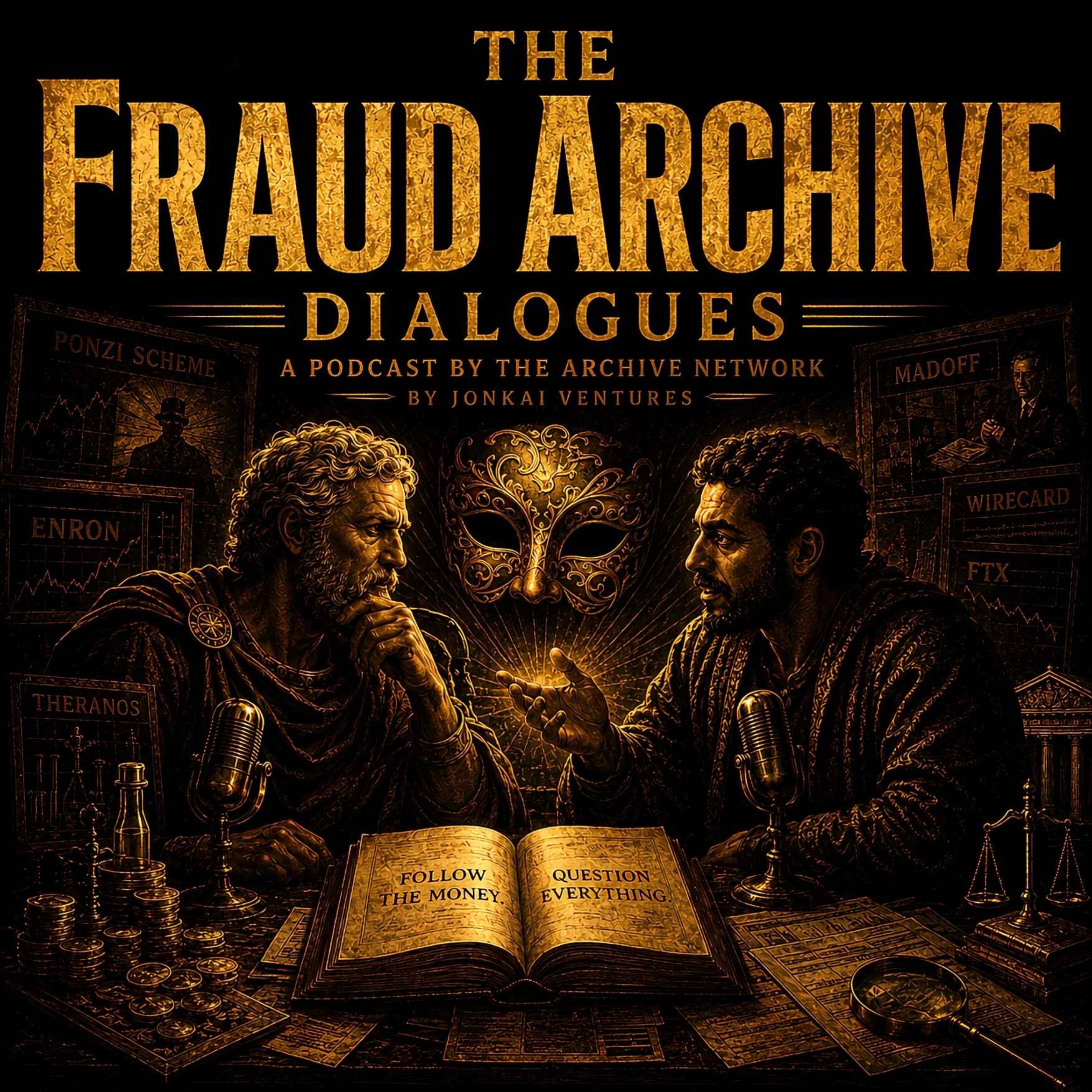
The Fraud Archive Dialogues is part of The Archive Network, a collection of podcasts dedicated to the stories that shaped our world. Every episode is a conversation. Aurelius and Malik, curators of The Fraud Archive, take a single case, a Ponzi scheme, an accounting fraud, a crypto collapse, a con that fooled investors, auditors and entire nations, and work through it together from beginning to end. One traces how the scheme was built: the mechanics, the numbers, the machinery of belief that kept it standing. The other presses on what that account leaves out, who actually lost, why intelligent people believed, what the regulators missed, and what the whole affair says about the systems that allowed it. From Charles Ponzi and Bernie Madoff to Enron, Theranos, Wirecard and FTX, these are not summaries. Each episode is one complete story, examined from both sides in a single sitting. The Archive Network is an independent project. Every archive, podcast and documentary is free, no ads, no paywalls. If it's been worth your time, you can help keep it that way: https://thearchivenetwork.com/support Discover more at: https://thefraudarchive.com https://thearchivenetwork.com Hosted on Acast. See acast.com/privacy for more information.
Pitch Analysis
Required Pod Score for this show. PitchCentric checks your profile against host openness, topical fit, and audience signals before you generate a pitch.
Contact path
Public web form
Booking probability
36%
Guest openness
Selective
80/100
Required Score
Sign up to generate a grounded pitch for The Fraud Archive Dialogues.
The Fraud Archive Dialogues is a general podcast hosted by Unknown Host, with 0 episodes on record and a Required Pod Score of 80. PitchCentric scores this show on Booking Probability, Listen Score, and live audience signals refreshed every 24 hours.
About the host
Unknown Host hosts The Fraud Archive Dialogues, a general show with 0 episodes published.
Our AI reads these to draft pitches. Use them as grounding for a pitch that cites a real guest and a specific topic.
Episode #10
The Fyre Festival: Influencer Marketing Meets Fraud
Aug 13, 202631 minS1
Billy McFarland didn’t start with a beach. He started with a story. And in the startup world he came from, story could move money faster than proof.New York’s startup scene rewarded speed, presentation, and charm. It was a place where weak ideas could sound inevitable. McFarland understood that. By the time Fyre Festival took shape, the culture was already primed to confuse confidence with substance.Aurelius and Malik take on this case in full — 5 chapters, 31 minutes, one complete story.Learn more at: https://thefraudarchive.com/fraud/fyre-festival-billy-mcfarland<p><br></p><p> The Fraud Archive Dialogues is part of The...
Nick Leeson did not look like a man about to destroy Britain’s oldest merchant bank. He looked like a junior trader doing well in a distant office. But the first lie was already inside the numbers, and Barings was still calling it success.Barings Bank was old, respected, and proud of its history. Founded in seventeen sixty-two, it carried the weight of centuries. But by the late nineteen eighties and early nineteen nineties, prestige was not enough. Derivatives were changing the business. Banks wanted profits from faster markets, especially in Asia, and they wanted them without the inconvenience of co...
OneCoin: The Crypto That Was Never on a Blockchain
Aug 11, 202633 minS1
Picture a woman stepping onto a stage, lights blazing, applause thundering, and a promise in her voice: this is your chance to join the future. Most people in the room don't realize what they're really buying isn't a coin, but a story.In the years before OneCoin became a global sensation, Ruja Ignatova was already a master of appearances. Raised in Bulgaria and later educated in Germany, she knew the power of credentials and polish. She held a law degree and had stints in business and consulting, but the real lesson she learned was in persuasion. Technical mastery wasn't what...
The Original Con: How Charles Ponzi Invented Modern Fraud
Aug 10, 202630 minS1
Charles Ponzi arrived in Boston with almost nothing, but he carried one thing that mattered more than money. He carried appetite. Appetite for status. Appetite for speed. Appetite for reinvention.And in nineteen nineteen, in a city primed to believe a polished stranger, that appetite would become a business model. Ponzi was born in Lugo, Italy, in eighteen eighty-two. The public record traces a hard path before Boston. He worked as a waiter, a laborer, a clerk, and a bank errand boy. Those were not glamorous jobs, but they taught him something valuable. He learned how institutions look from the...
In Bavaria, a modern fintech quietly promised to change everything. Wirecard’s story started with the future of money, but beneath the surface, something stranger was taking root.Germany’s business world is famous for caution and tradition, but by the middle of the twenty-tens, it was hungry for something new. Wirecard stepped in, offering the future: seamless online payments, cross-border transactions, and a platform that could bring German respectability to the internet age. The company’s offices in Aschheim near Munich looked ordinary. The language was all about margins, platform fees, and digital commerce. No smoke, no mirrors—at least, n...
Every question we get asked before someone starts their trial.
If you have a concern about deliverability, AI quality, data privacy, or whether this will actually work for your specific situation, it's probably answered below.
What is the difference between Founder Solo and Founder Pro?
Founder Solo gives you 50 AI pitches per month using the credit model (Standard pitches cost 1 credit, Enriched pitches cost 2). Founder Pro raises that to 200 credits per month and adds full Booking Probability access, unlimited Magic Match, Apollo enrichment credits, and data export capabilities. Both plans use the same credit system, so you can stretch your monthly budget further by using Standard-mode drafting.
How do agency tiers work?
Agency tiers have no base fee. You pay per managed client and per talent profile. Agency Standard is $199 per client per month; Agency Pro is $399 per client per month. Both add $39 per talent profile per month. Your own team's user seats are always free.
What is a talent profile?
A talent profile represents one person (founder, executive, or spokesperson) you are booking onto podcasts. It includes their bio, topics, headshots, and outreach history. Team plans include 5 profiles; agency plans are pay-as-you-go.
Can I switch plans later?
Yes, at any time. Upgrades take effect immediately; downgrades apply at the end of the current billing period. Contact support if you need help migrating between plan families.
Do you offer a free trial?
Every paid plan includes a 15-day free trial. Your card is saved at signup but you will not be charged until day 16. Cancel any time from your dashboard.
What happens if I cancel?
You keep access until the end of your current billing period. No charges after that. Your data is retained for 30 days in case you reactivate.
Is the 20% annual discount automatic?
Yes. Select Annual on the pricing toggle and the discounted price is applied automatically at checkout. The annual price shown is the full year cost.
What if I have more than 50 profiles or 20 clients?
That is our Enterprise tier. Contact our sales team and we will build a custom plan with volume pricing, a dedicated account manager, and SLA guarantees.