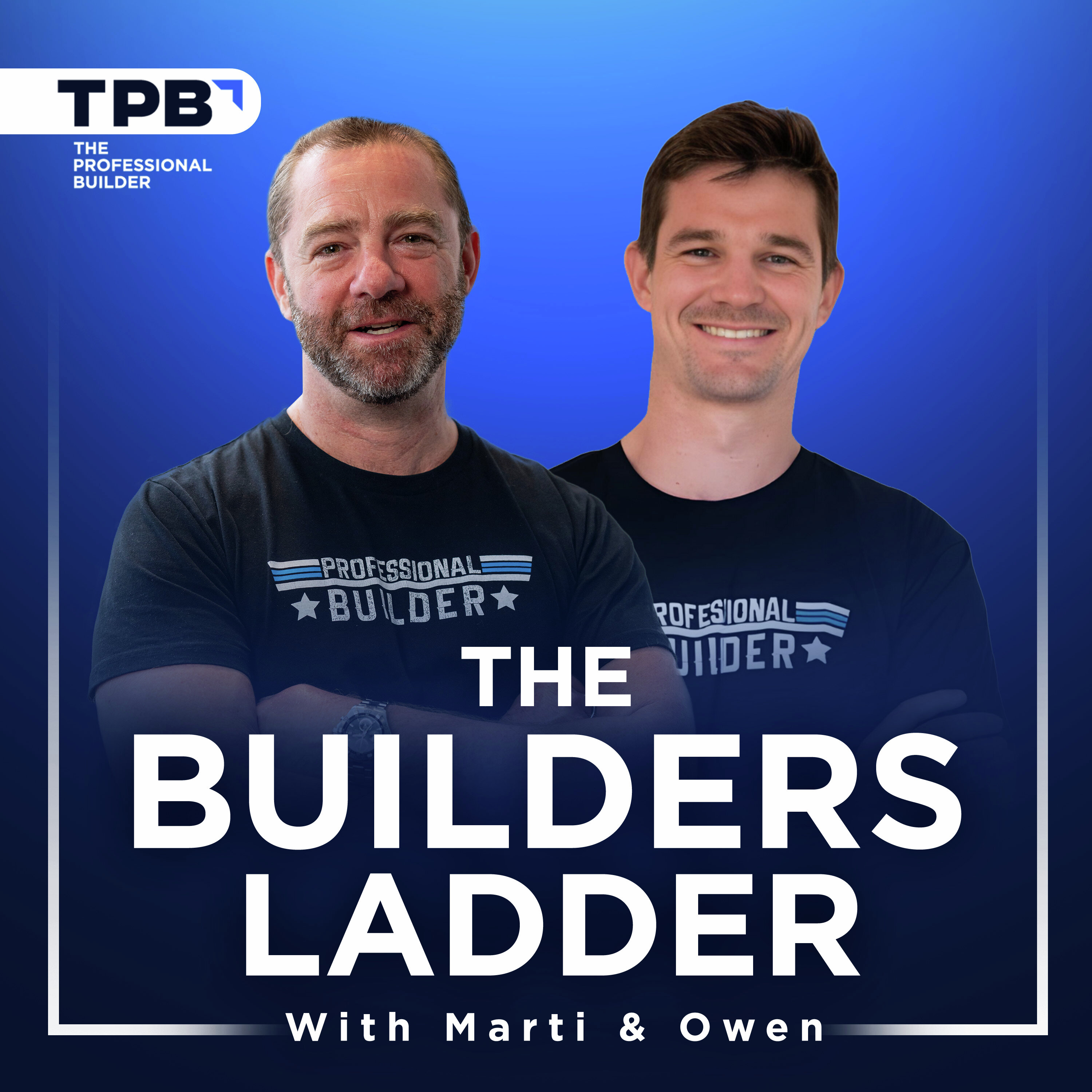
Welcome to The Builders Ladder, for residential builders and construction business owners who want to fast-track their results, scale their construction company, and create a systemized, profitable construction business.If you’re ready to free up your time, increase profit, and build a high-performing team, you’re in the right place.Your host, Marti Amos, has worked with over 5,000 building companies globally over the last 19+ years through builder coaching and proven business systems. His mission? To help you climb the builder’s ladder and run a predictable, high-margin construction business.Tune in to hear from industry experts and discover step-by-step strategies to become a strategic building business owner - and ultimately, achieve true wealth, time freedom, and financial freedom through your residential construction business.
Pitch Analysis
Required Pod Score for this show. PitchCentric checks your profile against host openness, topical fit, and audience signals before you generate a pitch.
Contact path
Verified email
Booking probability
34%
Guest openness
Selective
Verified email on file
80/100
Required Score
Sign up to generate a grounded pitch for The Builders Ladder: Business Growth Strategies for Residential Construction Businesses.
What is The Builders Ladder: Business Growth Strategies for Residential Construction Businesses?
The Builders Ladder: Business Growth Strategies for Residential Construction Businesses is a business podcast hosted by The Professional Builder, with 100 episodes on record and a Required Pod Score of 80. PitchCentric scores this show on Booking Probability, Listen Score, and live audience signals refreshed every 24 hours.
About the host
The Professional Builder hosts The Builders Ladder: Business Growth Strategies for Residential Construction Businesses, a business show with 100 episodes published.
Our AI reads these to draft pitches. Use them as grounding for a pitch that cites a real guest and a specific topic.
The Builders Ladder: Business Growth Strategies for Residential Construction Businesses
[ON SITE] Epi 12: Fixing A 3 PERCENT Margin Mistake On A Commercial Build | Tyrone & Marion Galloway
Aug 21, 202651 min
Tyrone and Marion operated their building company by working massive hours, starting at 4 AM and finishing at 11 PM six days a week. Because Tyrone treated his crew and his clients like family, he constantly absorbed the costs of uncharged variations to "help out" his network. On one large commercial project, his failure to track daily site expenses led to a gross profit margin of just 3% after paying for undocumented waste removal. By joining The Professional Builder, Tyrone implemented a holistic financial framework. He instituted tiered pricing based on project size, ensuring jobs under $80,000 carried a 40% margin, while larger jobs held a strict 30% to 35% margin. He also deployed a default diary to ring-fence his time for quoting and established scorecard accountability for his staff, finally moving his business from a reactive state into a proactive, highly profitable company. Links & Resources TJ's Kitchens & Bathrooms Website - https://www.kitchensandbathrooms.co.nz/ Timestamped Key Points 00:00 Introduction 06:30 Hiring an office administrator to manage marketing, client communication, and contract administration. 15:32 Implementing tiered pricing to secure a 40% margin on jobs under $80,000. 18:00 Using a default diary to ring-fence the owner's time specifically for quoting and architect meetings. 27:52 Hitting a psychological breaking point before adopting a holistic approach to business coaching. 32:12 How working from 4 AM to 11 PM six days a week forced the owner to finally restructure the company. 42:12 The financial penalty of performing uncharged variations for friendly clients. 45:00 Watching a commercial job margin collapse to 3% due to un-tracked skip bin expenses. 50:02 Transitioning from a family-run company to a sports team model using scorecard accountability. https://www.facebook.com/groups/TPBmember: https://www.facebook.com/TheProfessionalBuilder See omnystudio.com/listener for privacy information.
Epi 226: Why New Builders Must Spend 10 PERCENT To Compete With Established Brands | Elly Smith
Aug 18, 202639 min
Elly from Gordon Digital explains that residential builders actively burn their marketing budgets by treating ads as a short-term fix. Many builders try to run their own marketing by randomly boosting Facebook posts or paying for cheap SEO that only targets basic keywords. Because the residential buying cycle is long, these disconnected tactics fail to build the brand trust required to secure high-margin contracts. To fix this, Elly introduces Answer Engine Optimization (AEO). Because clients now use large language models like ChatGPT to research build costs and processes, ranking number one on a standard Google search is no longer enough. Builders must create long-form content that specifically answers the questions clients ask AI platforms. By combining this AI visibility with face-to-camera social media content, builders establish trust long before the client requests a quote. Links & Resources Gordon Digital Website - https://gordondigital.com.au/ Timestamped Key Points 00:00 Intro 01:41 Shifting the marketing focus from lead volume to attracting 7 to 25 highly qualified custom home prospects. 06:03 Setting a realistic marketing budget of 3% for established brands and up to 10% for newer companies. 08:31 Managing the long residential sales cycle and why turning ads off at three months kills the pipeline. 11:00 Structuring website messaging to build trust during the client's initial research phase. 13:16 Using face-to-camera content to establish a personal connection before the initial consultation. 17:28 Transitioning from keyword SEO to Answer Engine Optimization (AEO) to rank in AI search results. 27:14 Optimizing long-form website content so large language models like ChatGPT recommend your building company. 34:52 Hiring a specialized digital marketing agency instead of tracking money down the toilet with DIY Facebook ads. https://www.facebook.com/groups/TPBmember: https://www.facebook.com/TheProfessionalBuilder See omnystudio.com/listener for privacy information.
Epi 225: Why Accepting The First Qualified Applicant Guarantees A Bad HIRE | Scott Rammage
Aug 10, 20261h 1m
Scott Ramage from HireVP discusses how residential builders fall into the habit of solving every site problem themselves. Taking 50 phone calls a day, chasing down subcontractors, and processing invoices reduces an owner's effective pay to around $35 an hour. Handing an assistant a random list of chores rarely fixes this capacity problem. Scott advises defining a strict role, such as a project coordinator, and holding that person responsible for specific outcomes like processing draws and answering client questions. Scott uses the "bus test" to demonstrate what happens to a building company if the owner is suddenly unavailable. If daily operations live entirely in the founder's head, the active projects stall. He suggests recording daily tasks using video or voice tools, like Loom, so staff can learn the steps without the owner needing to sit down and type out a formal manual. Links & Resources HireVP Website - hirevp.us Timestamped Key Points 00:00 Introduction 03:23 The mechanical differences between a managed talent service and a standard virtual assistant agency. 06:34 Why builders choose to stay involved in daily site problems instead of delegating the administrative work. 13:14 Calculating your effective hourly rate to see the financial cost of doing your own admin. 15:15 Assigning exact outcomes to a new hire so they manage a defined role instead of waiting for a daily task list. 20:30 Explaining the "bus test" and what happens to active construction projects if the owner cannot work. 24:18 Recording processes with Loom and audio tools to avoid writing out long training documents. 38:18 Using cognitive scores during the interview phase to gauge a candidate's learning speed. 43:08 Hiring a project coordinator to handle draws, pay invoices, and answer subcontractor questions. https://www.facebook.com/groups/TPBmember: https://www.facebook.com/TheProfessionalBuilder See omnystudio.com/listener for privacy information.
Epi 224: Why Your Free Spreadsheet Is The Most EXPENSIVE Tool On Site | Ahmed Noor Yusuf
Aug 6, 202628 min
Ahmed from Wunderbuild observed that residential builders fail themselves by relying entirely on their brains or paper books to track site progress. This lack of a structured system forces them into a cycle of daily firefighting, leaving them with zero time to learn the exact software that would solve their crisis. To remove the friction of adopting new technology, WonderBuild sets up the 14-day free trial using the builder's actual project data. The platform includes a voice-to-task feature where a builder can record a video on site, speak an instruction, and have the software instantly generate a scheduled task and checklist for a specific team member. Ahmed also introduced the Workplace Studio, enabling builders to use AI to generate custom human resources documents, leave forms, and injury lists to run the administrative side of their company. Links & Resources Wunderbuild Website - https://www.wunderbuild.com/ Timestamped Key Points 00:00 Introduction 01:28 Managing construction workflows from takeoffs and estimations directly through to financial tracking using Xero two-way integration. 03:04 Processing up to 30 daily feature requests from residential builders to guide 24 months of engineering work. 12:18 Transitioning residential builders away from using physical notebooks and spreadsheets as their primary tracking tools. 13:12 Uploading a builder's live project data during the 14-day free trial to remove the friction of software training. 15:28 Delegating software management to a virtual assistant when the business owner is too busy firefighting daily site issues. 17:58 Using the Workplace Studio to generate custom HR documents, leave forms, and injury lists using AI. 19:56 Converting spoken site observations into scheduled tasks with mandatory completion checklists for specific team members. 24:16 Guaranteeing support response times of under one minute to ensure site supervisors receive immediate technical help. https://www.facebook.com/groups/TPBmember: https://www.facebook.com/TheProfessionalBuilder See omnystudio.com/listener for privacy information.
The Builders Ladder: Business Growth Strategies for Residential Construction Businesses
[ON SITE] Epi 11: How Outsourcing Administration Cut Overheads From 35% To 8% | Joshua Rosinski
Aug 5, 202647 min
Josh runs Helix Group alongside his brother in northern Sydney. Before applying a formal management structure, the company operated with overheads at 35 percent and paid $9,000 a month for local accounting. The lack of formal processes forced them to absorb a $160,000 basement variation because they failed to secure written approval from the client prior to excavation. Josh also worked for six years without a holiday, constantly answering his phone. Josh laid off excess in-house staff and hired offshore virtual assistants for estimating and bookkeeping, dropping accounts costs to $800 a month. He established variation approval rules requiring client sign-off before site work continues. By organizing his schedule with a Default Diary, Josh separated site meetings from business development, which helped him secure a 1.1 million dollar cost-plus contract. This structure enabled him to take a two-week unplugged trip to Vietnam while his site foreman managed the active projects. Links & Resources Helix Group Website: https://www.helix.group/ Timestamped Key Point 00:00 Introduction 04:58 Securing a 1.1 million dollar contract through 14 months of negotiation and transitioning it to a cost-plus agreement after lock-up. 14:00 Using an A to Z operations org chart to formalize the roles of site foremen and project managers. 16:10 Installing Alpha flooring to block sound transfer between levels in a split-living residence. 18:57 Mandating written client approval for variations to prevent absorbing costs like a 160,000 dollar basement excavation. 22:15 Outsourcing bookkeeping to the Philippines to drop accounting costs from 9,000 dollars down to 800 dollars a month. 26:42 Blocking out the schedule to take a two-week trip to Vietnam after working six years without a holiday. 35:22 Sending 100 direct messages a week on LinkedIn to schedule coffee meetings with architects and designers. 40:57 Implementing a Default Diary to separate mandatory site meetings from dedicated business development time. https://www.facebook.com/groups/TPBmember: https://www.facebook.com/TheProfessionalBuilder See omnystudio.com/listener for privacy information.
Every question we get asked before someone starts their trial.
If you have a concern about deliverability, AI quality, data privacy, or whether this will actually work for your specific situation, it's probably answered below.
What is the difference between Founder Solo and Founder Pro?
Founder Solo gives you 50 AI pitches per month using the credit model (Standard pitches cost 1 credit, Enriched pitches cost 2). Founder Pro raises that to 200 credits per month and adds full Booking Probability access, unlimited Magic Match, Apollo enrichment credits, and data export capabilities. Both plans use the same credit system, so you can stretch your monthly budget further by using Standard-mode drafting.
How do agency tiers work?
Agency tiers have no base fee. You pay per managed client and per talent profile. Agency Standard is $199 per client per month; Agency Pro is $399 per client per month. Both add $39 per talent profile per month. Your own team's user seats are always free.
What is a talent profile?
A talent profile represents one person (founder, executive, or spokesperson) you are booking onto podcasts. It includes their bio, topics, headshots, and outreach history. Team plans include 5 profiles; agency plans are pay-as-you-go.
Can I switch plans later?
Yes, at any time. Upgrades take effect immediately; downgrades apply at the end of the current billing period. Contact support if you need help migrating between plan families.
Do you offer a free trial?
Every paid plan includes a 15-day free trial. Your card is saved at signup but you will not be charged until day 16. Cancel any time from your dashboard.
What happens if I cancel?
You keep access until the end of your current billing period. No charges after that. Your data is retained for 30 days in case you reactivate.
Is the 20% annual discount automatic?
Yes. Select Annual on the pricing toggle and the discounted price is applied automatically at checkout. The annual price shown is the full year cost.
What if I have more than 50 profiles or 20 clients?
That is our Enterprise tier. Contact our sales team and we will build a custom plan with volume pricing, a dedicated account manager, and SLA guarantees.