Small Team Big Scale with Ron Schmelzer Helping Teams With Big Ambitions Scale without Scaling Headcount. The Small Team Big Scale Scale podcast explores how the smallest teams are scaling big. Hosted by Ron Schmelzer , Forbes writer, 3x exited founder, AI thought leader, and founder of Scalebrate, each episode explores the playbooks, systems, and mindset behind today’s fastest-scaling Microteams who are looking to Megascale. You’ll hear from visionary “Scalebrity” founders, thought leaders, and AI-powered builders who are proving that you don’t need a megateam to make a mega impact. Learn how they automate, systemize, and scale smarter, not bigger. If you’re a small team with big ambitions, this is your unfair advantage to grow with clarity, leverage, and celebration. Because the future isn’t big teams: it’s small teams that scale exponentially.
Pitch Analysis
Required Pod Score for this show. PitchCentric checks your profile against host openness, topical fit, and audience signals before you generate a pitch.
Contact path
Verified email
Booking probability
32%
Guest openness
Selective
Verified email on file
80/100
Required Score
Sign up to generate a grounded pitch for Small Team Big Scale.
Small Team Big Scale is a business podcast hosted by Ron Schmelzer, Scalebrate, with 48 episodes on record and a Required Pod Score of 80. PitchCentric scores this show on Booking Probability, Listen Score, and live audience signals refreshed every 24 hours.
About the host
Ron Schmelzer, Scalebrate hosts Small Team Big Scale, a business show with 48 episodes published.
Our AI reads these to draft pitches. Use them as grounding for a pitch that cites a real guest and a specific topic.
Episode #48
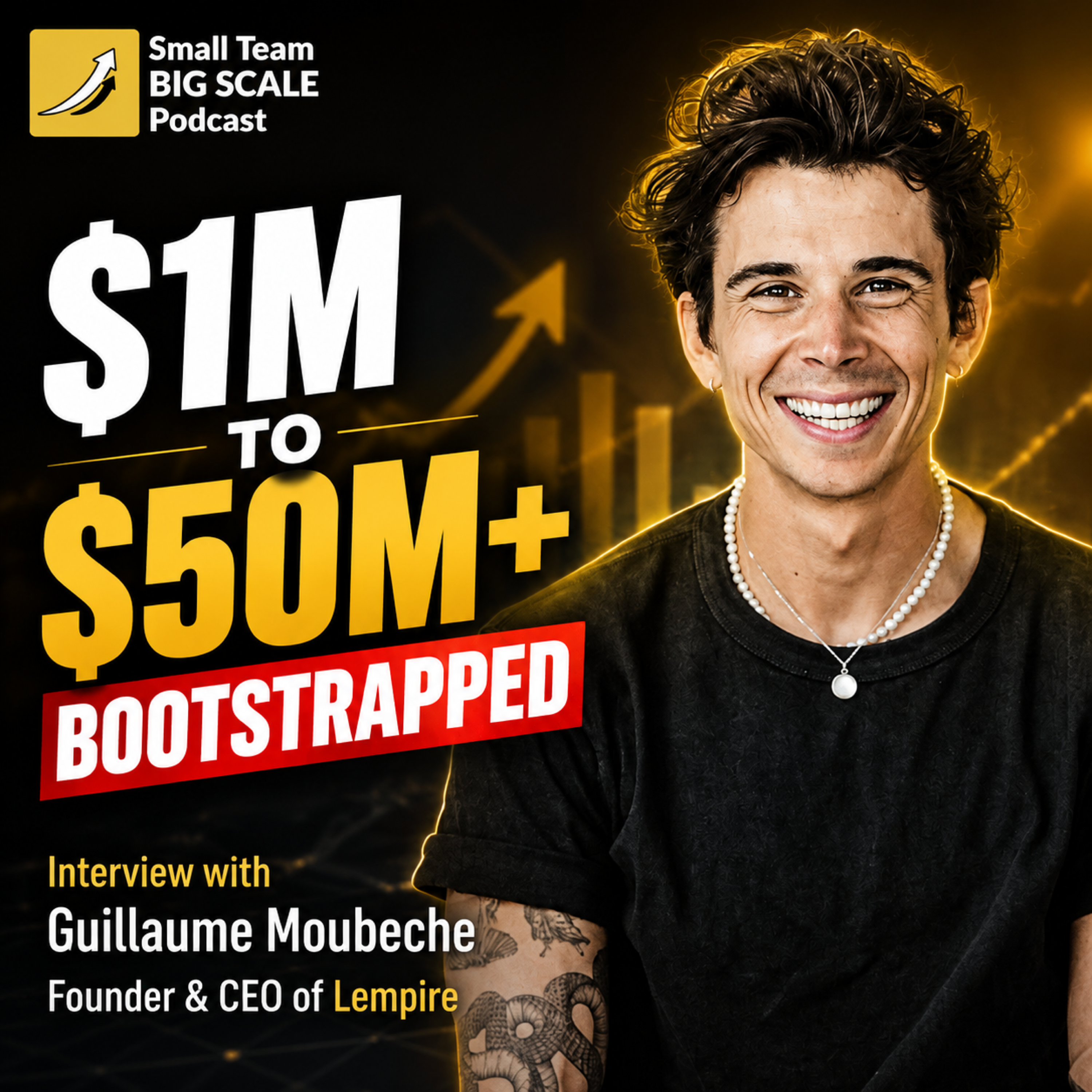
$1M to $50M+ Bootstrapped — Interview with Guillaume Moubeche, Lempire
Sep 3, 202651 minS1
Guillaume Moubeche started Lemlist with $1,000 and 30 VC rejections. Five years later, his company Lempire hit $57M ARR with 40% EBITDA margins and zero outside funding. He ran 400 demos himself in year one, built a community that became his growth loop, and acquired three businesses below $1M ARR each that doubled within the year. In this episode, Guillaume breaks down how "eating your own dog food" became a compounding growth engine, why revenue is a lagging indicator, and how he transitioned from CEO to chairman while building an employee equity model designed to create millionaires. He also shares his investing philosophy through Clifton Family Office and why he started the BILLIONS podcast to answer the question his own $150M valuation raised. What you'll learn: How 400 personal demos in year one landed the first 100 customers with zero sales team Why growth loops beat paid acquisition — and how Lemlist's community became the engine Revenue is a lagging indicator: why what you do now shows up six months later The trust triangle: credibility, reliability, and emotional connection in founder-led growth From CEO to chairman: how Guillaume structured employee equity to create millionaires Links: Guillaume Moubeche on LinkedIn Lempire Lemlist Small Team Big Scale Podcast Subscribe to Small Team Big Scale: scalebrate.com/podcast
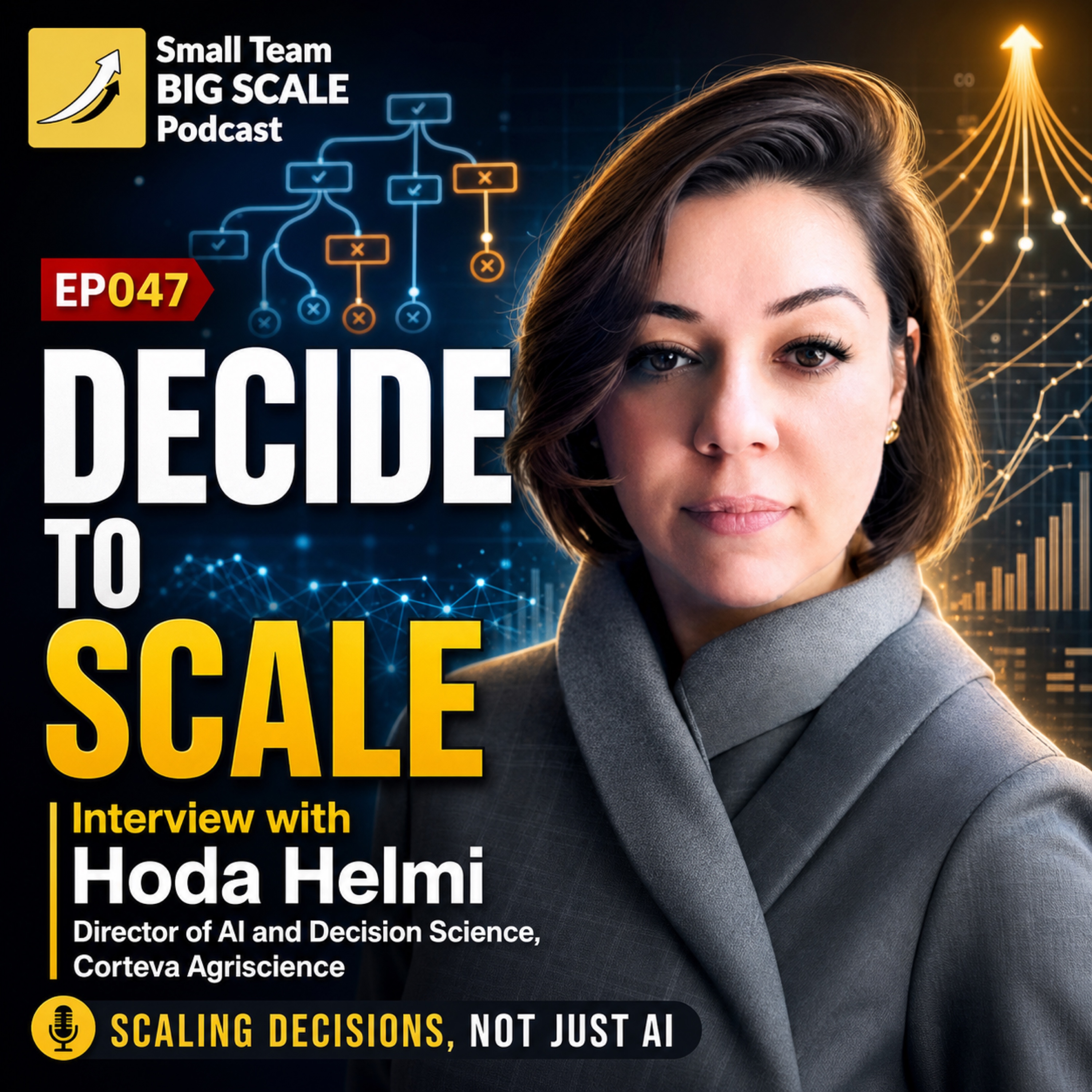
Decisions That Scale — Interview with Hoda Helmi, Corteva Agriscience
Aug 27, 20261h 1mS1
Hoda Helmi started as a team of one inside Corteva Agriscience — a $17.4B agricultural company with 21,500 employees across 110 countries — and built an AI and decision-science practice that now shapes how the enterprise makes its most consequential decisions. She didn't start with a data platform or an AI lab. She started with one decision and built outward. She introduces the "digital decision twin" — a living model of enterprise decisions, constraints, and possible futures — and explains why starting with the decision (not the data) is the fastest path to measurable value. Along the way, she shares the Name, Fame, Same, Aim, Game framework for introducing yourself and your work, the franchise model for scaling small teams inside large organizations, and why asking the right questions beats knowing all the answers. What you'll learn: Why decisions — not data or tools — are the true leverage point for scaling teams How to build a digital decision twin that models enterprise decisions and constraints The Name, Fame, Same, Aim, Game framework for introducing yourself and your work Why starting with one consequential decision beats building a massive platform How to balance operating model structure with team flexibility and innovation Links: Hoda Helmi on LinkedIn Corteva Agriscience Small Team Big Scale Podcast Subscribe to Small Team Big Scale: scalebrate.com/podcast
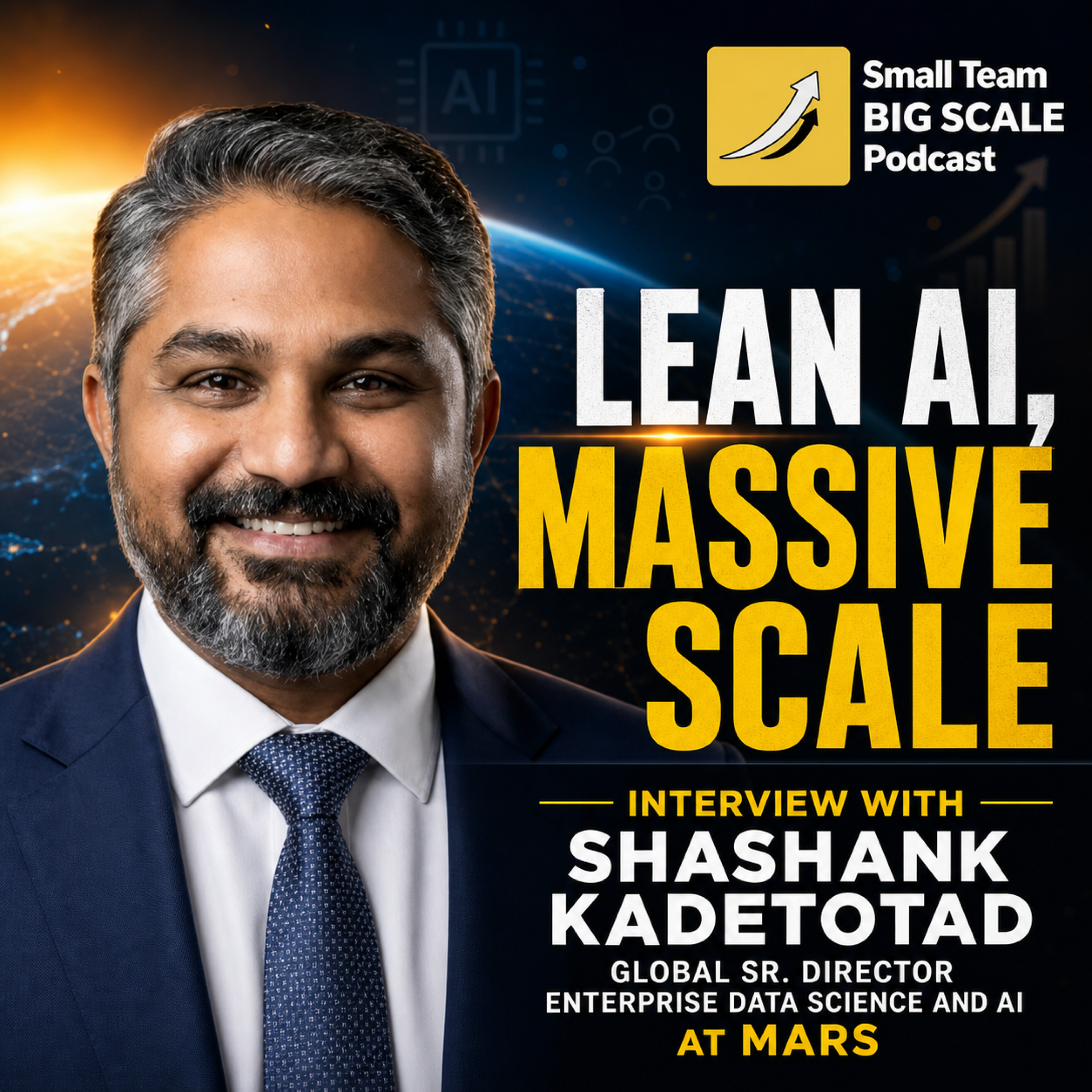
How does a Tiny 12 Person Team Support a $50 Billion Org? Interview with Shashank Kadetotad, Mars
Aug 13, 202650 minS1
A 12-person data science team driving AI transformation across a $50B+ global conglomerate. Shashank Kadetotad, Global Sr. Director of Enterprise Data Science and AI at Mars, reveals how his lean team accelerates outcomes across hundreds of brands by building composable "accelerator" modules, defining criteria for failure before they start, and staying vendor-agnostic in a rapidly shifting AI landscape. Shashank shares how Mars went from weeks-long deployments to days using standardized forecasting and optimization accelerators, why governance is the biggest enabler of scale rather than a bottleneck, and how the AI Lab they built provides a safe space for experimentation with built-in failure criteria. From pizza-team principles borrowed from Amazon to the discipline of killing pilots early, this episode is packed with practical lessons for any team trying to punch above its weight. What you'll learn: How a 12-person AI team serves an organization of 100,000+ across supply, demand, finance, and HR Why governance is your biggest enabler of scale, not a bottleneck The "accelerator" approach: 15 reusable Lego blocks that cut deployment time from weeks to days How defining failure criteria upfront prevents pilots from dragging on for years Why staying vendor-agnostic and systematizing processes is the key to long-term AI adaptability Links: Shashank Kadetotad on LinkedIn Mars Small Team Big Scale Podcast Supported by: This episode is sponsored by qBotica — helping enterprises move beyond AI pilots and into real execution. Through qubi, its Agentic AI platform, qBotica brings together intelligent agents, automation, enterprise systems, and human oversight to transform complex workflows across healthcare, banking, insurance, real estate, and more. Learn more at qBotica.com → Subscribe to Small Team Big Scale: scalebrate.com/podcast
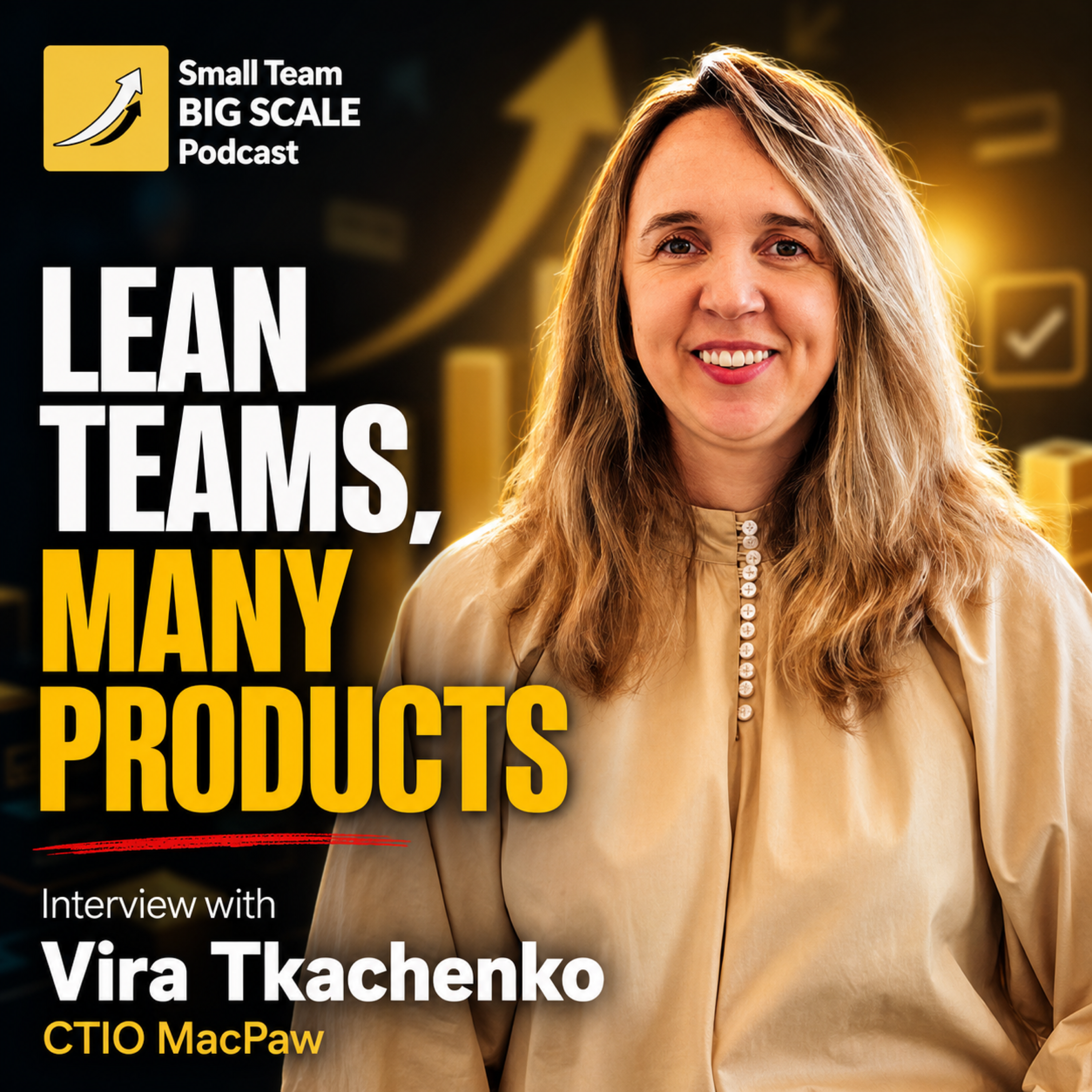
Lean Teams, Many Products — Interview with Vira Tkachenko, MacPaw
Aug 6, 202634 minS1
MacPaw built 15 products with ~500 people and zero venture funding. Co-founder Vira Tkachenko started in a Kyiv dorm room in 2008 and now leads technology and innovation across a multi-product portfolio that includes CleanMyMac and Setapp — proving a lean team can scale globally from Ukraine. Vira explains why MacPaw invests in AI tokens instead of headcount, how the company went from 5 people to 200 engineers, why B2C founders struggle to raise money compared to B2B, and the counterintuitive advice to be a co-founder rather than a solo founder because diversity of thought beats AI agreement every time. What you'll learn: How MacPaw grew from 5 co-founders in a dorm to ~500 people across 15 products with zero VC funding Why MacPaw now invests in AI tokens over new hires — keeping headcount flat while scaling output The B2C funding challenge: why investors favor B2B and how MacPaw stayed profitable from day one How starting globally from Ukraine shaped a bootstrapped company selling to 100+ countries Why "be a co-founder" is Vira's top advice — diversity of thought beats solo founder ambition Links: MacPaw Vira Tkachenko on LinkedIn CleanMyMac Setapp Subscribe to Small Team Big Scale: smallteambigscale.com/podcast
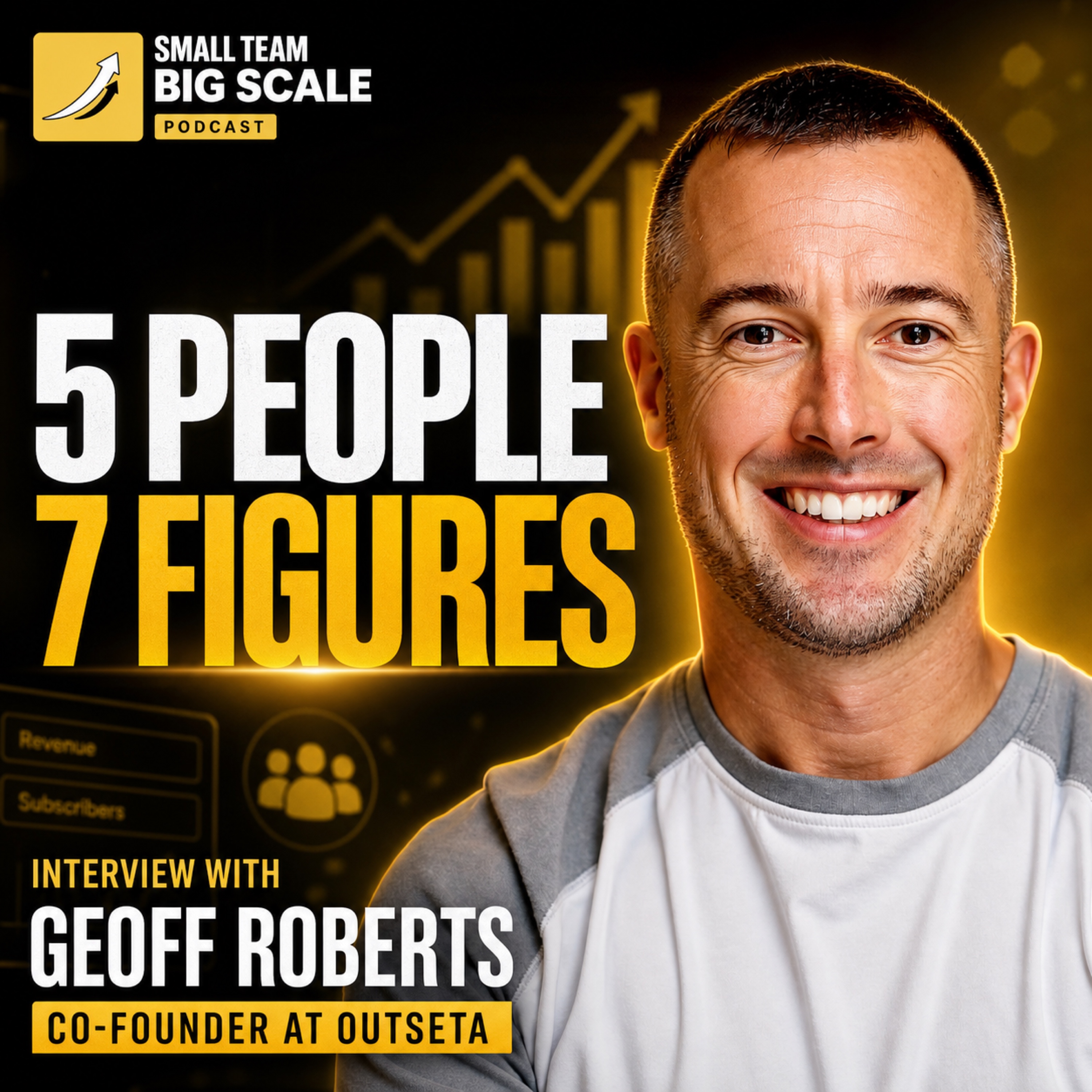
5 People, 7 Figures: Interview with Geoff Roberts, Outseta
Jul 30, 20261h 2mS1
Geoff Roberts, Co-founder of Outseta, has built a profitable seven-figure business serving over 1,000 SaaS companies with a team of just five people working four to five days a week, all without taking a dollar of outside funding. In this episode, he explains how Outseta's unusual equal-compensation model and Growth by Elimination philosophy keep the team small, focused, and profitable over a 15-year horizon. Geoff shares why Outseta deliberately chose bootstrapping over venture capital, how eliminating management layers and traditional sales actually accelerated growth, and how existing customers organically moving through pricing tiers drove 70% year-over-year revenue growth. The conversation covers the organizational structure designed to let five people build an ambitious platform product, the philosophy of "life profitability," and what it means to work on something durable enough to sustain a 15-year commitment. What you'll learn: How a team of 5 people built a profitable 7-figure SaaS platform without venture capital Why Outseta's equal salary and equity model was designed to keep the team small over 15 years How Growth by Elimination — removing investors, management, sales, budgets, and forecasts — actually accelerated revenue growth Why 70% year-over-year growth came from existing customers expanding, not new customer acquisition How Outseta provides "core feature parity" across UI, API, and AI agents What "life profitability" means and why work should enable a better life, not consume it Links: Outseta Growth by Elimination Outseta Equal Compensation Model Payment Structure & Organizational Design Seven-Year Update Nine-Year Update (Equity, Expenses, Growth) SaaS Operating Agreement Geoff Roberts on LinkedIn Outseta on LinkedIn Subscribe to Small Team Big Scale: smallteambigscale.com/podcast
Every question we get asked before someone starts their trial.
If you have a concern about deliverability, AI quality, data privacy, or whether this will actually work for your specific situation, it's probably answered below.
What is the difference between Founder Solo and Founder Pro?
Founder Solo gives you 50 AI pitches per month using the credit model (Standard pitches cost 1 credit, Enriched pitches cost 2). Founder Pro raises that to 200 credits per month and adds full Booking Probability access, unlimited Magic Match, Apollo enrichment credits, and data export capabilities. Both plans use the same credit system, so you can stretch your monthly budget further by using Standard-mode drafting.
How do agency tiers work?
Agency tiers have no base fee. You pay per managed client and per talent profile. Agency Standard is $199 per client per month; Agency Pro is $399 per client per month. Both add $39 per talent profile per month. Your own team's user seats are always free.
What is a talent profile?
A talent profile represents one person (founder, executive, or spokesperson) you are booking onto podcasts. It includes their bio, topics, headshots, and outreach history. Team plans include 5 profiles; agency plans are pay-as-you-go.
Can I switch plans later?
Yes, at any time. Upgrades take effect immediately; downgrades apply at the end of the current billing period. Contact support if you need help migrating between plan families.
Do you offer a free trial?
Every paid plan includes a 15-day free trial. Your card is saved at signup but you will not be charged until day 16. Cancel any time from your dashboard.
What happens if I cancel?
You keep access until the end of your current billing period. No charges after that. Your data is retained for 30 days in case you reactivate.
Is the 20% annual discount automatic?
Yes. Select Annual on the pricing toggle and the discounted price is applied automatically at checkout. The annual price shown is the full year cost.
What if I have more than 50 profiles or 20 clients?
That is our Enterprise tier. Contact our sales team and we will build a custom plan with volume pricing, a dedicated account manager, and SLA guarantees.