Shrink The Nation is a political psychology podcast about the behavior underneath the headlines. Hosted by military psychiatrists Dr. David and Dr. Robby, the show uses current events as case studies in how people, groups, institutions, and political systems behave under pressure. Each episode looks beyond the news cycle to examine the mechanisms shaping modern public life: cognitive dissonance, propaganda, grievance, polarization, conformity, institutional failure, trust collapse, group identity, and the stories people use to make sense of political reality. The goal is not to diagnose politicians or tell listeners what to think. It is to understand why people believe what they believe, why institutions behave the way they do, and what happens when loyalty, identity, or narrative becomes more important than evidence. Sharp, funny, clinically informed, and grounded in behavioral science, military experience, and systems thinking. Current events are the case m
Pitch Analysis
Required Pod Score for this show. PitchCentric checks your profile against host openness, topical fit, and audience signals before you generate a pitch.
Contact path
Verified email
Booking probability
33%
Guest openness
Selective
Verified email on file
80/100
Required Score
Sign up to generate a grounded pitch for Shrink The Nation.
Our AI reads these to draft pitches. Use them as grounding for a pitch that cites a real guest and a specific topic.
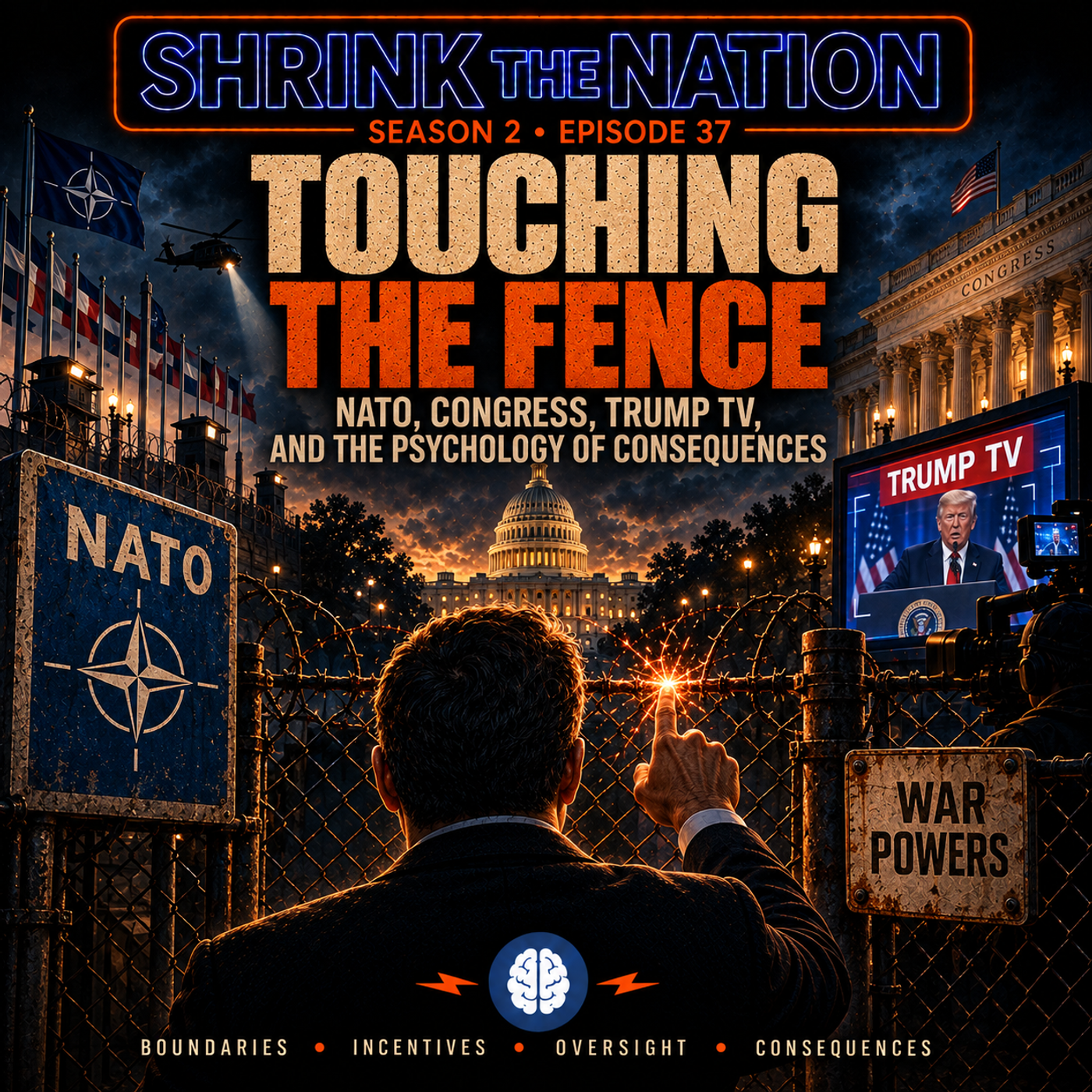
Episode #37
Touching the Fence: NATO, Congress, Trump TV, and the Psychology of Consequences
Sep 29, 20261h 16mS2
A Russian military helicopter crosses roughly 300 meters into Polish airspace for 42 seconds, and Poland says the incident appears to be testing its air defenses. That becomes the starting point for a larger question: How do people and institutions learn where the real boundary is? David and Rob follow that question through Congress and the Iran war, bureaucratic incentives inside immigration enforcement, the White House fight over independent press access, and the difference between being observed and being displayed. The Senate’s latest Iran War Powers resolution failed 49–50, while a federal judge temporarily restored White House access to CNN, MS NOW, and Politico after their credentials were revoked. Different institutions. Very different stakes. But underneath them is the same behavioral machinery: people adapt to the consequences they actually experience, the metrics they are rewarded for, and the boundaries somebody is willing to enforce.
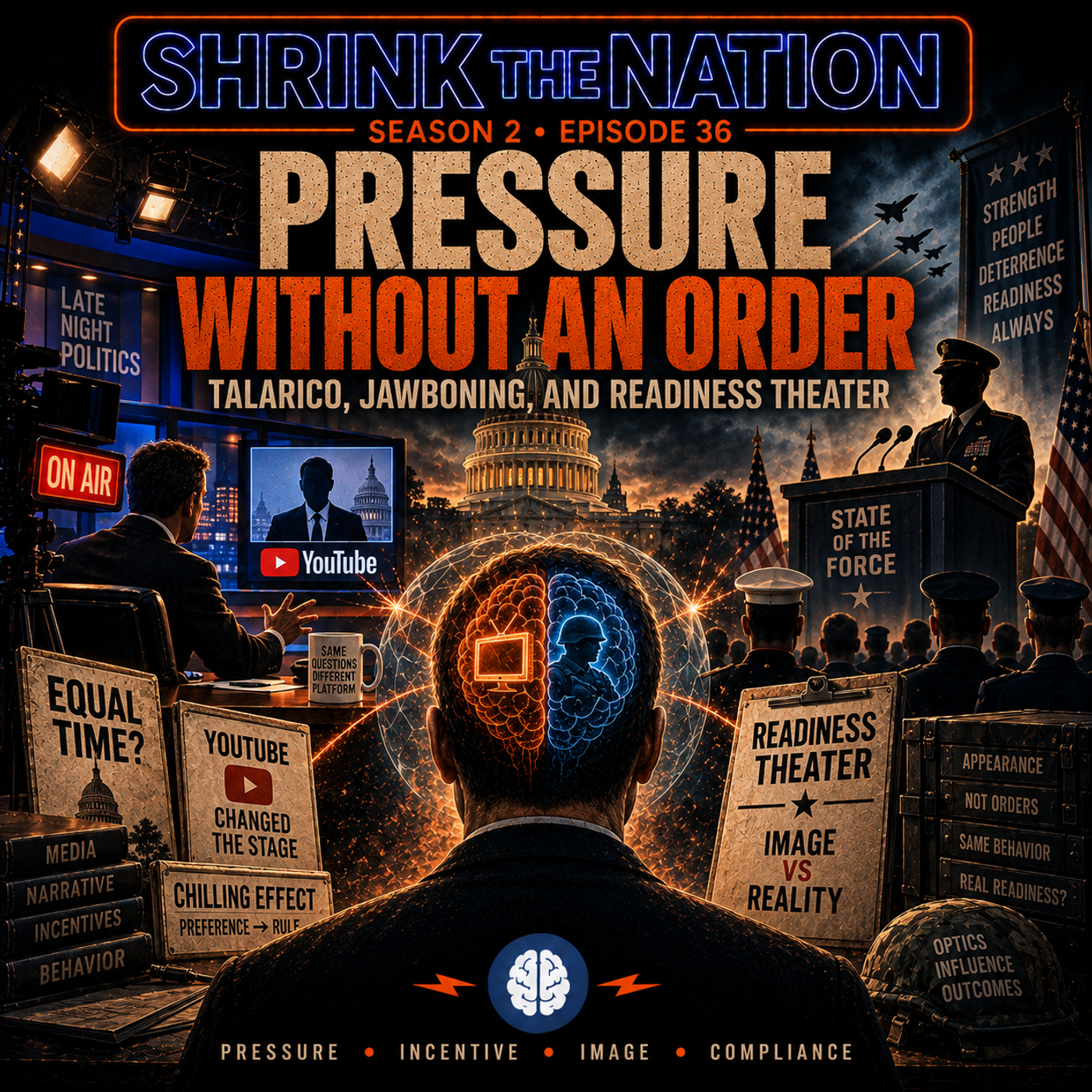
Pressure Without an Order: Talarico, Jawboning, and Readiness Theater
Sep 22, 202647 minS2
Twice this year, James Talarico sat down with a major late-night host. Twice, the interview ended up on YouTube instead of broadcast television. Nobody appears to have issued an order saying, “Don’t air James Talarico.” That may be exactly what makes the situation psychologically interesting. Drs David, Rob, and returning guest Amit look at jawboning, chilling effects, negative reinforcement, and anticipatory compliance: what happens when people understand the possible consequences well enough that authority no longer needs to give an explicit command? Then they turn the same question on themselves. If outrage, certainty, and telling audiences exactly what they want to hear would grow the show faster, why not do it? And how would they know if the algorithm had already started shaping them? Finally: Pete Hegseth’s upcoming “State of the Force,” military fitness as political imagery, and the uncomfortable difference between projecting readiness and actually measuring it. Because readiness is hard to photograph. Abs are easy.
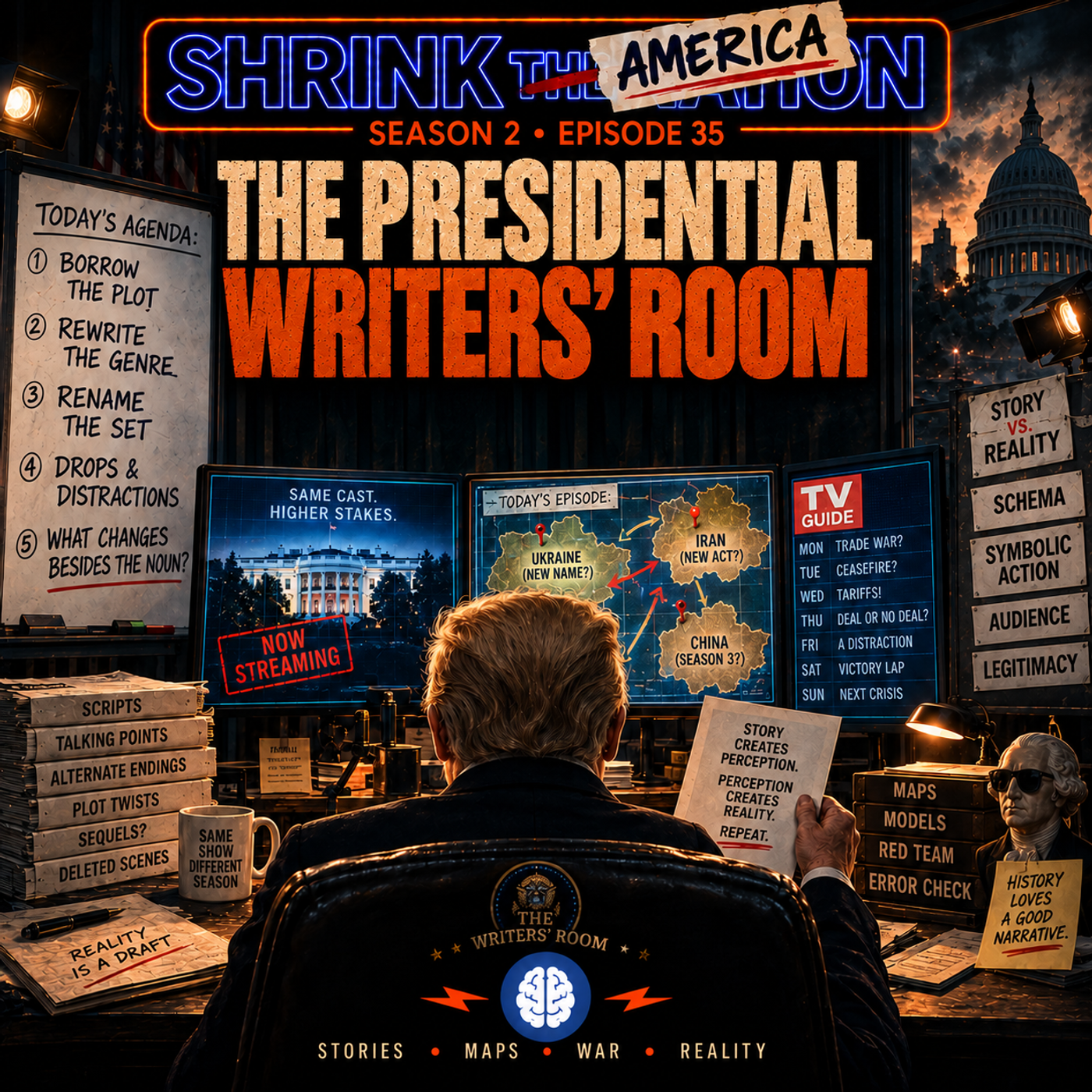
What if some of Donald Trump’s stranger ideas sound familiar because we have already seen the movie? A Starship Troopers -inspired Space Force uniform. Reopening Alcatraz shortly after Escape from Alcatraz aired in South Florida. “One rough hour” of aggressive policing that sounds suspiciously like The Purge . There is no evidence Trump actually watched those broadcasts and then turned them into policy. But the coincidences lead David, Rob, and guest psychiatrist Amit somewhere more interesting: why are stories so good at organizing reality, and what happens when we become more committed to the story than to correcting it? The conversation moves from movies to psychiatric formulation, military planning, red teaming, deepfakes, the Iran conflict, JD Vance resisting the word “war,” the Department of War, DHS declaring itself “at war every single day,” and the political value of making symbolic change look like substantive action. Also: Japanese whiskey, Walmart bourbon, Space Nazis, Skynet, a paranoid patient with an unusually difficult-to-falsify theory, and the inevitable question of whether Turner Classic Movies should be considered part of the national security apparatus. The map is useful. The map is not the territory. And if reality stops matching the map, somebody has to be willing to redraw it.
Readiness Theater: Testosterone, Trump Strait, and the Illusion of Control
Sep 8, 202649 minS2
What do testosterone screening, Trump Strait, world maps, browser games, and military readiness have in common? This week, Dr. David and Dr. Rob look at what happens when complicated reality gets replaced by something easier to measure, name, display, or score. They start with the Pentagon’s short-lived clinical guidance on testosterone screening, including the unexpectedly evidence-based provision involving postmenopausal women with diminished sexual desire, before asking whether a hormone level tells us anything meaningful about combat readiness. From there: Lake America, Trump Strait, the United States casting the lone “no” vote on a U.N. map-projection resolution, the White House launching an arcade, JD Vance arguing the Iran conflict shouldn’t be called a war, and reports that the actual military may be increasingly strained by it. The recurring problem is simple: the representation can look excellent while the underlying system is failing. Also, David finally tried Laura Bush’s pie. It did not live up to expectations.
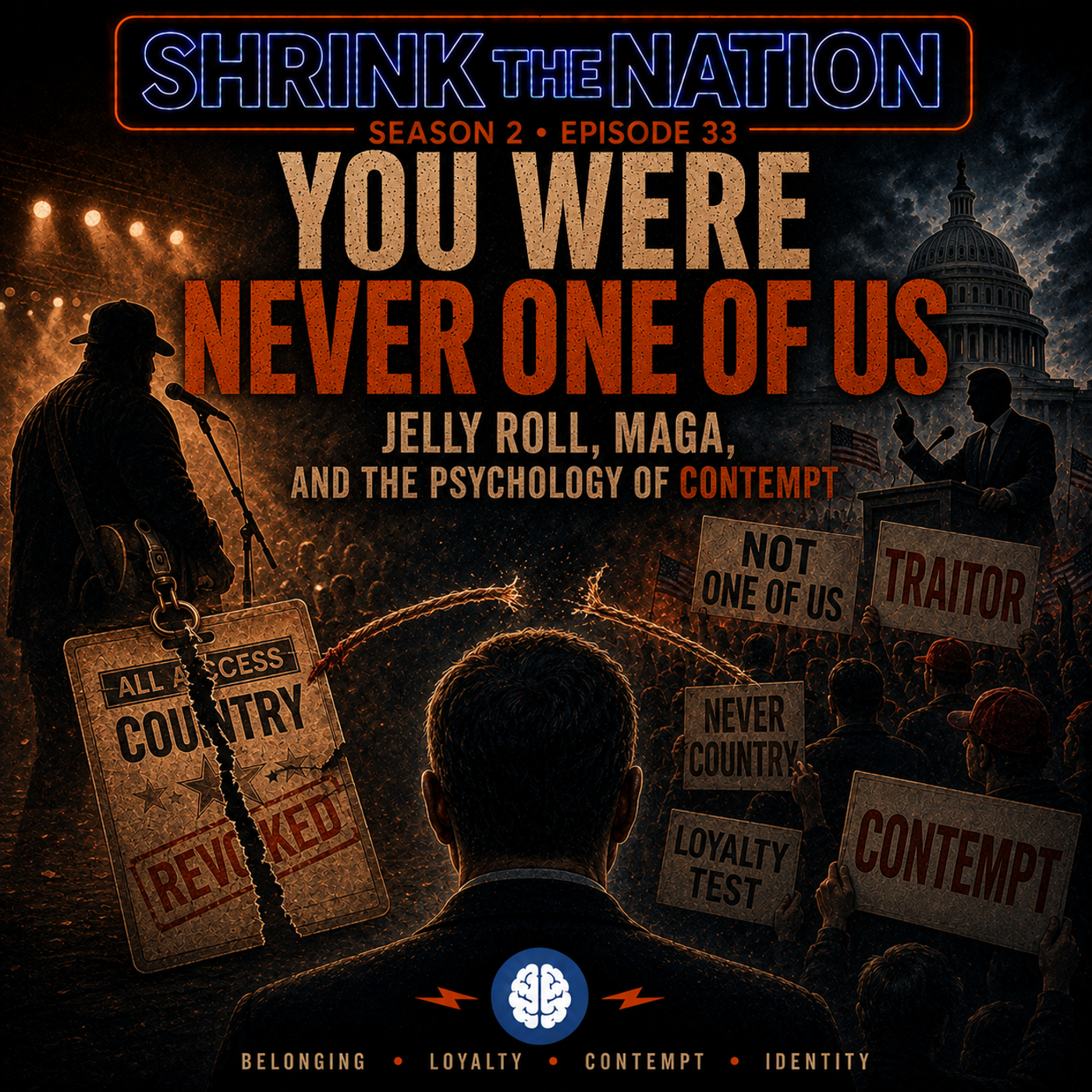
You Were Never One of Us: Jelly Roll, MAGA, and the Psychology of Contempt
Sep 1, 202647 minS2
Jelly Roll guest-hosts Jimmy Kimmel Live , jokes about Donald Trump, and suddenly one Republican congressman is telling him he was never really country and is no longer welcome in Florida. That reaction sends Dr. David and Dr. Robby somewhere more interesting than the joke itself: what happens when political disagreement becomes a threat to group identity? They trace how groups regulate belonging, why contempt is more powerful than simple disagreement, how people can be pushed to prove loyalty by showing increasing hostility toward outsiders, and why “you were never one of us” is such an effective way to restore a shaken group boundary. The conversation moves through MAGA purity tests, earlier progressive purity tests, Charlie Kirk’s rejection of empathy, the Asch conformity experiments, coalition shrinkage, and the uncomfortable fact that political groups often become most rigid precisely when they are starting to feel less secure. Plus: a deeply unfortunate Target costume, the Florida panhandle as punishment, and far more discussion of Laura Bush’s pie than anyone requested.
Every question we get asked before someone starts their trial.
If you have a concern about deliverability, AI quality, data privacy, or whether this will actually work for your specific situation, it's probably answered below.
What is the difference between Founder Solo and Founder Pro?
Founder Solo gives you 50 AI pitches per month using the credit model (Standard pitches cost 1 credit, Enriched pitches cost 2). Founder Pro raises that to 200 credits per month and adds full Booking Probability access, unlimited Magic Match, Apollo enrichment credits, and data export capabilities. Both plans use the same credit system, so you can stretch your monthly budget further by using Standard-mode drafting.
How do agency tiers work?
Agency tiers have no base fee. You pay per managed client and per talent profile. Agency Standard is $199 per client per month; Agency Pro is $399 per client per month. Both add $39 per talent profile per month. Your own team's user seats are always free.
What is a talent profile?
A talent profile represents one person (founder, executive, or spokesperson) you are booking onto podcasts. It includes their bio, topics, headshots, and outreach history. Team plans include 5 profiles; agency plans are pay-as-you-go.
Can I switch plans later?
Yes, at any time. Upgrades take effect immediately; downgrades apply at the end of the current billing period. Contact support if you need help migrating between plan families.
Do you offer a free trial?
Every paid plan includes a 15-day free trial. Your card is saved at signup but you will not be charged until day 16. Cancel any time from your dashboard.
What happens if I cancel?
You keep access until the end of your current billing period. No charges after that. Your data is retained for 30 days in case you reactivate.
Is the 20% annual discount automatic?
Yes. Select Annual on the pricing toggle and the discounted price is applied automatically at checkout. The annual price shown is the full year cost.
What if I have more than 50 profiles or 20 clients?
That is our Enterprise tier. Contact our sales team and we will build a custom plan with volume pricing, a dedicated account manager, and SLA guarantees.