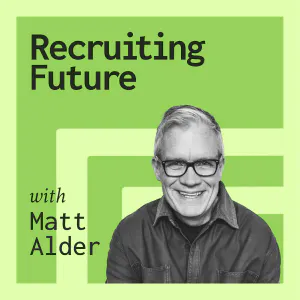
Talent acquisition is undergoing unprecedented disruption as AI, economic uncertainty, and the ever-shortening lifespan of skills radically reshape recruiting. On Recruiting Future, Matt Alder explores this evolving landscape, using insightful interviews with transformational TA practitioners and forward-thinking experts to spark your imagination and provide the insights you need to shape the future of talent acquisition in your organization. Each episode explores topics such as AI, recruiting automation, recruitment marketing, employer branding, skills-based hiring, assessment, candidate experience, DEI, internal mobility, and the transformation of TA teams. Recruiting Future is an essential resource for everyone involved in hiring. Matt Alder is a globally respected talent acquisition futurist, author, and speaker with over 25 years of experience exploring what’s next in recruiting. Renowned for his expertise in strategic foresight and technology trends, Matt provides a unique perspective that empowers leaders to navigate disruption. His deep industry knowledge and ability to spark meaningful conversations make Recruiting Future a must-listen for talent acquisition and HR professionals everywhere.
Pitch Analysis
Required Pod Score for this show. PitchCentric checks your profile against host openness, topical fit, and audience signals before you generate a pitch.
Contact path
Verified email
Booking probability
39%
Guest openness
Selective
Verified email on file
80/100
Required Score
Sign up to generate a grounded pitch for Recruiting Future with Matt Alder - What's Next For Talent Acquisition, HR & Hiring?.
What is Recruiting Future with Matt Alder - What's Next For Talent Acquisition, HR & Hiring??
Recruiting Future with Matt Alder - What's Next For Talent Acquisition, HR & Hiring? is a business podcast hosted by Unknown Host, with 904 episodes on record and a Required Pod Score of 80.
About the host
Unknown Host hosts Recruiting Future with Matt Alder - What's Next For Talent Acquisition, HR & Hiring?, a business show with 904 episodes published.
Our AI reads these to draft pitches. Use them as grounding for a pitch that cites a real guest and a specific topic.
Episode #827
Ep 827: Agent To Agent Recruiting
Sep 23, 202634 min
Recruiting is generating more activity than ever and less connection. Candidates are using AI to produce polished applications at scale, employers are using AI to screen and reach out at scale, and the result is a level of noise that is eroding trust on both sides. More automation applied to the same processes will only make this worse. Solving it means rethinking how matching works, with depth of understanding on both sides and transparency and fairness designed in from the start. So what does that look like in practice? My guest this week is Matt Wilson, Co-founder and CEO of Jack and Jill, whose AI agents work on both sides of the hiring market. In our conversation, Matt shares why supercharging existing processes deepens the noise problem, how transparency and independent auditing build trust in AI matching, and where human judgment remains essential. https://www.linkedin.com/in/matthew-wilson-671a757a/ https://www.jackandjill.ai In the interview, we discuss: Why job hunting is still an inefficient, luck-based process How AI is supercharging broken processes and creating noise on both sides of hiring Building trust in agentic driven processes Bias, fairness, and transparency Challenging deep-seated beliefs about how recruiting gets done Where human judgment remains essential in the hiring process How Jack and Jill manage their own hiring process What does agent-to-agent recruiting mean for the future of hiring? Follow this podcast on Apple Podcasts. Follow this podcast on Spotify.
AI is becoming more embedded across recruiting tools, but there is a meaningful difference between AI that automates workflows behind the scenes and AI that talks directly to candidates. When AI conducts the conversation, the stakes are higher; the first interaction shapes how candidates perceive the employer and the role. That is why many talent acquisition teams remain cautious about AI interviews, even as they adopt AI everywhere else. A growing number of enterprises are now running AI interviews at scale in high-volume hiring, and the data coming back on candidate experience and quality of hire improvements is difficult to ignore. So what does that evidence show, and what should it mean for how the industry thinks about AI in hiring? My guest this week is Dave Vu, Co-Founder and COO of Ribbon, who spent 15 years in talent and people leadership before co-founding the AI interview platform. In our conversation, Dave shares what enterprises are reporting from deploying AI interviews across thousands of candidates, how those candidates are responding, and what this could mean for the future of hiring. In the interview, we discuss: The shift from AI experimentation to enterprise deployment The difference between back-office AI and candidate-facing AI Moving from chatbots to natural conversations The impact on the candidate experience Building candidate trust and AI interviewing Improving speed, efficiency and quality of hire Detecting cheating and protecting interview integrity How will AI interviewing evolve over the next few years Follow this podcast on Apple Podcasts. Follow this podcast on Spotify.
Remote hiring, freely available deepfake tools and harvested identities have created an opportunity that organized criminals are now taking seriously. State-backed operations are training workers to apply for remote roles using stolen credentials and proxy interviewers. The aim is the salary and access to source code, customer data and intellectual property once they are inside. Recruiters are the ones meeting these people first, and in most organizations they are assessing them with a background check and their own judgment while IT, InfoSec and legal are rarely involved. So how seriously should employers be treating this, and what does a credible response look like? My guest this week is Lauren Furey, Principal Product Manager at Proof, where she leads product work on candidate fraud and identity verification. In our conversation, Lauren explains how these attacks work, where hiring processes are most exposed, and what TA teams can do about it. In the interview, we discuss: Bots, deepfakes, identity harvesting and proxy interviewers The criminal motivations behind state-backed infiltration Why the background check is no longer enough on its own How much recruiters overestimate their ability to spot a fake Why remote hiring created the gaps bad actors exploit Building identity continuity through the hiring process Making fraud prevention a shared responsibility with IT and InfoSec The candidate experience trade-off and where to place verification Verifiable credentials and protecting candidates' own identities Practical first steps and what does the future look like? https://www.linkedin.com/in/laurennfurey/ https://www.proof.com Follow this podcast on Apple Podcasts. Follow this podcast on Spotify.
Recruiting Future with Matt Alder - What's Next For Talent Acquisition, HR & Hiring?
Round Up August 2026
Sep 17, 202631 min
If you've not listened to Round Up before, it's a short review of the episodes that I've published in the last month to make sure you don't miss out on the valuable insights that my guests are sharing. This month Round Up returns to its live format, and this is a recording of my live conversation with my guest co-host Rhona Pierce from Workfluencer Media, about six of the episodes published during July and August 2026 Episodes featured in this Round Up: Ep 803: AI Native Recruiting Ep 807: Trust, Transparency And The AI Interview Ep 809: The Data Foundation For AI In Hiring Ep 812: Who Trains The Human In The Loop? https://recruitingfuture.com/2026/07/ep-812-who-trains-the-human-in-the-loop/ Ep 816: Hiring For Judgment In The AI Era https://recruitingfuture.com/2026/08/ep-816-hiring-for-judgment-in-the-ai-era/ Ep 821: Why Every Employer Brand Sounds The Same https://recruitingfuture.com/2026/08/ep-821-why-every-employer-brand-sounds-the-same/
Inside most organizations, the pressure has shifted from proving that AI works to showing what it is worth in cost, productivity and headcount. Some workforce plans are now being decided on that basis before anyone has looked closely at how the work is done. The organizations getting the most from AI are treating it as a question of work design rather than technology. So what does designing work around AI involve, and what does it cost the organizations that skip that step? My guest this week is Matt Campbell, Managing Director at Alvarez & Marsal, where he leads the Talent, Organization & People practice and advises organizations on workforce strategy and organization design. In our conversation, he explains why most AI pilots produce an inconclusive result, a five-stage model of AI's impact on work, the ways organizations misread their own people, and why cutting too far, too fast creates a talent debt. In the interview, we discuss: - Why most AI pilots are designed to prove the wrong thing - Who owns AI? - Why big tech's approach to AI and headcount is the wrong template for everyone else - The difference between a job and a role - The five A's: avoid, assist, augment, automate and autonomous - How to put numbers against cost, productivity and capacity - The four things organizations most often get wrong - Why unauthorized AI use gives employees the benefit and the organization the risk - Talent debt and the cost of cutting too far, too fast - Are you designing work around AI, and what does the future look like?
Every question we get asked before someone starts their trial.
If you have a concern about deliverability, AI quality, data privacy, or whether this will actually work for your specific situation, it's probably answered below.
What is the difference between Founder Solo and Founder Pro?
Founder Solo gives you 50 AI pitches per month using the credit model (Standard pitches cost 1 credit, Enriched pitches cost 2). Founder Pro raises that to 200 credits per month and adds full Booking Probability access, unlimited Magic Match, Apollo enrichment credits, and data export capabilities. Both plans use the same credit system, so you can stretch your monthly budget further by using Standard-mode drafting.
How do agency tiers work?
Agency tiers have no base fee. You pay per managed client and per talent profile. Agency Standard is $199 per client per month; Agency Pro is $399 per client per month. Both add $39 per talent profile per month. Your own team's user seats are always free.
What is a talent profile?
A talent profile represents one person (founder, executive, or spokesperson) you are booking onto podcasts. It includes their bio, topics, headshots, and outreach history. Team plans include 5 profiles; agency plans are pay-as-you-go.
Can I switch plans later?
Yes, at any time. Upgrades take effect immediately; downgrades apply at the end of the current billing period. Contact support if you need help migrating between plan families.
Do you offer a free trial?
Every paid plan includes a 15-day free trial. Your card is saved at signup but you will not be charged until day 16. Cancel any time from your dashboard.
What happens if I cancel?
You keep access until the end of your current billing period. No charges after that. Your data is retained for 30 days in case you reactivate.
Is the 20% annual discount automatic?
Yes. Select Annual on the pricing toggle and the discounted price is applied automatically at checkout. The annual price shown is the full year cost.
What if I have more than 50 profiles or 20 clients?
That is our Enterprise tier. Contact our sales team and we will build a custom plan with volume pricing, a dedicated account manager, and SLA guarantees.