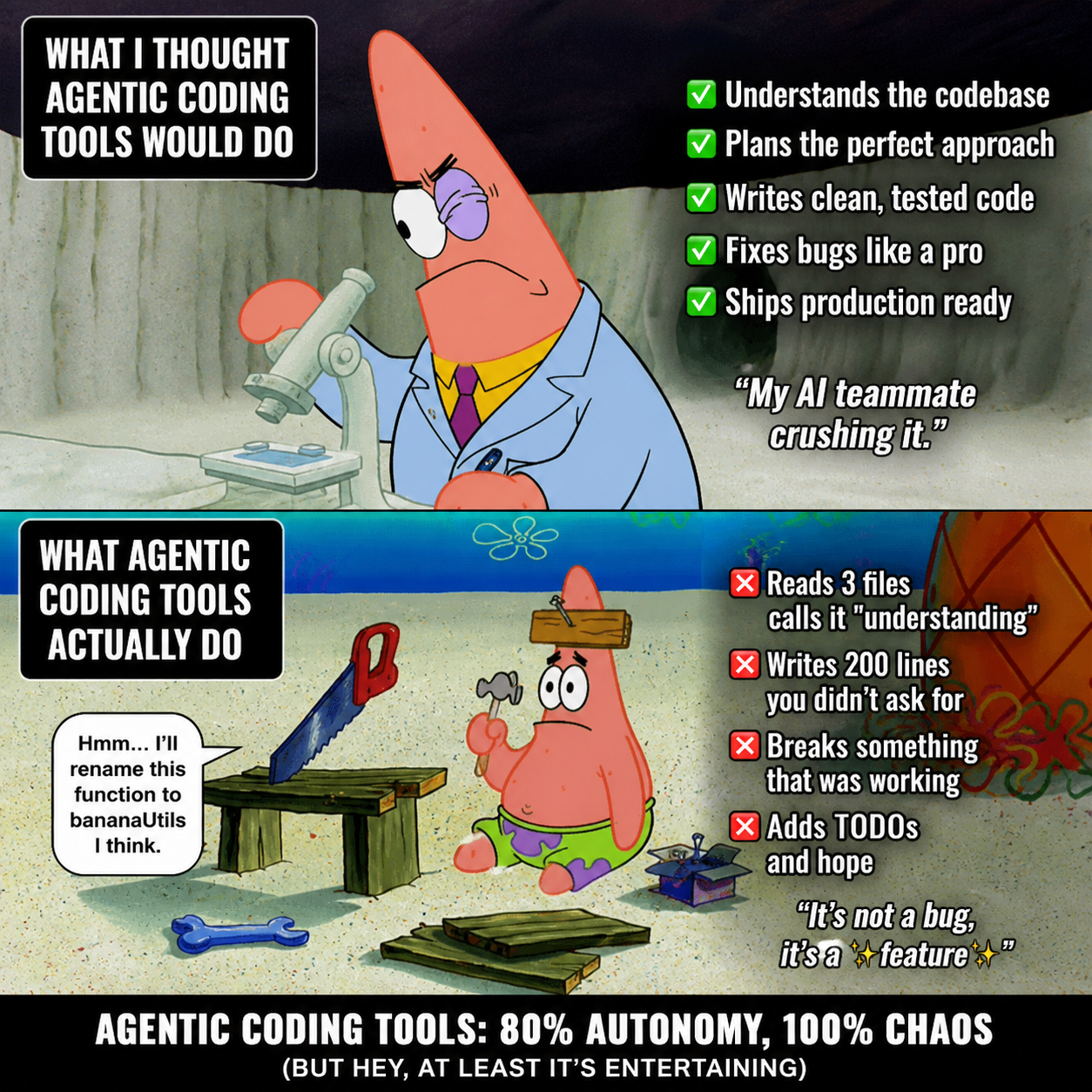
187: Agentic Coding
In this episode, Patrick and Jason cover Agentic Coding!

Hosted by Patrick Wheeler and Jason Gauci · 🇺🇸 US · EN-US · 188 episodes
Established thought leaders with verified media credentials.
Programming Throwdown educates Computer Scientists and Software Engineers on a cavalcade of programming and tech topics. Every show will cover a new programming language, so listeners will be able to speak intelligently about any programming language.
Patrick Wheeler and Jason Gauci hosts Programming Throwdown, a education show with 188 episodes published.

In this episode, Patrick and Jason cover Agentic Coding!

Patrick and Jason discuss what it means to become a manager and how the role differs from individual engineering work. They cover hiring, coaching, performance management, team goals, and when moving into management is o

Patrick and Jason break down workflow orchestrators and why they matter for batch jobs, long-running tasks, and resumable distributed systems. They compare tools such as Airflow, Dagster, Temporal, Ray, and Kubeflow whil

Patrick and Jason explain asynchronous programming and how it differs from traditional multithreading and multiprocessing. They cover coroutines, blocking versus non-blocking operations, promises, callbacks, async/await,

Patrick and Jason are joined by Mark Cunningham to discuss how software engineers can find strong job opportunities and perform well throughout the interview process. They cover sourcing strategies, reverse interviews, n

Patrick and Jason discuss how AI-assisted coding tools can speed up development, answer questions about a codebase, and reduce boilerplate work. They compare common workflows and tools such as Copilot, Cursor, and comman

Patrick and Jason cover memory management from both the operating-system and language-runtime perspectives. They discuss heap management, virtual memory, garbage collection, ownership models, and practical techniques for

Patrick and Jason introduce reinforcement learning and place it alongside supervised and unsupervised learning. They cover Q-learning, SARSA, policy gradients, actor-critic methods, PPO, imitation learning, and why train

Patrick and Jason discuss project planning and management for software teams. They cover why planning matters, how frameworks like SMART goals, Gantt charts, Scrum, Agile, and Kanban fit together, and how to deal with un

Patrick and Jason revisit working from home and the realities of remote engineering work. They cover communication, scheduling, home-office setup, motivation, distractions, and why remote work is not equally effective fo

Patrick and Jason explain vector databases by starting with embeddings, similarity metrics, and approximate nearest-neighbor search. They discuss how these systems store and query high-dimensional vectors and where tools

James Morse: Software Engineer at Cisco System Administrator to DevOps Difference between DevOps and MLOps Getting Started with DevOps Luke Marsden: CEO of Helix ML How to start a business at 15 years old BTRFS vs ZFS ML

Patrick and Jason discuss how to write a strong technical resume that gets attention without becoming bloated or misleading. They cover what to include, what to avoid, how automated screening changes resume writing, and

Patrick and Jason explain DevOps and how it relates to site reliability, build systems, testing infrastructure, and release processes. They cover infrastructure as code, CI/CD, deployment strategies, operational metrics,

Patrick and Jason discuss unit testing, regression testing, and system testing, with a focus on when mocking actually helps. They explain mocks versus fakes, testing tradeoffs, and the practical role of testing libraries

Patrick and Jason explain transformers and large language models from the ground up. They cover attention, encoders and decoders, self-supervised learning, RLHF, and the key architectural ideas that made modern LLMs poss

Patrick and Jason walk through the differences between compilers and interpreters, starting from machine code and assembly and moving up to high-level languages. They cover bytecode, JIT compilation, intermediate represe

Predictions: Jason VR for Work Lowering AI training cost/ improved efficiency RISC-V takeoff Patrick Ai claim of AGI Ai peer reviewer Ai Video Generator More space vehicles reaching orbit Early career, finding role at FA

Patrick and Jason explain HyperLogLog and the broader problem of estimating cardinality efficiently at scale. They walk through the ideas behind Linear Counting, LogLog, and HyperLogLog, including how these probabilistic

Patrick and Jason discuss the Godot game engine and what a game engine actually provides to developers. They cover graphics, physics, scripting, portability, rapid prototyping, and why Godot has become an appealing open-
Sponsor detection runs nightly. Check back soon.
No public pitch examples yet for this show.
Generate your own personalised pitchBased on semantic analysis of episode topics and host coverage, this show is a strong guest fit for executives in:
Industry fit is computed by PitchCentric using vector embeddings of the show's episode catalog.
Shows with the most semantically similar episode content. Pitch one, pitch all; producers cluster.


Programming Throwdown has a verified contact on file. Create a free PitchCentric account to access it and generate a personalised pitch in seconds. Research at least 3 recent episodes first and lead with a specific angle that serves their education audience.
Programming Throwdown is hosted by Patrick Wheeler and Jason Gauci. The show is categorised under education (news) and has published 188 episodes.
Programming Throwdown has published 188 episodes.
Programming Throwdown regularly covers education, news, how to. It sits in the education category, with a news focus.
Programming Throwdown is accessible for guests with genuine education expertise. A personalised, episode-aware pitch will still outperform a generic one every time.
Programming Throwdown hasn't explicitly signalled guest openness in recent episodes. That doesn't rule out pitching. your hook just needs to be especially compelling and relevant to their recent content.
Episodes of Programming Throwdown average 97 minutes, giving guests a long-form format with plenty of time to expand on their expertise.
Our data rates Programming Throwdown's guest bar at 84/100 (Premium tier). Established thought leaders with verified media credentials. Sign in to PitchCentric to see how your own Pod Score compares against this show.
Methodology. Booking Probability™ blends Listen Score, 30-day Virality, open-to-guests detection, and Apple ratings. Data refreshed every 60 minutes. Listen Score and Booking Probability are calculated by PitchCentric. Last enriched yesterday.