Podcast - SURF MASTERY
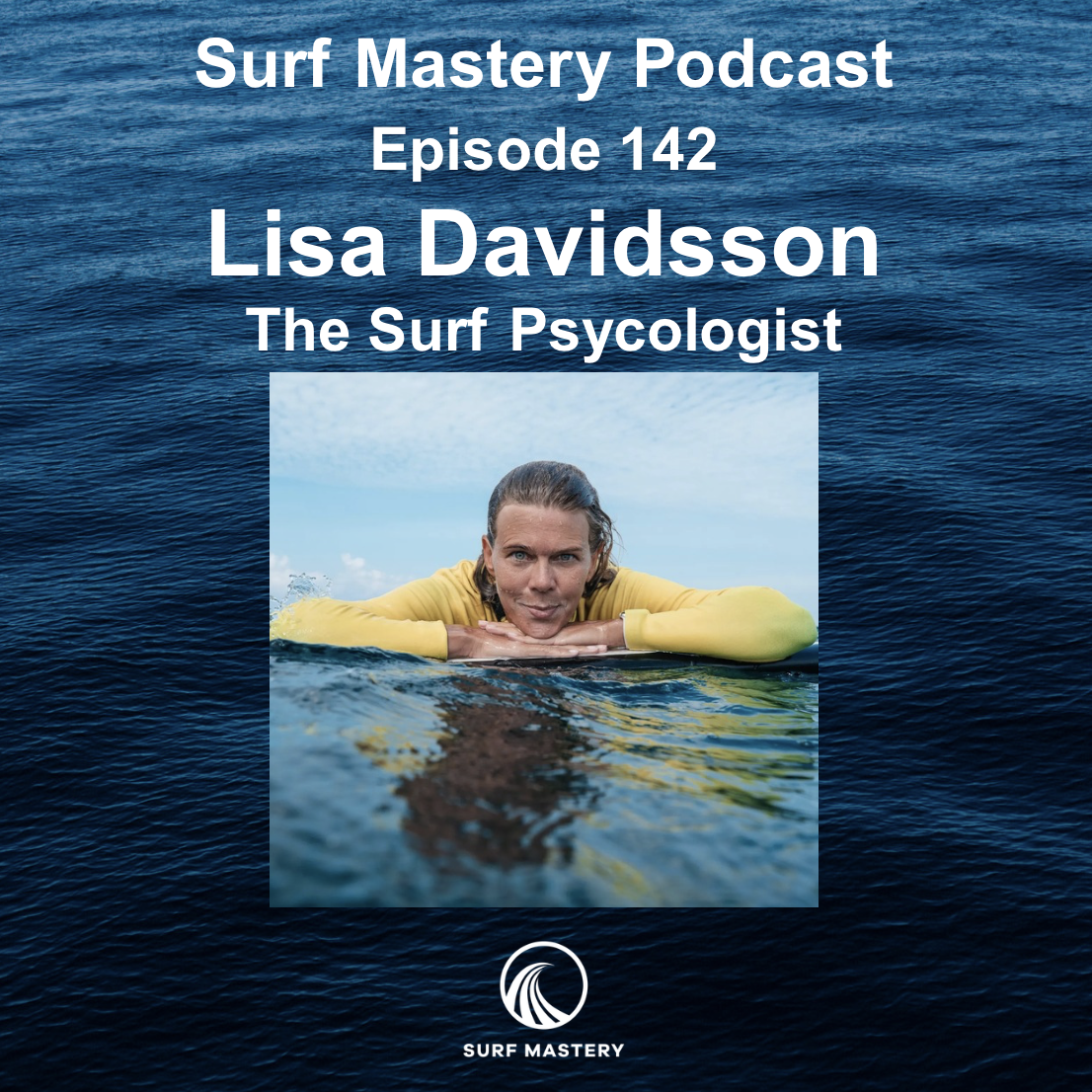
142 Surfing Is Meant to Be Experienced: Lisa Davidsson on Fear, Progress, and Self-Mastery
142 Surfing Is Meant to Be Experienced: Lisa Davidson on Fear, Progress, and Self-Mastery Surf Mastery Podcast Download What if becoming a better surfer has less to do with technique, and more to do with how you handle fear, frustration, pressure, and the need to perform? Surfing has a way of exposing what’s happening between your ears. You can spend years improving your technique and still find yourself frustrated by slow progress, intimidated by bigger waves, comparing yourself to other surfers, or turning a bad session into a judgment about your ability. In this episode, surf psychologist Lisa Davidson explores the intersection of psychology, sport, and surfing. Lisa explains how shifting your relationship with performance can help you enjoy the ocean more, navigate fear more effectively, and keep progressing without making every session a test of your self-worth. In this episode, you’ll discover: How to shift your focus from outcomes you can’t control to the process, habits, and actions you can control. How to interrupt frustration and overthinking in the lineup by reconnecting with your senses and bringing yourself back into the present moment. Why making room for fun, play, and pressure-free surf sessions can strengthen your motivation, confidence, and long-term relationship with surfing. Press play to learn how to work with your mind, not against it, so you can handle fear and frustration, enjoy the process of improving, and experience more of what surfing has to offer. https://thesurfpsychologist.com/ https://www.instagram.com/thesurfpsychologist/ Transcript: SMP142LisaD Lisa: Yes, let's do it. Let's do it. Host: I wanted to start by just reading to you some of your own words. Oh, excellent. Says on, on your, on your w- on your website here- Mm ... uh, you're a licensed psychologist and hypnotherapist as well as a surfer. Um, mm-hmm. It, the, so the first paragraph you've written here, it says, "I didn't grow up surfing. I found the ocea- Yes ... "i found the ocean as an adult after years of studying the human mind and working in mental health with clinical neuropsychology and behavioral change. Lisa: But long before I ever picked up a board, two threads were already shaping my life: a deep curiosity about how the brain works, and a love for sport as a path to self-mastery." Yes. That's quite a paragraph. Right. Right. I guess you want me to comment on that. First, I wanna say that I'm actually not a clinical psychologist, so I'm not a licensed psychologist as that. But I do have my master's, and it's in clinical neuropsychology. That's what I focused on. Okay. So just a slight correction there. That line, I was working hard on that one. But it's, uh, it came to me when I was, thinking about, like, what is it that I actually do, you know? Like, what is it, what's the essence of the work that I wanna, or the services that I wanna provide for people, and what do I think is really fascinating about the intersection of, you know, therapy, you know, psychology and sports,, and, , how I wanna help people. Which is really sits right there. How can you get to know yourself and understand yourself and show up better for yourself in life, but through your sport, through mastering an activity, how does that help me see certain parts of myself and come into contact with certain parts of myself? And how can I, you know, tweak those parts, , to show up better and perform better, basically? Host: Okay, so, so your love for psychology and the human brain came before surfing. So- Yes ... is it something that you studied after high school? Or during high school? Lisa: Yes. So I, , yeah, I didn't study it in high school, but I I started with my bachelor's in, when was that? Early 2000s. 2004 I might have started that my dad is a psychologist, I can add that. So that's... it's been... But I've always been a person who thinks a lot and wants to understand what other people, , are doing. But mainly from the perspective of, like, myself, my emotions, how, how I am being, , affected, met, you know, interact with other people, and to just, like, understand. But I think it comes from some- like, more from a philosophical point of view, as in, , how do I understand life? ... What is important in life in order to live a good one, a happy one, ? And what is even a happy life, ? Deep questions. Yes. So I would say it start, like if the thread started really early, it started, , reading and reading, 'Cause through, 'cause, , my love for literature has been with me , my entire life, and I think it's the stories of people and how we, uh, yeah, love and life through, through literature. And, and I also read a bunch of philosophy when I was young, you know, teenage years, to, to kind of- Delve into these questions Mm-hmm. Um- Hmm ... and then from there it grew into psychology as in like, and yeah, human behavior and how the brain works, 'cause I'm, you know, always been sort of a person who, the science-based and like these like, yeah, more interesting, like, or like quite hands-on and physical than more than philosophical, I guess. So- Yeah ... in neuropsychology, sort of the more that thread when it comes to psychology, I guess. I don't know. Okay. But it also shifted into more of a, you know, other things later in life that are perhaps less, less structured, less research less, and more holistic, and yeah. Mm-hmm. So. Well, be- before we get to surfing- Mm-hmm Host: at the end of that little paragraph I just read, it says, obviously a deep curiosity for how the brain works, you went into studying that. Yeah. But you also say here, and the, this is before you even discovered surfing, a love for sport as a path to self-mastery, and then you go on to mention horse riding. Lisa: Now, is ho- Yes ... is horse, is, was horse riding sort of, h- h- how does- That was the sport. Yeah. That was that thread, yes. Exactly. Yeah, I, uh, I pretty much grew up on, on horseback. I started when I was eight. I had my own pony a- and all of it, you know? So from the age of 10, I think I spent every day in the stables, training, trying to, , qualify for the Sw- you know, Swedish championships and the European championships and things like that. , So that was the work that I was putting. It was more important than anything else in my life, ? I had my eyes set on the Olympics. That's where I wanted to go. , But yeah, it, I didn't And you mentioned your father had a history of psychology. , Was he helping you in that regards as y- when you were involved with horses? , Was h- was he inkling towards sports psychology at all, or was that something you discovered yourself, or? No, that was me, myself. No, he's always been more from the, social, aspect of things, working with this, social system in Sweden and working with, , foster families and children and adolescents placed out of the s- home, institutions and things like that. So always been coming at it from much more of that side, and disabilities and, a- and things like that, much more than the self-mastery sort of, you know, performance sports side of things. He's always been into sports, but, , yeah, work-wise. And that's also the work that we did, 'cause then later I, , worked for the family business, which was running those types of facilities and Work, yeah Okay, so you've been in the trenches a little bit, psychologically- Yes ... wise as well by the sounds. Yes, it's pretty, it's pretty tough work. It's, , you know, working with teenagers who, who are on the neur- you know, like neurodivergent teenagers who had horrible upbringings and situations in life, and then to, , get through to them, to support them and create, you know, wanting to create these changes in their lives that they are really struggling to do because of how they grew up and also the, the neurological compositions they have that creates, makes life more challenging as well. So that's, uh, that's really, really hard work. And, and from there to, to work with, with surfers, it feels a bit of a, it's a bit of a breeze. It's like, it's a bit lighter, which is, uh, what I like. Yeah, I don't, I don't wanna work that clinically anymore. , I've done enough of it. I've done my years. Yes. , Host: Yeah. So when did surfing come into the picture? Lisa: It came in my early 30s. , I did a semester, or about a year of studies. I did one semester of studies, but I did a, a year in San Diego, San Diego, California, and tried a bit of surfing then. And then a few, like one or two, three years later after I was there for school, I kept coming back 'cause I really loved, I loved the life in San Diego and I was, you know, searching for a way to not be in Sweden pretty much. And I spent one summer there and decided to, to learn to surf. And then I stuck with it. I guess I found that, that thing in my life to pour my energy and self-mastery into, you know? It's, , I believe also that is one of the bigger corner stores, cornerstones of the good life is to have something that is not your, your relationships, and that is not your work, and that is, , for you, something to, that you can pour energy and, and love and meaning into. Host: Yeah. So it was horses. Lisa: Exactly. It was horses, and then it was, triathlons for a little bit, and then surfing. Mm-hmm. But, I think the triathlons was a little bit, , coexisting with the surfing while I was sort of landlocked in Sweden for a while. Or I wasn't landlocked, like it's close to the ocean, but there's no waves that are- Mm-hmm particularly interesting. A lot of Swedish surfers would be upset with me for saying that, but All three of them. Yes, exactly. , But I think for a long time there was a, there was a big gap when I didn't really, you know, um, commit to any sport because it was basically from late high school years and those first years of uni and education and all of that. I didn't really have that because basically my social life , and studies took up, and work took up all of that, 'cause, 'cause I pretty much worked continuously through my studies as well. So then I didn't have room for it. But it was, , I did lack that part in my life. It was too much, too much work and too much studies. It, it didn't go very well. Like ended up- Hmm ... you know, with burnout and all of those kinds of lovely things. Host: So. How, how far or how deep into your surfing journey did you realize that surfing was that thing that was gonna replace the, the horses, let's say? Lisa: I mean, I th- yeah, when I like consciously realized it, I was probably, you know, five years in or something, , because I just hadn't reflected on it from that perspective necessarily. , But I think people around me saw it and my family saw it way earlier. You know, like when you pack your bags and, and move to Bali and decide to, to live here, you know, really, really on the other side of the planet for, uh, surfing was the reason I picked here, you know. I was gonna move somewhere for sure, but yeah, that was the... , and when we sold our family business and I, I couldn't work for a year and, , 'cause I had a non-compete and everything. So then I was like, "Okay, let's see what I wanna do," and I just went on a round the world surf trip. So and that was pretty early. I think I'd only surfed for like one or like two, two years or something. And then obviously I wasn't living next to the... co- to surf, so I was one of those who only surfed when I traveled , and things like that. So- That kind of dedication, , was already there. Yeah. Host: How would you describe your current relationship to surfing in the ocean, and how has it evolved over the years? Lisa: . I mean, now it's also my work, right? So it gets a little bit more complicated when, when you mix in those elements, because it's no longer just for me. Like, there's elements of me being out there that sometimes feel like I'm, I'm in the office, you know? As in, like, um, watching for behaviors. I'm, I'm noticing things and I have thoughts about it and I'm like, "Oh, should I make a reel about that?" You know, like so it's not, it's not completely just, , that joy and freedom and personal pursuit for me. Like, it's a... Anymore. So I would say that's how it, uh, how it shifted into that, where it is that. And if we go to it more currently, as in, like, it's not my highest priority. My highest priority is my work and, and building my business, and then after that comes surf. So I still surf a bit, but I'm currently with it as in like, uh, I kinda just go to, yeah, to just get away a little bit, to have spent some time with myself and to be in the water and to move around. So I'm currently not in a, in a place where I'm, you know, trying to get a whole lot better or where I'm working on techniques or where it has that sort of place for me that's not very active. Like, that comes and goes a little bit for me. And, and when it goes, it goes into the place where it's, um, I would say recovery. , Where it gives me, um, you know, reconnects with myself and with, you know, being present a- and not, you know, distracted by all of these other things. So it's, then it becomes that balancing force in my life where I just get to take a sigh of, of relief and just be for a bit. And then I don't like to put the element of trying to get better or trying to perfect, trying to perform into that, you know? , So yeah. I would say that. It's there. , So you're, are, are you saying you're not trying to improve your surfing at the moment? No, not at the moment. But we're talking about, like, this will maybe go on for, like, a few weeks where that's not... But I still kind of, yeah, I'm not working super actively towards that, uh, technique wise. I am working on surfing, being comfortable with surfing bigger waves. So, but that is not, like, a... For me, that's not, like, a performance element. It's a, it's an element of, you know, self-regulation and, um, what else should I kind of... Yeah, it's more of a sort, yeah, more of the self-mastery than, I guess, like, how do I, how do I control my fear? How do I approach something consciously? So sure, there, there's still elements of pressure in, in showing up and doing all of this, but it's not so much like, "Oh, I need to get so much better at surfing." I know there's, there's still an element there of, um, getting better at something. So I would say that's kind of what I'm working on, but I'm taking it very slow with it because I can't, don't have the, the mental space to put a lot of energy into it, 'cause I'm putting a lot of energy into my work and building my business and- Mm Host: other things. Yeah. What, what's harder to read: the ocean or a horse? The ocean Lisa: Much harder ... yes. Are there, do you think there's similarities? Because the thing is with most sports- Mm ... the, the playground is static. Yeah. It's always the same. Yeah. Surfing is obviously it's never the same- Mm ... ever, in any way almost. Mm. And I, I imagine a horse sort of is somewhere in between? Yeah. It's probably somewhere in between. You're right. But I feel like I've always had a really good connection w- especially with my horse, you know? Like, I could arrive at the stables a- and, and my horse, pony knows it and comes galloping. You know, like, I show... You know. So there's, there's always been sort of a, deeper connection there when I can know and feel what's, what's going on, which can sound a little woo woo, but that's how I experi- that's my experience. So whether that's what that's based in, I don't know. , But yeah, of course. I would say for me the elements of that was more like, 'Cause, , it's not a machine. It's, it's a horse that, , gets injured and has, has its things, , and doesn't want certain days. So it's like more that, that element of surrendering to that a little bit, as in there's not all parts that you can control. , You don't... You can to s- more extent than you can control the ocean, but there's an element that you just have to accept and, and work with, you know? Mm. I think that's perhaps the, the biggest- Point, 'cause that also re- , relates back to yourself, right? As in how do I relate to that element, because I can't change it. You know? Like, I can't change the ocean, and I can't change my horse as much either. You know? Like, I can influence it a bit more than I can influence the ocean, but what I can really do is work on how do I relate to it. Do I keep getting frustrated every time the conditions aren't the way I want 'em to, or do I just do what I can, yeah, so managing your own expectations. Yeah. And- And manage how you relate and look at those things, because it's not, it's more than expectations, I would say. It's, yeah. Say, say more about that. It's more than- Well, I mean, expectations is sort of like, okay, I can't expect this or that, but it's also, like, how, how do I feel about the fact that I can't control certain things, what comes up in me when I can't really control the outcome of something, you know? There's a sense of vulnerability there, especially i- in a place where you're trying, if you're really trying to get better at something. And what does getting better at something , mean for you? And then that is sort of exposed in, in that, in that element. So I believe it, it hits, like, deeper notes sometimes. Host: Hmm. Yeah, so what does getting better mean for you? Lisa: For me, it's, that's a, a journey that's, evolved through all of this. In the beginning, and I think o- what, if we look at the horse part, I definitely had a very, very strong attachment between my results and how I felt about myself and who I was, and that, that extended into, academics and school and everything. , Results, it was everything. , If you're not delivering your shit, you know, like, you're not worth anything. Like, all of this work was for nothing and blah blah blah. Your whole life is, you can throw it in the bin, ? And so going from, from that into now, it still shows up for me, that sense of, oh, if I'm not g- good enough, like, I c- I can, you know, be a bit critical of myself and hard on myself, but not at all the same way I, I used to. And I am shifting. But for me, it was not necessar- with surfing, it wasn't necessarily as much as, , being able to surf really well, 'cause also I started in my 30s, so I know that I, I don't think I'll consider myself as ever being able to surf really well. But for me, it's more like how do I show up for it, If I really want something, do I put in the time? And so I- I'm more judgmental around myself i- in that, and, and also a little bit about when it comes to being tough and, and brave, , to charge. That's sort of more of a, a, an area where I can be a little bit hard on myself and look at it from a pers- performance sort of angle where I'm like, oh, not, not good enough. But I've also let go mostly of that, and, uh, then I lean into to the parts of, , the enjoyment of it. Like, why... 'Cause I'm not out there to become the best of the best. I am out there to work on things, to, to be in a process of trying to get better at something that's really hard, and every time I go, I am doing that. So, you know, there's a s- success just by, by going out, you know? Yeah, I love that. And you, you kind of already answered that question the way you said you were trying to, , learn to surf bigger waves. Mm. What's been your, your strongest barrier there? To going out surfing bigger waves? Oh, 'cause it's shit fucking scary. Like, I... is, you know, I had some experiences early, early on in my surf career when you don't really know better and you go out and you just get, like, pummeled and dragged and held under. And, like, there was a moment where I was like, ", I don't know if I'm gonna survive this," ? And if you've had an experience like that, that sticks with you a little bit. I'm worked a lot to, to, uh, not let that stop me, but it's still there to some point, you know? So sometimes I can get a littl