
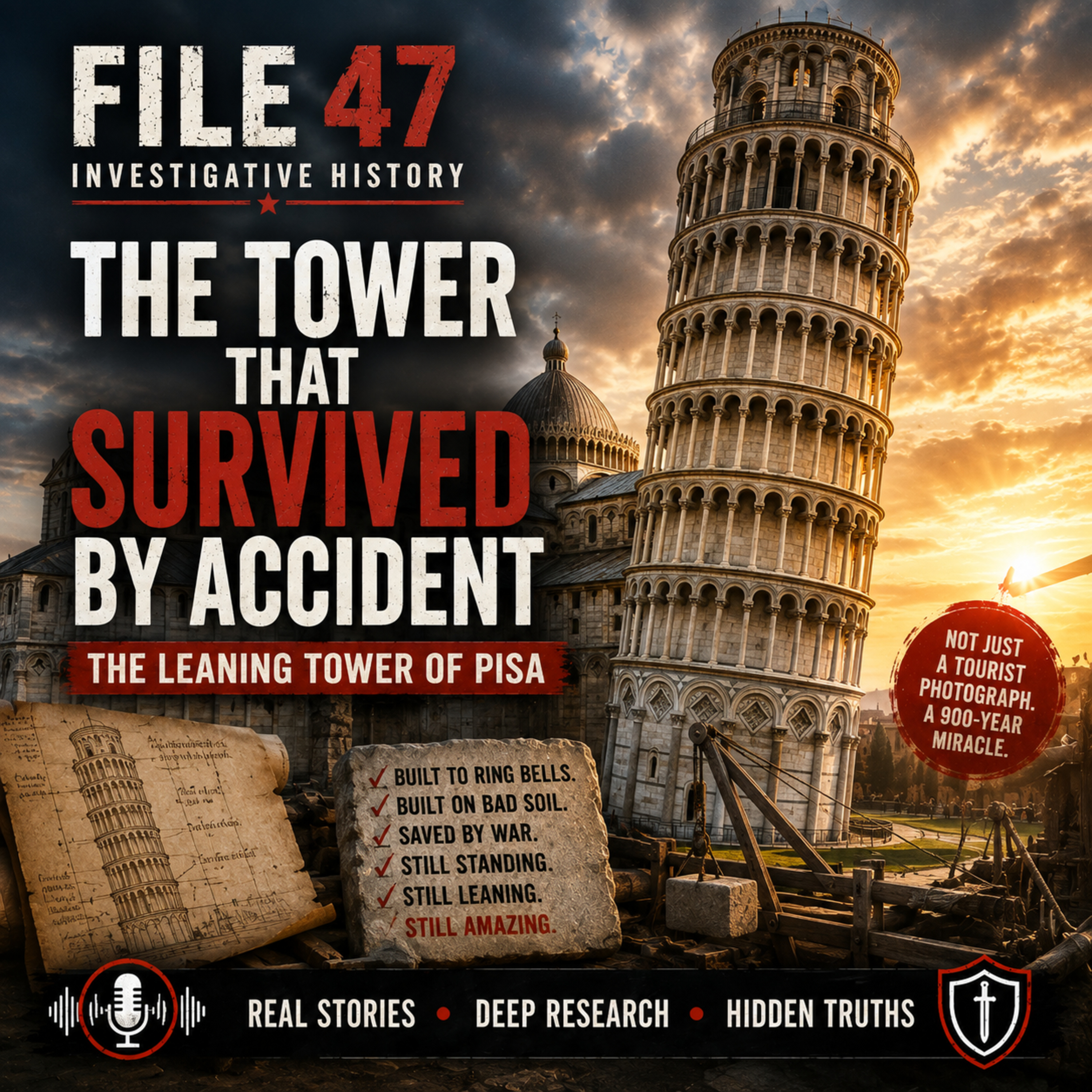
File 47: Investigative History Podcast
The Tower That Survived by Accident: The Leaning Tower of Pisa
On August 9, 1173, construction began on a bell tower for the cathedral complex in Pisa, Italy. The foundation was three meters deep — approximately ten feet — set into a mixture of clay, fine sand, and shells on the southern bank of the Arno River. By the time the builders reached the third floor, approximately five years later, the tower had already begun to tilt. They stopped building. Not because they had noticed the tilt, although they had. They stopped because Pisa had gone to war with Genoa, and war required resources and attention that a bell tower did not. Construction halted for nearly a century — 99 years, by most accounts — before resuming in 1272. Those 99 years of war and abandonment saved the tower. Engineers analyzing the tower's survival in the twentieth century established what the medieval builders could not have known: the soft, waterlogged soil beneath the foundation needed decades to compress under the existing weight before it could bear the weight of additional floors. If construction had proceeded continuously, the tower would almost certainly have collapsed before it was finished. The wars with Genoa, Lucca, and Florence that repeatedly interrupted construction — events entirely unrelated to any decision about the tower — were the mechanism that preserved it. This is not the story most people know about the Leaning Tower of Pisa. The story most people know is: it leans because of soft soil, Galileo dropped cannonballs from it to demonstrate the principle of gravitational acceleration, and in the 1990s engineers stabilized it. The soft soil part is accurate. The Galileo story is almost certainly a legend invented by his disciple twelve years after Galileo's death, published 75 years after the supposed event, with no contemporary corroboration and no mention in Galileo's own writings. And the 1990s stabilization — which is presented as a triumph of modern engineering — nearly caused the catastrophic collapse it was designed to prevent, when a soil-freezing attempt in 1995 caused the tower to lurch more in a few days than it had in the previous year. Subscribe wherever you get podcasts. Companion article on Medium, linked in show notes.