Welcome to Optimizing Beyond , the podcast for people who refuse to settle and are ready to grow, stretch, and challenge their thinking. Hosted by Josh Negron β entrepreneur, leader, and lifelong student of growth β this show explores how to optimize every corner of life: fitness, longevity, leadership, business, psychology, health, nutrition, technology, culture, faith, and more. Every week, Josh shares lessons drawn from years of experimenting, habit stacking, and pushing beyond his own limits. Episodes are designed to leave you with one actionable step to implement right now, and one idea to wrestle with long after the episode ends. Whether youβre chasing one percent improvements or searching for breakthroughs, Optimizing Beyond equips you to move past comfort, embrace growth, and build a life worth living.
Pitch Analysis
Required Pod Score for this show. PitchCentric checks your profile against host openness, topical fit, and audience signals before you generate a pitch.
Contact path
Public web form
Booking probability
30%
Guest openness
Selective
80/100
Required Score
Sign up to generate a grounded pitch for Optimizing Beyond.
Optimizing Beyond is a business podcast hosted by Unknown Host, with 0 episodes on record and a Required Pod Score of 80. PitchCentric scores this show on Booking Probability, Listen Score, and live audience signals refreshed every 24 hours.
About the host
Unknown Host hosts Optimizing Beyond, a business show with 0 episodes published.
Our AI reads these to draft pitches. Use them as grounding for a pitch that cites a real guest and a specific topic.
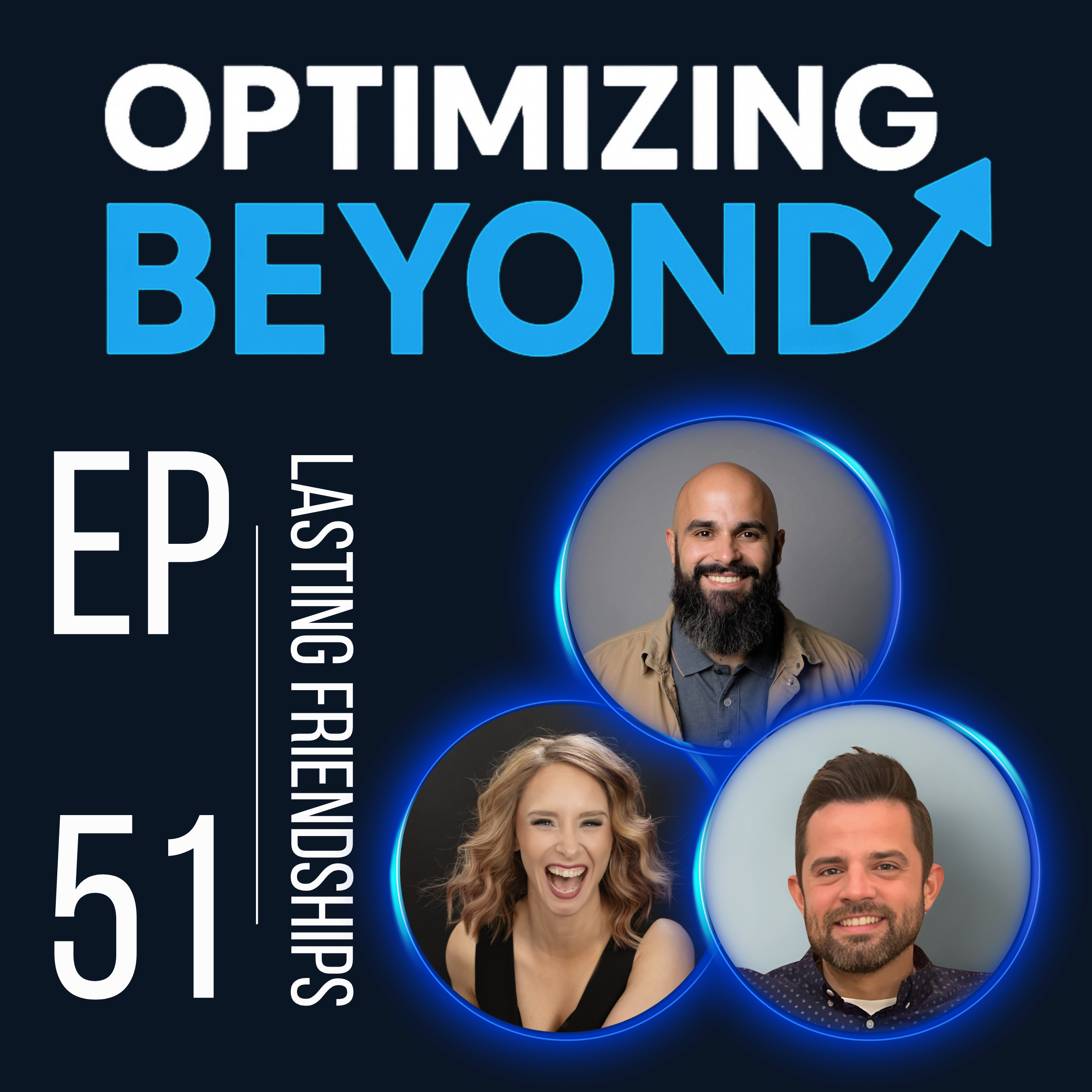
Episode #51
The Friendships That Last (Part 1): Eric Dwyer on Grief, Adaptability, and Love After Loss | Ft. Eric Dwyer & Ashley Negron
Sep 2, 202639 min
Some friendships survive every season β job changes, marriages, loss, grief. This episode is a front-row seat to one of them. Eric Dwyer β pastor, former foster parent, widower β joins Josh and Ashley for a wide-ranging conversation that started as a weekend hangout and turned into something worth sharing. They cover ground that's hard to fake: why some friendships built in college survive decades of distance and life change while others quietly disappear, what it actually feels like to receive condolences after devastating loss, how a father and his 12-year-old daughter navigate grief together in the same house, and why the love you used to give someone doesn't disappear when they're gone β it just becomes available for someone else. There's no framework here. Just three people who've known each other for over twenty years, talking honestly about what it takes to keep showing up for each other through the hardest seasons of life. In This Episode: Why some college friendships survive every season while others fade β and the specific commitment to intentionality that separates the ones that last Acting on small prompts: the habit of texting someone the moment they cross your mind, even after years of silence, and why Josh has never once regretted it How to reach out when you don't know what to say β Eric's perspective on receiving imperfect condolences and choosing to hear the love underneath the awkward words Eric and his daughter Cadence's phrase for the hard days: "I really miss mom a lot today" β and how naming it simply created space for both of them to feel it without explanation The love abundance mindset after loss: love doesn't disappear when someone dies β it becomes available for the people still in the room Why fighting grief makes it worse β the "uninvited guest" wisdom Eric received, and what sitting with it instead actually looks like How Josh and Ashley discovered they grieve differently β same loss, different timing, different triggers, and what that required of each other The empty chair: what it feels like for the couples friendships around Eric to recalibrate, and why the best friendships adapt into the next season rather than stopping at the edge of it Related Episodes: When Life's Not Optimal with Eric Dwyer (Ep 15) Optimize Through Grief (Ep 18) Optimize Friendships (Ep 20)
Identity Is Best: Rewiring the False Beliefs Behind Every Behavior You're Trying to Change
Aug 26, 202636 min
Show Notes: Willpower runs out. Discipline helps β until it doesn't. The missing layer isn't more effort. It's identity. Most people trying to build better habits treat willpower and discipline as the tools. They're not wrong β but they're incomplete. When those run out (and they do), what's underneath either saves you or sinks you: the beliefs baked into your identity about who you are and what you're capable of. Building on the Good, Better, Best framework from Episode 43, Josh makes the case that identity is the most powerful layer of lasting change β and that it works in both directions. The same mechanism that gives you a false belief like "I'm bad with money" or "nothing I do is good enough" can be deliberately reversed over time. Through recognizing false beliefs, applying Glenn Lundy's second-thought principle, and using the Replacement Principle to put truth where the lie used to be, you can start changing not just what you do, but who you believe yourself to be. In This Episode: Why willpower, discipline, and identity aren't competing strategies β they're layered stages, and stopping at discipline leaves you vulnerable when it runs out How to find the false beliefs running your behavior: the negative self-talk that's loudest, the promises you made to yourself after getting hurt, and the scarcity vs. growth lens you inherited without realizing it Glenn Lundy's "second thought" principle applied to identity work β you can't control first thoughts, but the second thought (your response, not your reaction) is where the rewiring happens The Replacement Principle: why subtracting a false belief without putting something in its place leaves a void the brain will fill on its own β and how to choose what goes there instead Breath work, the limbic system, and the prefrontal cortex β why taking a pause before you respond is a physiological strategy, not just a mindset tip Josh's personal exercise: asking 20 people how they saw him, getting 12β15 detailed responses, and having Siri read them daily as ammunition against his own negative self-talk The guilt vs. shame distinction β why the goal isn't to eliminate accountability but to stop attaching failure to your identity ("I did bad" vs. "I am bad") Fear of abandonment as a live example: how one false belief quietly drives conflict avoidance, over-serving, and self-protection β and what it looks like to walk through it instead Related Episodes: The Good, Better, Best Framework (Ep 43) The Power of Morning Routines with Glenn Lundy (Ep 19) Optimize Your Words with Gregg Hull (Ep 31) Resources: οΈ Live Free Podcast by LakePointe Church Atomic Habits by James Clear Extreme Ownership by Jocko Willink The Legacy Titles by Glenn Lundy This description contains affiliate links. If you purchase through them, I may earn a small commission at no extra cost to you.
Understanding Isn't Healing: Why Explaining Your Past Doesn't Fix It β and What Actually Does
Aug 19, 202630 min
You can perfectly explain why a moment from your childhood hurt β and still be wrecked by it today. That gap between knowing and healing is exactly what this episode is about. Most adults doing any kind of self-reflection hit the same wall: logic. They understand why a parent acted a certain way, they see the context, they extend grace. And they expect to feel better. Often they don't. The gap between understanding and healing β between knowing why something hurt and actually being free from it β is where most people get stuck, sometimes for decades. Drawing on his half-completed master's in marriage and family therapy, four-plus years of group therapy work with college students, and his own personal work, Josh makes the case that understanding is the first step, not the finish line. Logic can explain a wound. It cannot clean one. And when people turn that logic on their younger selves β "your dad was just trying to make you better, why did that even affect you?" β they add contempt to an open wound instead of closing it. The alternative is approaching your younger self with the same compassion you'd give an actual hurting child standing in front of you: with curiosity, patience, and the recognition that what you felt was completely real. In This Episode: Why getting the full context and forgiving the people involved still leaves you reacting the same way when similar scenarios show up in adulthood β understanding is necessary, but it is not sufficient "Throwing contempt backwards": the specific trap of using adult logic to scold your younger self ("you pansy, why did that even hurt you?") and why it deepens wounds instead of closing them Why unresolved childhood trauma stays emotionally frozen at the age it happened β and why a fully grown adult can respond like a 7-year-old when the right scenario bumps against those old wounds Two things that can be absolutely true at the same time: a parent who loved you can have genuinely hurt you β and recognizing those moments of responsibility isn't the same as assigning 100% blame The "10 earliest memories" exercise: how to surface the wounds you've been avoiding, including Josh's personal example of a restaurant moment from childhood that wired a quiet, lasting anxiety into every unfamiliar place he enters Kevin Whisman's reframe of trauma from Episode 27: it isn't only something bad that happened β it can also be something good that should have happened but never did Why handwriting unlocks different memories and facets of an experience than typing or thinking out loud β and how to use it in the exercise The Ted Lasso Season 3 scene where Ted confronts his mom β "thank you for... and f*** you for..." β as a real example of holding appreciation and honest hurt at the same time without either canceling the other Related Episodes: Rewriting Stories with Kevin Whisman (Ep 27) Three Life Lessons (Ep 12) When You Feed (Ep 14)
To Love Is to Be Vulnerable: Why Locking Your Heart Away Doesn't Keep It Safe β It Changes It | Ft. Ashley Negron
Aug 12, 202628 min
A sealed heart doesn't stay preserved β it transforms into something worse. That's the lesson hiding in one of Harry Potter's darkest stories. "The Warlock with the Hairy Heart" from J.K. Rowling's Tales of Beedle the Bard tells the story of a young warlock who uses dark magic to lock away his heart so he can never be hurt. It works β until it doesn't. What he stored in the dark didn't stay preserved. It became something unrecognizable. C.S. Lewis described the same dynamic in The Four Loves : a heart kept "safe" from love eventually becomes "unbreakable, impenetrable, irredeemable." Josh and Ashley use both stories to examine the quieter, more ordinary ways people do the same thing β surface-level friendships, humor and cynicism as armor, staying too busy to be known, and silent vows made after getting badly hurt. They also get into grief, the experience of losing people they loved deeply, why Ashley left social media, and the surprisingly powerful habit of texting someone the moment they come to mind. In This Episode: The Warlock with the Hairy Heart decoded: why refusing vulnerability doesn't preserve you β it transforms you into something you don't recognize C.S. Lewis's full quote from The Four Loves : what he says a sealed heart eventually becomes, and why "impenetrable" isn't actually a win The four ways people emotionally self-protect without realizing it: surface relationships, humor and cynicism as armor, screens and hobbies as substitutes, and staying too busy to connect Jordan Peterson on malevolence β why the warlock's logic isn't irrational, and why bad actors cause damage that sometimes requires a professional to unpack Personal policies built on old wounds: the vows you make to yourself after getting hurt and why uncovering them is some of the most valuable work you can do "Grief is the tax on having loved" β Josh and Ashley on recent loss, who showed up, and why they'd make the same trade every time Ashley on leaving social media: why the algorithm decides who you see, and what real friendship requires that no feed can provide The habit of texting someone the moment they cross your mind β and why it lands the way it does more often than you'd expect Related Episodes: Optimize Friendships (Ep 20) Optimize Through Grief (Ep 18) Always on Offense: World Cup Lessons on Playing to Win (Ep 46)
Own Your Phone: Small Decisions That Add Up to Real Focus
Aug 5, 202615 min
160 phone pickups in one day. Josh found out the hard way β and built a system to fix it. No digital detox, no flip phone β just small, permanent decisions that add up. WHAT YOU'LL LEARN: Why Screen Time is your starting point β and what "data before decisions" really means How to find your lowest hanging fruit: the easiest notifications and apps to cut first The swipe-left trick that kills future notifications without ever opening Settings Why red badges are designed to keep pulling your attention back A weekly app-store habit that clears out apps you forgot you had The one-button email unsubscribe trick that saves hours over time Why texting STOP to marketing texts is a simple, permanent time-saver What grayscale icons do to your brain's pattern recognition β and why some people swear by them How to throttle specific apps and categories with Screen Time limits and Focus modes The psychological cost of a face-up phone at the dinner table Why every pickup should be on purpose, not autopilot β± CHAPTERS: 00:22 Intro: Recording Live from MCO Airport 00:36 Why This Isn't a Digital Detox Episode 01:16 The Moment Your Phone Starts Using You 02:14 Step One: Turn On Screen Time and Just Look 03:17 Data Before Decisions: Finding Your Lowest Hanging Fruit 03:50 Making Permanent Micro Decisions That Compound 04:22 Clearing Red Badges and Notification Traps 05:13 The Swipe-Left Trick to Kill Notifications for Good 06:02 Weekly App Store Audits: Deleting What You Don't Use 06:39 The Email Unsubscribe Method That Saves Hours 07:34 Texting STOP: Cutting Off Marketing Texts for Good 08:23 Grayscale Icons: Making Your Phone Less Fun on Purpose 10:04 Throttling Time: Screen Time Limits and Focus Modes 11:41 Phones at the Dinner Table: Face-Down vs. Face-Up 12:32 Recap: Practical Step After Practical Step 14:04 Final Word: Every Pickup Should Be on Purpose LISTEN/WATCH NEXT: Ep 3 β The Discipline of Focus ft. Solo Episode Ep 38 β The Discipline Trap ft. Solo Episode Ep 5 β Discipline Versus Motivation ft. Solo Episode CONNECT: Instagram Website βΆοΈ YouTube All Episodes #OptimizingBeyond #PhoneHabits #DigitalWellness
Every question we get asked before someone starts their trial.
If you have a concern about deliverability, AI quality, data privacy, or whether this will actually work for your specific situation, it's probably answered below.
What is the difference between Founder Solo and Founder Pro?
Founder Solo gives you 50 AI pitches per month using the credit model (Standard pitches cost 1 credit, Enriched pitches cost 2). Founder Pro raises that to 200 credits per month and adds full Booking Probability access, unlimited Magic Match, Apollo enrichment credits, and data export capabilities. Both plans use the same credit system, so you can stretch your monthly budget further by using Standard-mode drafting.
How do agency tiers work?
Agency tiers have no base fee. You pay per managed client and per talent profile. Agency Standard is $199 per client per month; Agency Pro is $399 per client per month. Both add $39 per talent profile per month. Your own team's user seats are always free.
What is a talent profile?
A talent profile represents one person (founder, executive, or spokesperson) you are booking onto podcasts. It includes their bio, topics, headshots, and outreach history. Team plans include 5 profiles; agency plans are pay-as-you-go.
Can I switch plans later?
Yes, at any time. Upgrades take effect immediately; downgrades apply at the end of the current billing period. Contact support if you need help migrating between plan families.
Do you offer a free trial?
Every paid plan includes a 15-day free trial. Your card is saved at signup but you will not be charged until day 16. Cancel any time from your dashboard.
What happens if I cancel?
You keep access until the end of your current billing period. No charges after that. Your data is retained for 30 days in case you reactivate.
Is the 20% annual discount automatic?
Yes. Select Annual on the pricing toggle and the discounted price is applied automatically at checkout. The annual price shown is the full year cost.
What if I have more than 50 profiles or 20 clients?
That is our Enterprise tier. Contact our sales team and we will build a custom plan with volume pricing, a dedicated account manager, and SLA guarantees.