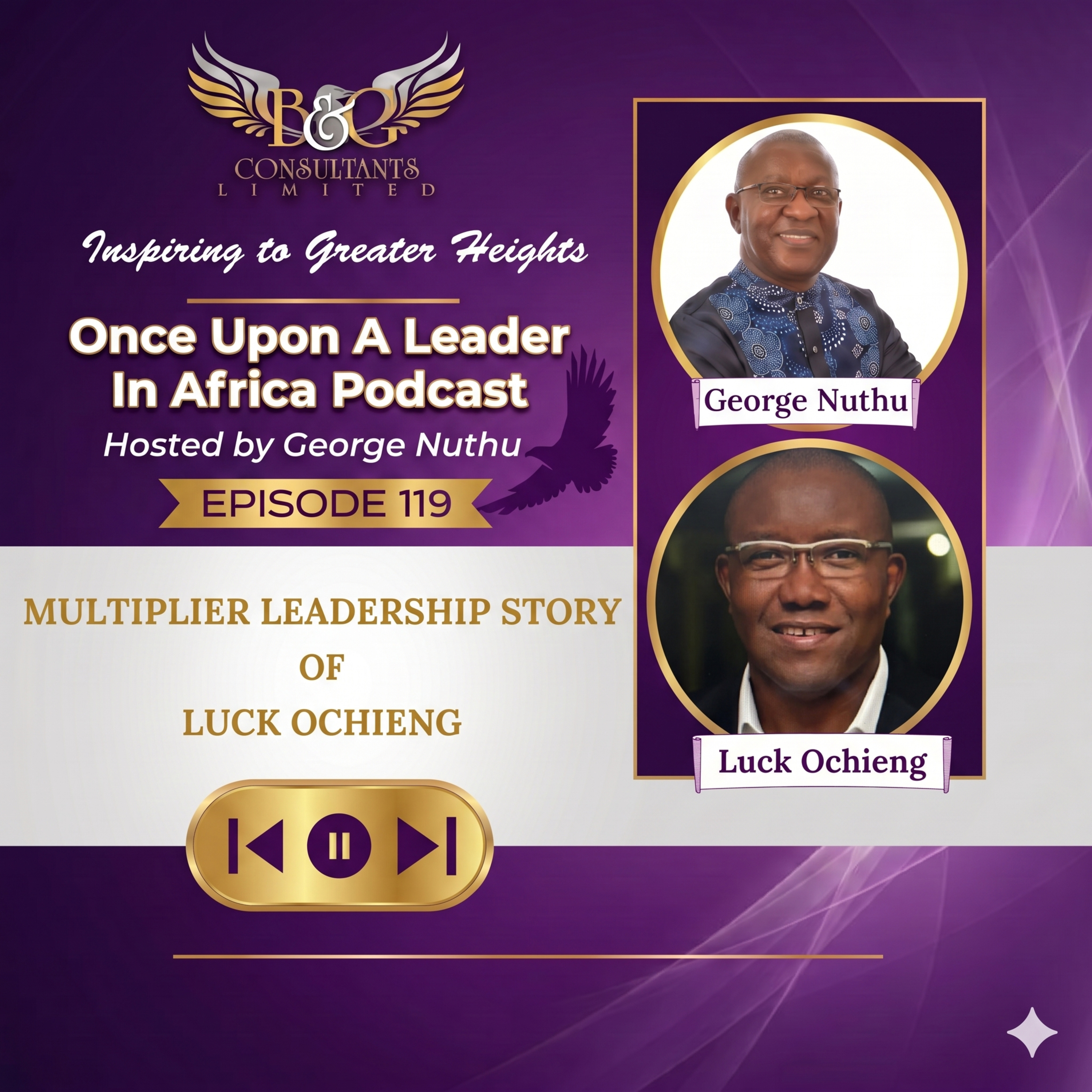
Episode #119
Multiplier Leadership Story of Luck Ochieng
What does it take to rise from a sales job to leading a major multinational business across East Africa—and still define leadership by the lives and communities you help transform? In this compelling episode of Once Upon a Leader in Africa , Luck Ochieng , Managing Director of Unilever East Africa, shares a leadership journey shaped by responsibility, resilience, purpose, integrity, continuous learning and a commitment to developing people. Growing up in a family of eight, Luck learned responsibility early from a strict and demanding mother who entrusted him with significant duties. After graduating from the University of Nairobi with a degree in Agriculture, he briefly hawked books on Nairobi’s streets before entering the corporate world. His career would eventually span major organizations including Unilever, Coca-Cola, Safaricom, Celtel (current Airtel) and Diageo, with assignments across Kenya, Tanzania, South Africa, West Africa, Bahrain and Amsterdam. Along the way, Luck discovered that career decisions that appear like backward steps can become defining opportunities. He recalls leaving a job paying about KSh45,000 to join Unilever for roughly one-third of the salary—a decision he considers one of the best he ever made. At the heart of Luck’s leadership philosophy is his personal purpose: to be “a catalyst for possibilities.” This means putting God and family first, living with integrity and giving back; inspiring and facilitating the growth of others; and using his leadership responsibilities to demonstrate what Kenyan and African talent can accomplish globally. This purpose shapes his approach to business. Luck explains how intentional efforts helped increase Unilever’s local sourcing of raw materials from less than 30% in 2019 to over 70%, with an ambition of reaching 90%. Through partnerships supporting small-scale farmers, he sees business not simply as generating shareholder returns, but also as creating opportunities throughout local communities and value chains. He also takes listeners behind the transformation of a previously loss-making business into a profitable operation. His lessons are straightforward but powerful: bring people of integrity into the organization, stop the leakages, focus on what truly matters, make deliberate choices and execute those priorities exceptionally well. Developing people is equally central to Luck’s leadership. He recounts mentoring a promising young manager in Ghana who was considering abandoning his career for a Green Card opportunity in the United States. Instead of telling him what to do, Luck helped him explore a way to meet the immigration requirements while continuing his career. Years later, the young leader became a deputy managing director in the telecommunications industry—illustrating how leadership can be measured by the possibilities created for others. The conversation also explores the discipline required to sustain leadership success: choosing friends wisely, investing for the future, remaining grounded in faith and family, and taking responsibility for continuous development. In a rapidly changing digital world, Luck argues that leaders cannot stop learning. They must intentionally build new capabilities, acknowledge what they do not know and remain willing to learn from others. Turning to Africa, Luck contends that the continent does not lack talent, enterprise or resources. What it needs is responsible, accountable leadership that creates environments in which people can thrive. So, leadership should be use to improve the lives of others and not reduced for political power. Ultimately, Luck’s leadership story returns to his North Star: purpose —remaining grounded in God, succeeding through people, taking responsibility for results, creating opportunities for others and helping put Kenya and Africa firmly on the global map. Listen, reflect, share—and ask yourself: What possibilities is your leadership creating for others?