What’s it really like parenting a child with ADHD and autism? How can parents, teachers, and communities better support neurodivergent children? How do autistic and ADHD individuals experience the world? Each week, we explore these questions with practical strategies, emotional insight, and real stories. I’m Greer — a mum of two boys (and two dogs!) raising a child with special educational needs (SEN) alongside my husband. Our daily life looks different from the norm, but it’s full of love, advocacy, and growth. I started this podcast to create a space for parents of neurodivergent kids, educators, and allies to learn, connect, and build understanding together. You’ll hear parenting tips, advocacy guidance, sensory strategies, and personal reflections that shine a light on both the joys and challenges of neurodivergent parenting. Through heartfelt solo episodes and guest interviews, we’ll talk about EHCP or IEP processes, school support, emotional regulation, and the big feelings that come with raising ND kids. Whether you’re here as a parent of an autistic or ADHD child, a late-diagnosed adult, a teacher seeking insight, or someone wanting to understand the neurodivergent world, this podcast is your space to grow, connect, and know you’re not alone. Welcome to The Unfinished Idea — a podcast all about parenting, autism, ADHD, and life in a neurodivergent family. Here, we open up honest conversations about neurodiversity, raising neurodivergent children, and navigating the everyday realities of SEN parenting.
Pitch Analysis
Required Pod Score for this show. PitchCentric checks your profile against host openness, topical fit, and audience signals before you generate a pitch.
Contact path
Verified email
Booking probability
35%
Guest openness
Selective
Verified email on file
82/100
Required Score
Sign up to generate a grounded pitch for Neurodivergent Conversations | Autism, ADHD, AuDHD, PDA, Emotional Regulation, SEND parent, Meltdowns, Special Needs Parent.
What is Neurodivergent Conversations | Autism, ADHD, AuDHD, PDA, Emotional Regulation, SEND parent, Meltdowns, Special Needs Parent?
Neurodivergent Conversations | Autism, ADHD, AuDHD, PDA, Emotional Regulation, SEND parent, Meltdowns, Special Needs Parent is a education podcast hosted by Unknown Host, with 109 episodes on record and a Required Pod Score of 82. PitchCentric scores this show on Booking Probability, Listen Score, and live audience signals refreshed every 24 hours.
About the host
Unknown Host hosts Neurodivergent Conversations | Autism, ADHD, AuDHD, PDA, Emotional Regulation, SEND parent, Meltdowns, Special Needs Parent, a education show with 109 episodes published.
If you've ever stared at a 40-page IEP and thought “I know what all these words mean, but I have no idea what they mean together,” this episode is for you. This week I'm joined by Vicki Christensen, a parent advocate of about a decade and mom to two boys who both have IEPs and are wonderfully different from each other. Vicki has sat on both sides of these meetings, as the professional in the room and as the mum who once walked in with an empty binder and just hoped everyone was doing the right thing for her son. She's so good at making this stuff make sense. We get really practical in this one. Vicki shares how to prepare before you ever walk in, like requesting the draft documents a few days ahead so you actually have time to read them, sending your questions and concerns in advance, and making sure the right people are at the table. She talks about leading with curiosity instead of defensiveness when you disagree, and why protecting that long-term relationship with the school matters even on the days you'd love to go in guns blazing. I also share the one thing I make every person in the room do at the start of my son's meetings, and how it shifted everything. But this isn't only logistics. We talk about how lonely those early years can feel, even when you have a supportive family around you, and Vicki's beautiful reminder that if it feels like you're the only one, that feeling is real, and you're still not actually alone. Her chapter on finding your village is a favorite for a reason. Your village can be small, it can be online, it can look like whatever you need. Vicki's book, Uniquely Fully Enough: The Neurodivergent Parenting Journey, weaves her family's story together with a “love lesson from a mom” at the end of each chapter, plus quick handbook highlights you can actually use. You can also find her sharing advocacy tips on Instagram. Come sit with us. Whether you're prepping for a big meeting or just need to feel a little less alone today, this one delivers on both. Check out her book here Learn more about your ad choices. Visit megaphone.fm/adchoices
Same Spectrum, Different Kids: Raising Two Autistic Boys
Aug 12, 202629 min
If you're raising more than one neurodivergent kid and quietly wondering why what works for one does absolutely nothing for the other, this conversation is going to feel like such a relief. This week I'm joined by Dalisse Sequeiros, mom to two autistic boys who could not be more different, and a children's book author who turned her family's real life into stories that help other kids feel seen. Along the way, Dalisse was also diagnosed as autistic herself, so she's parenting and understanding her own brain at the same time, something she beautifully calls rewriting her own history while staying present and building her boys' future. We talk about how one son melts down in a quiet, dim room while the other needs to move and throw and be held in a safe space, and why that old saying rings so true: when you know one autistic kid, you know one autistic kid. Dalisse shares how her books started as a simple birthday social story in PowerPoint and grew into a whole series on meltdowns, masking, bullying, and confidence. And if you're in the thick of the hard days right now, exhausted and carrying that heavy dark cloud of guilt and grief, her words for you near the end are so tender. The cloud lifts. It might not get easier exactly, but it gets easier to carry. Trust your gut, let your kid just be, and remember they're moving at their own perfect pace. Come sit with us for this one. You'll walk away feeling a little lighter and a lot less alone. GUEST LINKS: Follow Dalisse Grab her books here GET THE LINKS The Unfinished Idea Website Join the Unfinished Community Exhausted to Empowered Course Follow me on socials: INSTAGRAM FACEBOOK Learn more about your ad choices. Visit megaphone.fm/adchoices
Routines vs rhythms: building a calmer home for your neurodivergent family
Aug 5, 202619 min
Join the After Christmas in July Sale- MAJOR SAVINGS!! If you have ever built the perfect color-coded chart, laminated it, felt so proud of it, and then watched it fall apart by Tuesday, this episode is for you. Greer opens with a picture you might recognize: 7:42 in the morning, cold coffee, a child on the kitchen floor over socks before shoes, and that sinking thought, "I did everything right. Why is the system not working?" Here is the gentle truth she landed on. The system was not broken. The expectation was. This whole episode is about one quiet shift that can change the feel of your home: trading rigid routines for simple rhythms. A routine runs on the clock. A rhythm runs on the flow. A routine shatters when the day goes sideways. A rhythm just bends, and then it comes right back. Greer walks through why rhythms work so well for neurodivergent brains. Underneath everything, our nervous systems are asking one quiet question, "Am I safe? Do I know what is coming next?" A rhythm answers that with the predictability of "this comes after that," minus the pressure of the exact minute that sets so many of our kids off. You will also hear the after-school example so many of us know by heart. That 3pm crash where your kid walks in the door and melts down ten minutes later. It is not bad behavior. It is a nervous system finally letting go in the one place it feels safe enough to. Greer shares the simple, no-clock flow that softened it in her own home: shoes off, a snack already waiting, the lights down a little, and no questions about their day for the first twenty minutes. And because real life is not tidy, she talks honestly about the days it all falls apart, why missing the rhythm is not the same as failing it, and why you get to be the thermostat in your home, not the thermometer. If you walk away with one thing, let it be this. You do not need a better chart. You do not need to overhaul everything by Sunday. You just need one small rhythm, anchored to the part of the day that hurts the most. Start there. You are not doing it wrong. And you are not doing it alone. Learn more about your ad choices. Visit megaphone.fm/adchoices
Why talking it out doesn’t always work for neurodivergent kids
Jul 29, 202630 min
Have you ever tried to talk your neurodivergent child through a big feeling and just hit a wall? Same. In this episode I sat down with Katherine, a neuro-affirming counsellor and craniosacral therapist, to talk about why words are not always the way in, and what to reach for instead. We start somewhere that might gently rearrange how you think about feelings. You know the “name it to tame it” idea? Katherine reminds us that naming a feeling is actually the last step, not the first. For so many neurodivergent and highly sensitive kids, the felt experience in the body comes long before the words, and honestly our language is too small to hold all of it. She also says something I have been shouting about for years: we are not meant to tell our kids how they feel. Instead of “I see you’re sad,” we can get down on their level and ask, what is happening in your body? What do you notice in your heart, your tummy, your feet? Is there a colour for this? An animal? A character? For the kids who love to get into character, this can open a door that “use your words” never could. We get into the vagus nerve too (yes, I am obsessed, and no, you are not crazy for finding it fascinating). Katherine breaks down how our nervous system is constantly scanning for safety, why co-regulation matters so much, and why she is not a fan of the word “regulation” at all. A lot of what gets called regulation, she says, is really just asking our kids to keep their feelings in and perform calm for the world. And then there is the part for you, mama. Because you are co-regulating everyone in your house, often while running on empty. Katherine shares simple ways to come back to your own body so you can respond instead of react, and she even guides us through a short somatic exercise called the salamander (from Stanley Rosenberg’s book Accessing the Healing Power of the Vagus Nerve). It takes a couple of minutes, and I felt the shift in real time. A gentle note before you listen: Katherine is sharing from her own training and experience as a counsellor and craniosacral therapist, so think of everything here as encouragement and ideas rather than a prescription. You know your family best, so take what fits and loop in your own care team or practitioner for anything specific to you or your child. If you have ever felt like the talk-it-out approach just is not landing, this one is for you. Come listen, take a breath, and remember you are not doing any of this alone. GUEST LINKS: Grab some great resources by Katherine here GET THE LINKS The Unfinished Idea Website Join the Unfinished Community Exhasuted to Empowered Follow me on socials: INSTAGRAM FACEBOOK Learn more about your ad choices. Visit megaphone.fm/adchoices
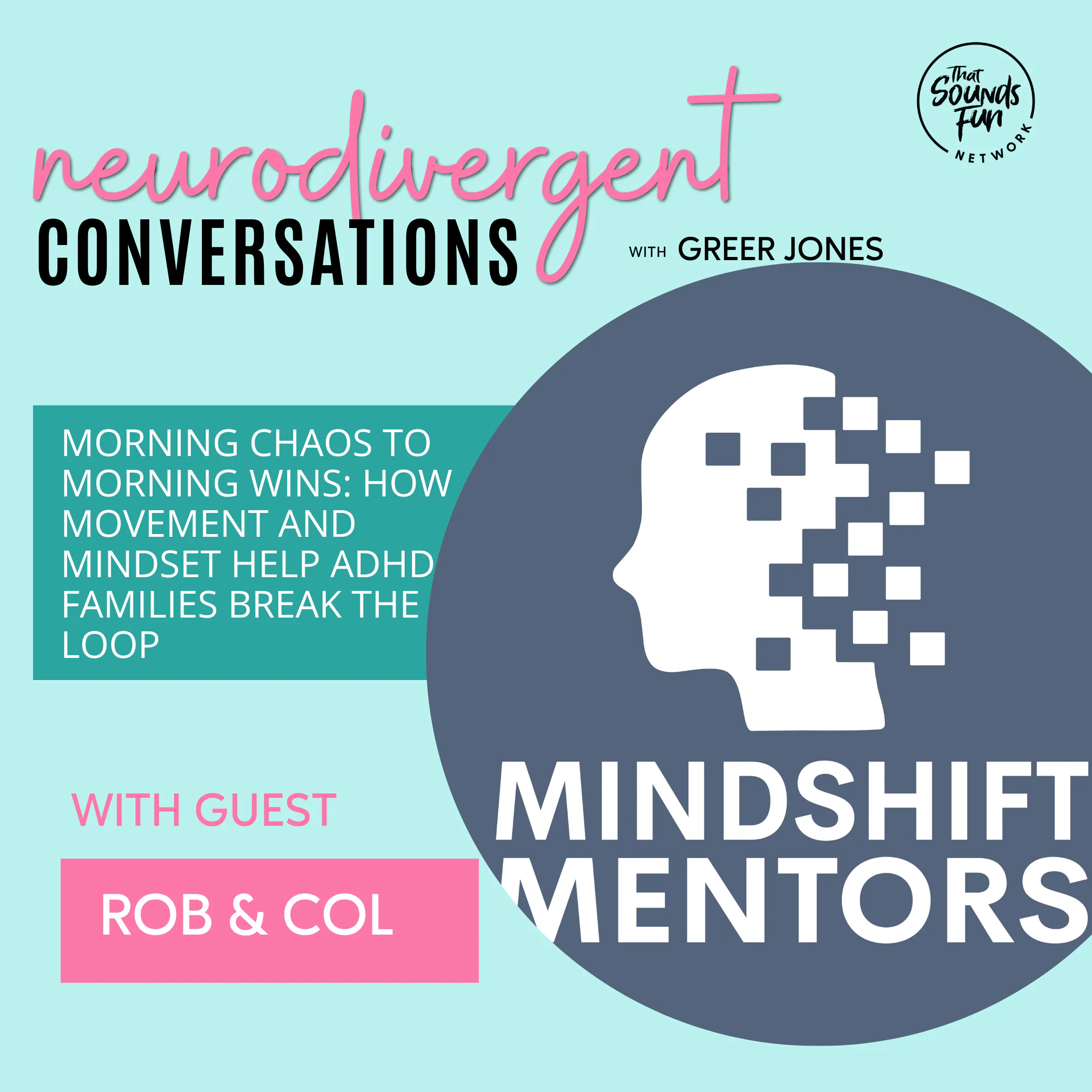
Morning Chaos to Morning Wins: How Movement and Mindset Help ADHD Families Break the Loop
Jul 22, 202632 min
If mornings in your house feel like a pressure cooker that goes off before you've even had your coffee — this episode is for you. Greer sits down with Rob Edmonds, co-founder of MindShift Mentors and a strategic psychotherapist and clinical hypnotherapist, and Carl (Col), a movement coach who has worked with over 3,000 families. Together, they've created a program called Morning Wars — a dual approach that combines intentional movement with cognitive pattern reprogramming to help ADHD kids (and their whole families) actually change the morning experience. What they share in this conversation is both validating and genuinely hopeful. Because the message isn't "your kid needs to be fixed." It's that nobody is the problem — the patterns are. And patterns can change. You'll hear them talk about why ADHD brains respond so powerfully to movement, how building a "bank of morning victories" can reduce meltdowns later in the day, and why what happens in your household before the school run is often less about your child's behavior and more about the loop the whole family is running together. There's something really grounding in this conversation about the idea that regulation is contagious — in both directions. When mum or dad wakes up already braced for a hard morning, that stress transfers. But when kids start the day doing something that builds their confidence, something shifts for the whole household. They also get practical: one instruction at a time, preparing the night before, specific guided audios and nighttime stories designed for little ones aged 3–10, and movement exercises that get the brain and body actually talking to each other. If you've been doing the same thing every morning and wondering why it isn't working, this episode offers a genuinely different way in — without blame, without pressure, and with a lot of warmth. GUEST LINKS: Mindshift Mentors Download the App & get the sleepy hallow story FREE GET THE LINKS The Unfinished Idea Website Join the Unfinished Community Exhausted to Empowered Course Follow me on socials: INSTAGRAM FACEBOOK Learn more about your ad choices. Visit megaphone.fm/adchoices
Best industries to pitch Neurodivergent Conversations | Autism, ADHD, AuDHD, PDA, Emotional Regulation, SEND parent, Meltdowns, Special Needs Parent for
Based on semantic analysis of episode topics and host coverage, this show is a strong guest fit for executives in:
Educationstrong
Industry fit is computed by PitchCentric using vector embeddings of the show's episode catalog.
Podcasts like Neurodivergent Conversations | Autism, ADHD, AuDHD, PDA, Emotional Regulation, SEND parent, Meltdowns, Special Needs Parent
Every question we get asked before someone starts their trial.
If you have a concern about deliverability, AI quality, data privacy, or whether this will actually work for your specific situation, it's probably answered below.
What is the difference between Founder Solo and Founder Pro?
Founder Solo gives you 50 AI pitches per month using the credit model (Standard pitches cost 1 credit, Enriched pitches cost 2). Founder Pro raises that to 200 credits per month and adds full Booking Probability access, unlimited Magic Match, Apollo enrichment credits, and data export capabilities. Both plans use the same credit system, so you can stretch your monthly budget further by using Standard-mode drafting.
How do agency tiers work?
Agency tiers have no base fee. You pay per managed client and per talent profile. Agency Standard is $199 per client per month; Agency Pro is $399 per client per month. Both add $39 per talent profile per month. Your own team's user seats are always free.
What is a talent profile?
A talent profile represents one person (founder, executive, or spokesperson) you are booking onto podcasts. It includes their bio, topics, headshots, and outreach history. Team plans include 5 profiles; agency plans are pay-as-you-go.
Can I switch plans later?
Yes, at any time. Upgrades take effect immediately; downgrades apply at the end of the current billing period. Contact support if you need help migrating between plan families.
Do you offer a free trial?
Every paid plan includes a 15-day free trial. Your card is saved at signup but you will not be charged until day 16. Cancel any time from your dashboard.
What happens if I cancel?
You keep access until the end of your current billing period. No charges after that. Your data is retained for 30 days in case you reactivate.
Is the 20% annual discount automatic?
Yes. Select Annual on the pricing toggle and the discounted price is applied automatically at checkout. The annual price shown is the full year cost.
What if I have more than 50 profiles or 20 clients?
That is our Enterprise tier. Contact our sales team and we will build a custom plan with volume pricing, a dedicated account manager, and SLA guarantees.