In a world full of financial information – and misinformation – what do you believe and incorporate into your life, and what do you throw away? As an independent, fee-only financial advisor, one of our founding pillars is education. Through accessible, transparent communication, we help filter out the noise for our clients to allow them to focus on their financial future. The goal of our podcast, Gimme Some Truth, is no different. From the corner of Monroe St. in Madison, WI, we cover the intersection of financial planning, investing, and everyday life.Disclosure: walknercondon.com/podcast
Pitch Analysis
Required Pod Score for this show. PitchCentric checks your profile against host openness, topical fit, and audience signals before you generate a pitch.
Contact path
Verified email
Booking probability
36%
Guest openness
Selective
Verified email on file
85/100
Required Score
Sign up to generate a grounded pitch for Gimme Some Truth | Investing, Financial Advice for High-Net-Worth Families and Individuals.
What is Gimme Some Truth | Investing, Financial Advice for High-Net-Worth Families and Individuals?
Gimme Some Truth | Investing, Financial Advice for High-Net-Worth Families and Individuals is a business podcast hosted by Walkner Condon Financial Advisors, with 287 episodes on record and a Required Pod Score of 85. PitchCentric scores this show on Booking Probability, Listen Score, and live audience signals refreshed every 24 hours.
About the host
Walkner Condon Financial Advisors hosts Gimme Some Truth | Investing, Financial Advice for High-Net-Worth Families and Individuals, a business show with 287 episodes published.
Our AI reads these to draft pitches. Use them as grounding for a pitch that cites a real guest and a specific topic.
Gimme Some Truth | Investing, Financial Advice for High-Net-Worth Families and Individuals
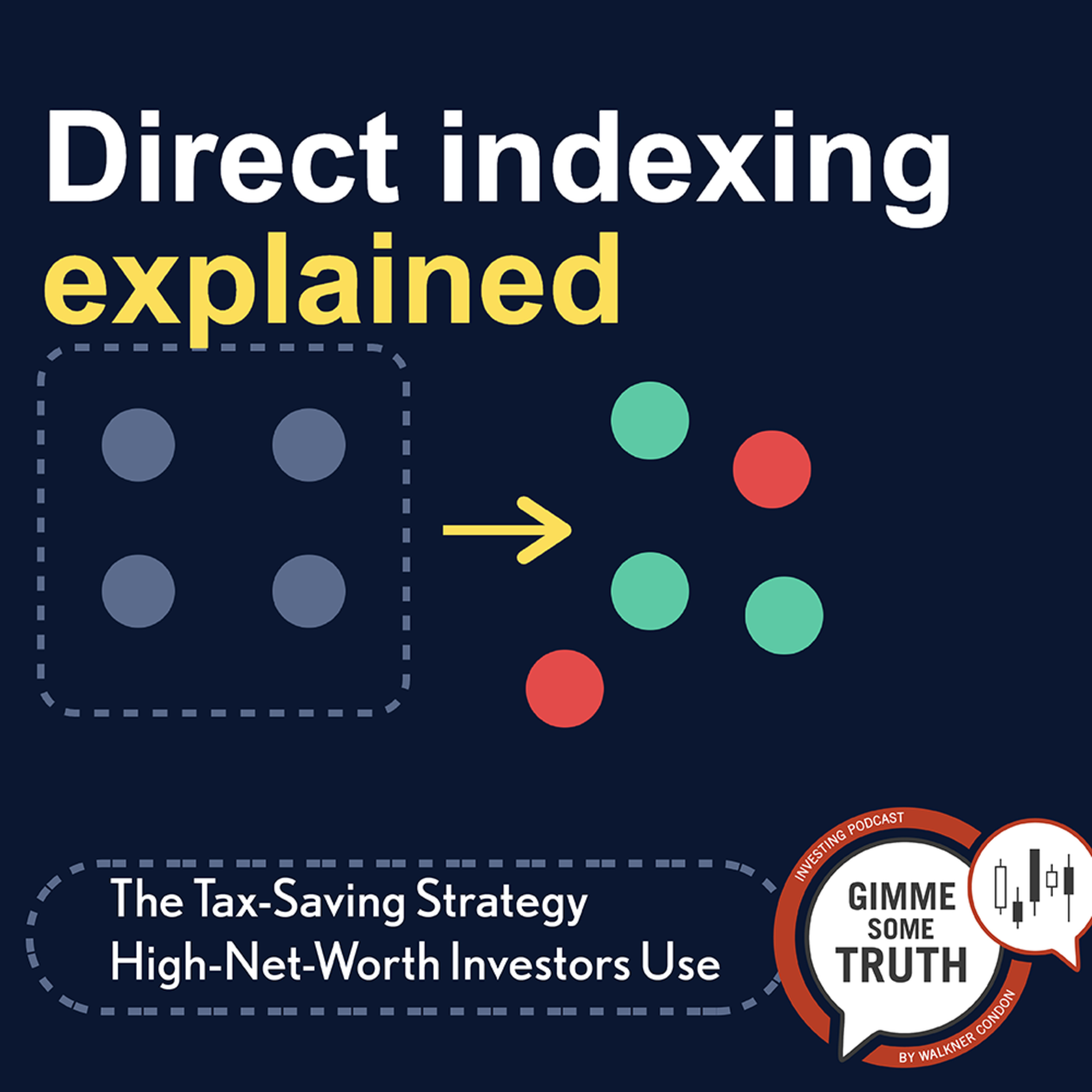
Direct Indexing 101: The Tax-Saving Strategy High-Net-Worth Investors Use
Sep 7, 202616 min
Direct indexing has become one of the hottest strategies in investing — but what is it, and does it actually work? In this episode of Gimme Some Truth, Nate, Mitch and Clint break down how direct indexing works, why it can outperform traditional index funds and ETFs on an after-tax basis, and who should actually be using it. Topics covered in this episode: ✅ What direct indexing is and how it differs from traditional index fund investing ✅ Tax alpha explained: how direct indexing creates tax savings that mutual funds and ETFs can't ✅ Real example: swapping individual stocks to harvest tax losses without losing diversification ✅ Why direct indexing offers flexibility ahead of a major capital gain event (like selling a business) ✅ How direct indexing helps retirees manage capital gains when withdrawing income ✅ Managing large unrealized gains from concentrated stock positions (early Apple investors, employees with company stock) ✅ Why rising capital gains tax rates make direct indexing more valuable over time ✅ Portfolio customization: excluding specific stocks for values-based, religious, or ESG investing ✅ Factor tilts: adjusting for growth vs. value, dividend income, and tax efficiency ✅ How direct indexing is customized based on your specific financial situation Timestamps 0:00 – Intro: what is direct indexing? 0:26 – Index investing vs. direct indexing: the basics 1:41 – Tax alpha: the core benefit of direct indexing 2:29 – Example: harvesting losses without losing diversification 3:06 – Why it matters: flexibility before a major capital gain event 4:16 – Avoiding forced capital gains in retirement 6:17 – Managing concentrated stock gains (Apple stock, business owners) 7:01 – Why rising capital gains tax rates make this strategy more valuable 7:22 – More control: excluding specific stocks from your portfolio 7:51 – Values-based & religious investing customization 8:36 – Factor tilts: growth vs. value and tax-efficient asset allocation 9:48 – How portfolios are actively managed and rebalanced 10:52 – Customizing strategy based on your financial situation 11:42 – Wrap-up: direct indexing 101 (and what's next) 12:00 – Bonus: NFL season predictions 14:14 – Outro If you're a high-net-worth investor, business owner, or retiree looking to reduce your tax bill while staying invested, this episode explains how direct indexing works and where it fits into a financial plan. Subscribe to Gimme Some Truth for more straight-talk investing and financial planning advice. Subscribe @walknercondon Visit our website for more financial planning resources and educational information: https://www.walknercondon.com ———————————————— ADD US ON: LinkedIn: https://linkedin.com/company/walkner-condon-financial-advisors-llc Facebook: https://facebook.com/walknercondon
Gimme Some Truth | Investing, Financial Advice for High-Net-Worth Families and Individuals
Big Announcements: New HQ, a Promotion & a Retirement | Gimme Some Truth
Aug 31, 202622 min
Walkner Condon's Managing Partners, Clint Walkner and Nate Condon sit down in their brand-new podcast studio to break down the biggest changes at Walkner Condon Financial Advisors this year— from a stunning new headquarters that brings four offices together under one roof, to major staff promotions, a retirement announcement, and the philosophy behind sustainable, client-first growth as the firm surpasses $1.25 billion in assets under management. In this episode of Gimme Some Truth, you'll hear about the team's new state-of-the-art studio and building, Alicia's promotion to partner, Evan's promotion, Andy King's upcoming retirement, how Walkner Condon structures its advisory teams for redundancy and collaboration, and why the firm has no "finish line" when it comes to growth. Timestamps: 0:00 – Welcome back & new studio reveal 0:34 – Behind the scenes of the new studio design 1:48 – New building: bringing four offices into one 3:54 – Staff update: Alicia promoted to partner 5:27 – Big news: Andy King announces retirement 10:00 – Why team structure & collaboration matter 15:35 – Philosophy on growth: no finish line 19:46 – Hitting $1.25 billion in assets under management 20:47 – Thank you to clients & closing thoughts Subscribe @walknercondon Visit our website for more financial planning resources and educational information: https://www.walknercondon.com ———————————————— ADD US ON: LinkedIn: https://linkedin.com/company/walkner-condon-financial-advisors-llc Facebook: https://facebook.com/walknercondon
Gimme Some Truth | Investing, Financial Advice for High-Net-Worth Families and Individuals
How to Tap Into Your Portfolio Without Triggering Capital Gains Tax — Box Spread Portfolio Loans Explained
Jul 20, 202616 min
What if you could access the money in your investment account without selling a single share or triggering capital gains tax? In this episode of Gimme Some Truth, Ian and Alicia break down pledged asset lines (PALs) — what they are and how they work — and then introduce a newer, lesser-known alternative: the box spread portfolio loan. With lower interest rates, lower minimums, better tax treatment, and fewer restrictions on how you use the funds, box spread loans are quickly becoming a go-to strategy for investors sitting on large unrealized gains. If you've ever thought "I need cash but I don't want to sell," this episode walks you through exactly how to think about it. Key topics covered: * What a pledged asset line is and how secured lending works * How box spread loans differ from PALs, HELOCs, and margin loans * Why box spread loans offer rates around 4% with minimums as low as $10K * The tax deductibility advantage most people don't know about * How interest payments become capital losses (and why that matters) * Real-world scenario: $100K invested, now worth $500K — what are your options? * Using box spread loans to diversify a concentrated position without triggering taxes * No restrictions on use of funds, setup in 1–2 weeks Check out our full blog post for more in-depth details on box spread loans. Book an appointment: walknercondon.com Chapters: 0:00 – Introduction & What Are Pledged Asset Lines (PALs)? 0:47 – The "PAL" Joke & Why Box Spread Loans Might Be Your Best Friend 1:04 – What Makes Box Spread Loans Different? 1:29 – What Is Secured Lending? How Does Borrowing Against Investments Work? 2:21 – Interest Rates & Other Lending Options Beyond PALs 2:41 – Introducing Box Spread Loans — A New Option for Individual Investors 4:26 – Benefits: Lower Rates (~4%), Lower Minimums ($10K vs. $100K), Better Tax Treatment 6:28 – The Tax Deductibility Advantage Over PALs and HELOCs 6:58 – Real-World Use Cases: Why Clients Are Choosing This 9:28 – Scenario Walkthrough: $100K Invested, Now Worth $500K — What Are Your Options? 10:33 – How Interest Becomes a Capital Loss — And Why That Matters 12:25 – Using Box Spread Loans to Diversify AND Eliminate Capital Gains Tax 16:00 – No Restrictions on Use of Funds (Unlike PALs or HELOCs) 17:22 – Speed & Flexibility: Set Up in 1–2 Weeks 20:25 – Why Working With a Financial Advisor Matters 23:45 – Disclaimer #BoxSpreadLoan #PledgedAssetLine #PAL #CapitalGainsTax #TaxPlanning #InvestmentStrategy #HELOC #SecuredLending #WealthManagement #FinancialPlanning #TaxEfficient #Liquidity #UnrealizedGains Subscribe @walknercondon Visit our website for more financial planning resources and educational information: https://www.walknercondon.com ———————————————— ADD US ON: LinkedIn: https://linkedin.com/company/walkner-condon-financial-advisors-llc Facebook: https://facebook.com/walknercondon
Gimme Some Truth | Investing, Financial Advice for High-Net-Worth Families and Individuals
Non-Qualified Deferred Compensation (NQDC)— Risks, Rewards & What to Know Before You Elect
Jul 6, 202618 min
Non-qualified deferred compensation could be one of the most valuable benefits you're not using. In this episode of Gimme Some Truth, we break down NQDC — a powerful but often overlooked benefit available to executives and high earners at many public companies. They cover how it works, who it's for, the key risks involved, and why planning ahead is critical before open enrollment season hits. If you're a senior leader, executive, or high-income earner at a public company, this episode could save you a significant amount in taxes — or help you avoid a costly mistake. 🔑 Key topics covered: * What "non-qualified" actually means and how NQDC differs from a 401(k) * How elections work and why NQDC is so inflexible once you commit * Choosing your payout timeline strategically * The biggest risk: what happens to your money if your company goes under * How investments work inside an NQDC plan * RSUs, taxes, and why your situation requires a personalized approach * What happens to your NQDC if you leave your company * Why you can't afford to wait for HR to bring this up 📌 Chapters: 0:00 – Introduction to Non-Qualified Deferred Compensation 0:42 – Who Has Access & How Common Is It? 1:52 – Why You Need to Ask About This Benefit 4:00 – What "Non-Qualified" Actually Means 4:54 – How Elections Work & The Inflexibility of NQDC 7:11 – Choosing Your Payout Timeline 8:14 – Best Use Cases: Who Should Use NQDC? 9:16 – The Key Risk: Company Creditworthiness 10:38 – 401(k) vs. NQDC — What's Protected? 11:13 – Annual Enrollment & The Exact Sciences Example 12:38 – How Investments Work Inside NQDC 13:26 – Don't Wait for Your Company to Tell You 15:25 – What Happens If You Leave Your Company? 16:13 – RSUs, Taxes & Why One Size Doesn't Fit All 16:55 – The Importance of Planning With Your Full Team 19:04 – When to Start the Conversation With Your Advisor 22:46 – Studio/Podcast Studio Announcement 24:09 – Disclaimer 📩 Have questions about your NQDC plan or open enrollment? Reach out to Walkner Condon to talk through your options. #NQDC #DeferredCompensation #ExecutiveCompensation #FinancialPlanning #TaxPlanning #401k #RSU #OpenEnrollment #WealthManagement #HighEarners #ExecBenefits #StockCompensation Subscribe @walknercondon Visit our website for more financial planning resources and educational information: https://www.walknercondon.com ———————————————— ADD US ON: LinkedIn: https://linkedin.com/company/walkner-condon-financial-advisors-llc Facebook: https://facebook.com/walknercondon
Gimme Some Truth | Investing, Financial Advice for High-Net-Worth Families and Individuals
Wisconsin Retirement System Explained — What Every WRS Participant Should Know
Jun 22, 202622 min
The Wisconsin Retirement System is one of the best-funded public pension plans in the country — but most participants don't fully understand how it works or how to maximize it. In this episode of Gimme Some Truth, Nate, Andrew, and Clint break down everything you need to know about the WRS and ETF. Whether you're a state employee, teacher, or public sector worker in Wisconsin, this episode is packed with practical insight to help you make smarter decisions with your retirement benefits. Topics include how the pension actually works, the Core vs. Variable investment decision, what to do as retirement approaches, common misconceptions that cost people money, and how to think about it if you're considering leaving public service for a private sector role. 🔑 Key topics covered: * What the WRS is and how the pension benefit is calculated * Why the WRS is one of the healthiest pension plans in the US * WRS vs. Social Security as a guaranteed income floor * Core Fund vs. Variable Fund: the 60/40 vs. 100% stock decision * The one-time switch back to Core and what to do as retirement approaches * Why "I have WRS, I don't need to save anything else" is a dangerous assumption * Leaving for the private sector: is that 15% raise actually worth it? * How to read your WRS statement and use ETF office projections 📌 Chapters: 0:00 – Introduction & Clint's Background With WRS 1:01 – Why This Topic Matters & Common Misconceptions 4:42 – What Is a Pension? WRS Basics Explained 6:51 – WRS vs. Social Security: Building a Guaranteed Income Floor 7:00 – Core vs. Variable: Investment Options Inside the Plan 9:36 – Approaching Retirement: The One-Time Core Switch & Practical Steps 11:27 – "WRS Is Enough" — Why You Should Still Save Outside the Plan 12:34 – Is Leaving for a Private Sector Job Worth It? 16:07 – Private Pensions: What's Different & What to Watch Out For 17:44 – Final Tips: Reading Your Statement & Visiting the ETF Office 📬 Have questions about your WRS benefits or retirement plan? Reach out to the team at walknercondon.com #WRS #WisconsinRetirementSystem #ETF #WisconsinPension #PublicPension #RetirementPlanning #StateEmployees #TeacherRetirement #PensionPlan #FinancialPlanning #CoreVsVariable #PublicSectorRetirement #Wisconsin Subscribe @walknercondon Visit our website for more financial planning resources and educational information: https://www.walknercondon.com ———————————————— ADD US ON: LinkedIn: https://linkedin.com/company/walkner-condon-financial-advisors-llc Facebook: https://facebook.com/walknercondon
Every question we get asked before someone starts their trial.
If you have a concern about deliverability, AI quality, data privacy, or whether this will actually work for your specific situation, it's probably answered below.
What is the difference between Founder Solo and Founder Pro?
Founder Solo gives you 50 AI pitches per month using the credit model (Standard pitches cost 1 credit, Enriched pitches cost 2). Founder Pro raises that to 200 credits per month and adds full Booking Probability access, unlimited Magic Match, Apollo enrichment credits, and data export capabilities. Both plans use the same credit system, so you can stretch your monthly budget further by using Standard-mode drafting.
How do agency tiers work?
Agency tiers have no base fee. You pay per managed client and per talent profile. Agency Standard is $199 per client per month; Agency Pro is $399 per client per month. Both add $39 per talent profile per month. Your own team's user seats are always free.
What is a talent profile?
A talent profile represents one person (founder, executive, or spokesperson) you are booking onto podcasts. It includes their bio, topics, headshots, and outreach history. Team plans include 5 profiles; agency plans are pay-as-you-go.
Can I switch plans later?
Yes, at any time. Upgrades take effect immediately; downgrades apply at the end of the current billing period. Contact support if you need help migrating between plan families.
Do you offer a free trial?
Every paid plan includes a 15-day free trial. Your card is saved at signup but you will not be charged until day 16. Cancel any time from your dashboard.
What happens if I cancel?
You keep access until the end of your current billing period. No charges after that. Your data is retained for 30 days in case you reactivate.
Is the 20% annual discount automatic?
Yes. Select Annual on the pricing toggle and the discounted price is applied automatically at checkout. The annual price shown is the full year cost.
What if I have more than 50 profiles or 20 clients?
That is our Enterprise tier. Contact our sales team and we will build a custom plan with volume pricing, a dedicated account manager, and SLA guarantees.