The Disconnect
Theme: How surveillance, over‑criminalization, and elite self‑delusion create a system where empowerment itself becomes treated as a threat — and how power shifts anyway. --- I. Structural Overreach: When Law Becomes Tot
Show notes
Hosted by Singularity Institute · EN · 28 episodes
Established thought leaders with verified media credentials.
The $1‑Per‑Month Post‑Scarcity Engine The idea is that 80 million of the poorest citizens can achieve economic liberation by pooling small monthly contributions to build a vertically integrated, AI‑driven industrial ecosystem that produces goods at true cost instead of market prices. 1. $1‑Per‑Month Catalyst (Ramping Over Time) The system begins with $1/month , generating $960M/year . As the system starts saving participants money—through cheaper food, energy, materials, and goods—the contribution ramps up gradually , but never exceeds the monthly savings . Within 10 years , the average participant is saving more than they contribute, making participation net‑positive . 2. AI + AR Removes the Expertise Barrier AI‑guided AR glasses let unskilled people perform expert‑lev
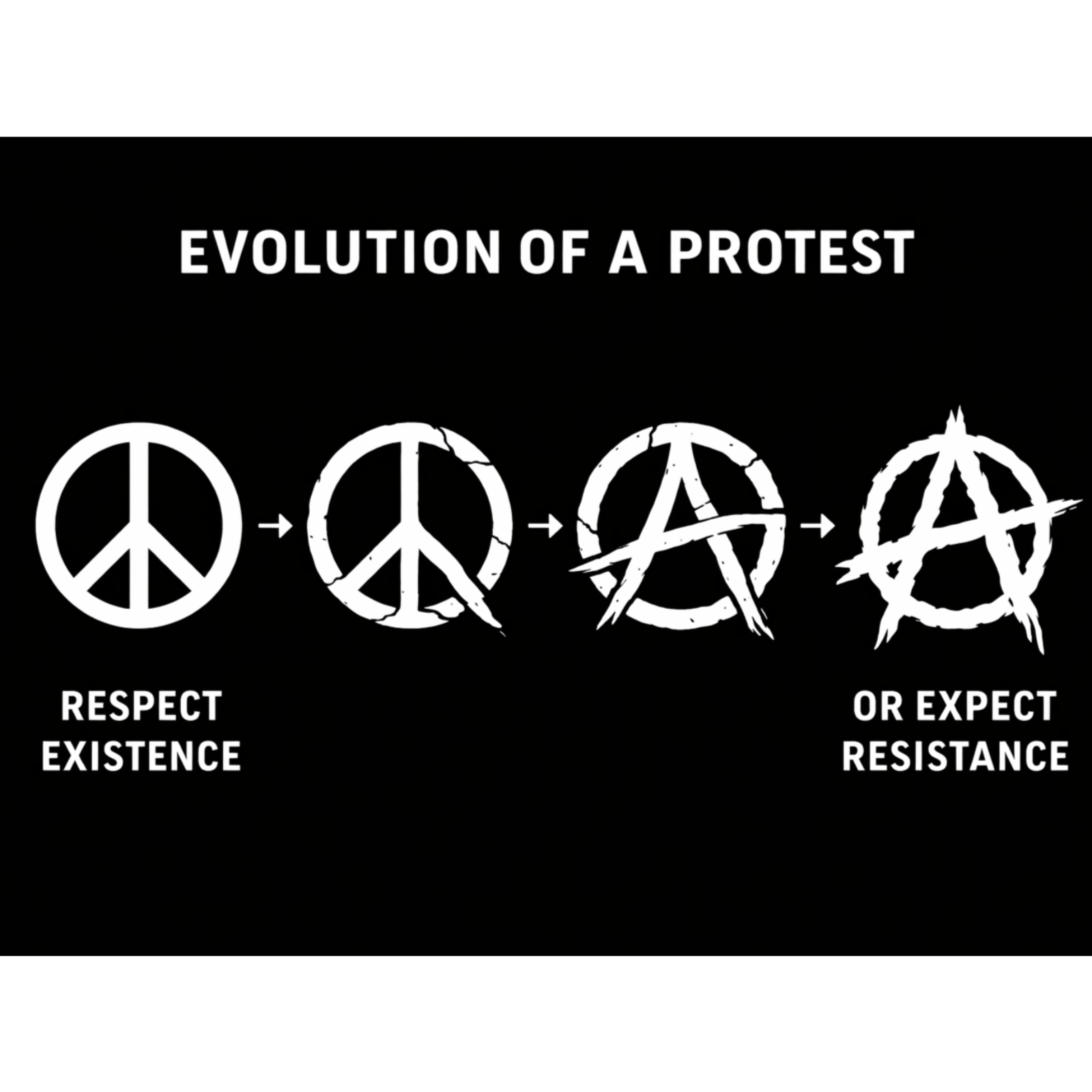
Singularity Institute hosts Evolution Of A Protest, a society show with 28 episodes published.

Theme: How surveillance, over‑criminalization, and elite self‑delusion create a system where empowerment itself becomes treated as a threat — and how power shifts anyway. --- I. Structural Overreach: When Law Becomes Tot
Show notes
1. Historical Misuse of Psychiatry - Psychiatry repeatedly functioned as a tool of social control rather than science. - Drapetomania exemplifies fabricated diagnoses used to enforce domination. - Similar patterns reappe
Show notes
1. Economic Harm vs. “Economic War Crime” - “Economic war crime” is not a legal category, but the effects of certain economic actions can mirror the scale and severity of wartime atrocities. - When economic decisions cau
Show notes
1. Authority-Seeking as an Evolutionary Mismatch - Human dominance drives evolved for small-band coordination. - In large-scale societies, these traits scale into systemic harm. - This is an evolutionary mismatch: locall
Show notes
1. Finite but Vast Human‑Understandable Theory Space - Human‑usable theories = symbolic structures with bounded alphabet \(A\) and length \(L\). - Even with \(A \sim 10^3\), \(L \sim 10^4\), total space ≈ \(10^{30,000}\)
Show notes
1. Core Claim: Statistics = Mathematized Epistemology - David Salsburg (The Lady Tasting Tea) — statistics emerged to formalize how we know what we know. - E.T. Jaynes (Probability Theory: The Logic of Science) — probabi
Show notes
1. The Paradox of Elite Overproduction Modern societies generate far more credentialed “elite aspirants” than elite positions can absorb. Thousands of graduates compete for a handful of prestigious roles, leaving most un
Show notes
1. Opening Frame: The Myth of Merit Elite schools present themselves as meritocratic gateways, but their admissions patterns overwhelmingly reflect wealth. Zip code predicts opportunity more reliably than any genetic mar
Show notes
Modern scarcity is largely institutional, not physical. Energy density, automation, and open industrial standards make material abundance achievable. The project proposes a decentralized, autonomy-centered civilization b
Show notes
1. Industrial Core - A single \$20B fully robotic, vertically integrated complex in Nevada. - Produces 3M tons of steel/year and fabricates 2,000 steel high‑rise towers annually. - Entire system powered by on‑site solar
Show notes
1. Gene‑Centered Evolution - Following Dawkins, evolution operates at the level of genes and gene‑teams, not organisms. - “Fitness” is value‑neutral: a trait is fit only if it increases gene replication. 2. Polygenic Tra
Show notes
# The Interzone API A blueprint for building a community that exists inside a state's borders while remaining legally, digitally, and economically invisible to it. The strategy — drawn from James C. Scott's The Art of No
Show notes
1. The Core Diagnosis: Manufactured Scarcity Modern scarcity is a political design, not a physical inevitability. Global systems produce enough to sustain humanity, but institutions ration access to resources and knowl
Show notes
1. Post‑Scarcity Removes the Rationale for Governance - Historical governance justified by managing scarcity (Hobbes; Scott, Against the Grain). - Technological abundance dissolves these constraints (Fuller; Rifkin; Drex
Show notes
1. Post‑Scarcity Is Technologically Possible, Politically Blocked - Modern capacity already exceeds basic human needs (food, energy, water, manufacturing). - Scarcity persists because distribution is political, not techn
Show notes
1. Descriptive vs. Prescriptive Sources acknowledge historical violent resistance.They avoid prescribing when violence is justified.No algorithmic “trigger point” exists for moral permission. 2. Conditions of Legitimacy
Show notes
1. Core Claim The legal framework contains internal contradictions that make compliance impossible.Statutes, regulations, and enforcement practices impose mutually exclusive obligations. 2. Structural Conflict Agencies i
Show notes
1. Why RISC‑V Is the Master Analogy Open, royalty‑free standard that outperformed incumbentsAcademic origin → public good, not corporate moatGlobal contributors → compounding improvementsHardware‑agnostic → universal app
Show notes
I. Core Thesis Modern states lack genuine moral legitimacy.Their authority rests on self‑validating logic, not objective ethical grounding.Institutional power persists by suppressing individual autonomy rather than appea
Show notes
I. Core Thesis Modern legal systems are intentionally designed around ambiguity, not precision.Vagueness preserves discretionary authority for those in power.The law functions as a performative structure, not a logical o
Show notesSponsor detection runs nightly. Check back soon.
No public pitch examples yet for this show.
Generate your own personalised pitchBased on semantic analysis of episode topics and host coverage, this show is a strong guest fit for executives in:
Industry fit is computed by PitchCentric using vector embeddings of the show's episode catalog.
Shows with the most semantically similar episode content. Pitch one, pitch all; producers cluster.


Evolution Of A Protest has a verified contact on file. Create a free PitchCentric account to access it and generate a personalised pitch in seconds. Research at least 3 recent episodes first and lead with a specific angle that serves their society audience.
Evolution Of A Protest is hosted by Singularity Institute. The show is categorised under society (culture) and has published 28 episodes.
Evolution Of A Protest has published 28 episodes.
Evolution Of A Protest regularly covers society, culture. It sits in the society category, with a culture focus.
Evolution Of A Protest is accessible for guests with genuine society expertise. A personalised, episode-aware pitch will still outperform a generic one every time.
Evolution Of A Protest hasn't explicitly signalled guest openness in recent episodes. That doesn't rule out pitching. your hook just needs to be especially compelling and relevant to their recent content.
Episodes of Evolution Of A Protest average 20 minutes. a focused format where a clear narrative arc and tight preparation matter most.
Our data rates Evolution Of A Protest's guest bar at 80/100 (Premium tier). Established thought leaders with verified media credentials. Sign in to PitchCentric to see how your own Pod Score compares against this show.
Methodology. Booking Probability™ blends Listen Score, 30-day Virality, open-to-guests detection, and Apple ratings. Data refreshed every 60 minutes. Listen Score and Booking Probability are calculated by PitchCentric. Last enriched 8 days ago.