Economics Matters with Laurence Kotlikoff
Is AI the End of Mathematics, or Its Most Exciting New Beginning?
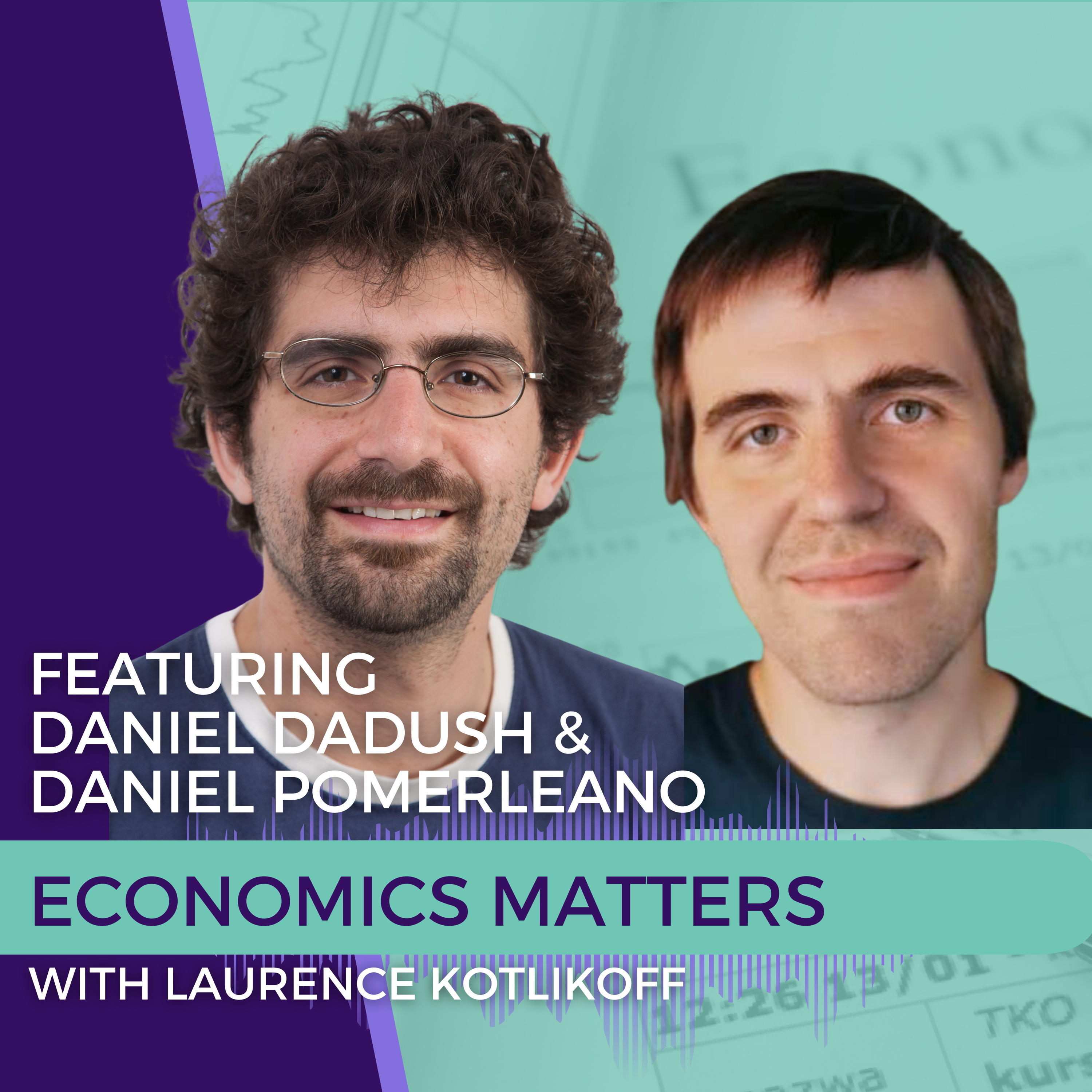
What does it feel like to watch an AI solve a problem in a single prompt that you've spent years working on, and produce a stronger result than your own published papers? Professor Kotlikoff grew up academically alongside two economists, Yuri Dadush and Michael Pomerleano, who were his classmates when he began his PhD at Harvard in 1973. In this episode, he sits down with their sons: Daniel Dadush , a professor of mathematics and optimization at Utrecht University, and Daniel Pomerleano , a professor of pure mathematics at UMass Boston, both of whom are watching AI upend their fields in real time. This is a conversation about what's actually happening inside mathematics right now: which problems AI has solved, how it solved them, what those solutions reveal about the limits of human specialization, and whether the next generation of mathematicians will bother showing up at all. What You'll Learn: [00:17:39] The moment ChatGPT produced a stronger result than two of Daniel Dadush's published conference papers: what happened in a single prompt session [00:31:13] The Erdos Distance Problem: open for 60+ years, solved by AI in a few pages, and why the ideas inside it cracked other problems too [00:35:39] The cycle double cover conjecture: an open problem with a short proof human mathematicians simply overlooked [00:36:26] Why AI proofs tend to be strikingly short: what that reveals about how differently machines approach mathematics [00:41:46] Why AI companies used math as their benchmark: what solving long chains of abstract reasoning was really designed to prove [01:00:39] The PhD thesis problem: how Daniel P. generated what would have been a strong thesis three years ago, in an afternoon, with a problem list and ChatGPT [01:08:46] Why pure mathematics may become a less attractive field for the next generation: and what's lost if that happens [01:09:23] The conference room scenario: an audience member spinning up 20 AI agents during a talk to answer the speaker's own research question before the talk ends [01:11:42] The policy question: NSF funding going to zero for economics while $200 billion flows to AI, and what hollowing out academic talent actually costs us Featured Guests: Daniel Dadush is a professor of mathematics at Utrecht University and leader of its Networks and Organizations Group. He completed his PhD in Algorithms, Combinatorics, and Optimization at Georgia Tech and held a Simons Postdoctoral Fellowship at the Courant Institute at NYU. He specializes in theoretical computer science and mathematical optimization. Daniel Pomerleano is a professor of mathematics at UMass Boston. He completed his PhD at UC Berkeley and has held positions at Imperial College London. His research focuses on mirror symmetry, symplectic topology, and non-commutative Hodge theory. Resource Links: Fermat's Last Theorem by Simon Singh: the popular mathematics history book Larry recommends for non-mathematicians, available in multiple editions: https://www.amazon.com/Fermats-Last-Theorem-Simon-Singh/dp/1841157910 The Man Who Knew Infinity (2016): the biographical film about Srinivasa Ramanujan, starring Dev Patel and Jeremy Irons, available to rent or buy on Amazon Prime Video: https://www.amazon.com/Man-Who-Knew-Infinity/dp/B01HRX0T8K Economics Matters Substack (Larry Kotlikoff): https://larrykotlikoff.substack.com Economics Matters: The Podcast is hosted by Larry Kotlikoff, Professor of Economics at Boston University. Disclaimer: Any opinions expressed on Economics Matters are those of the authors and guests. These are not the opinions of Boston University or Economic Security Planning, Inc.