Best AI papers explained
Pointwise or pairwise: when do pairwise losses help reward learning, provably?
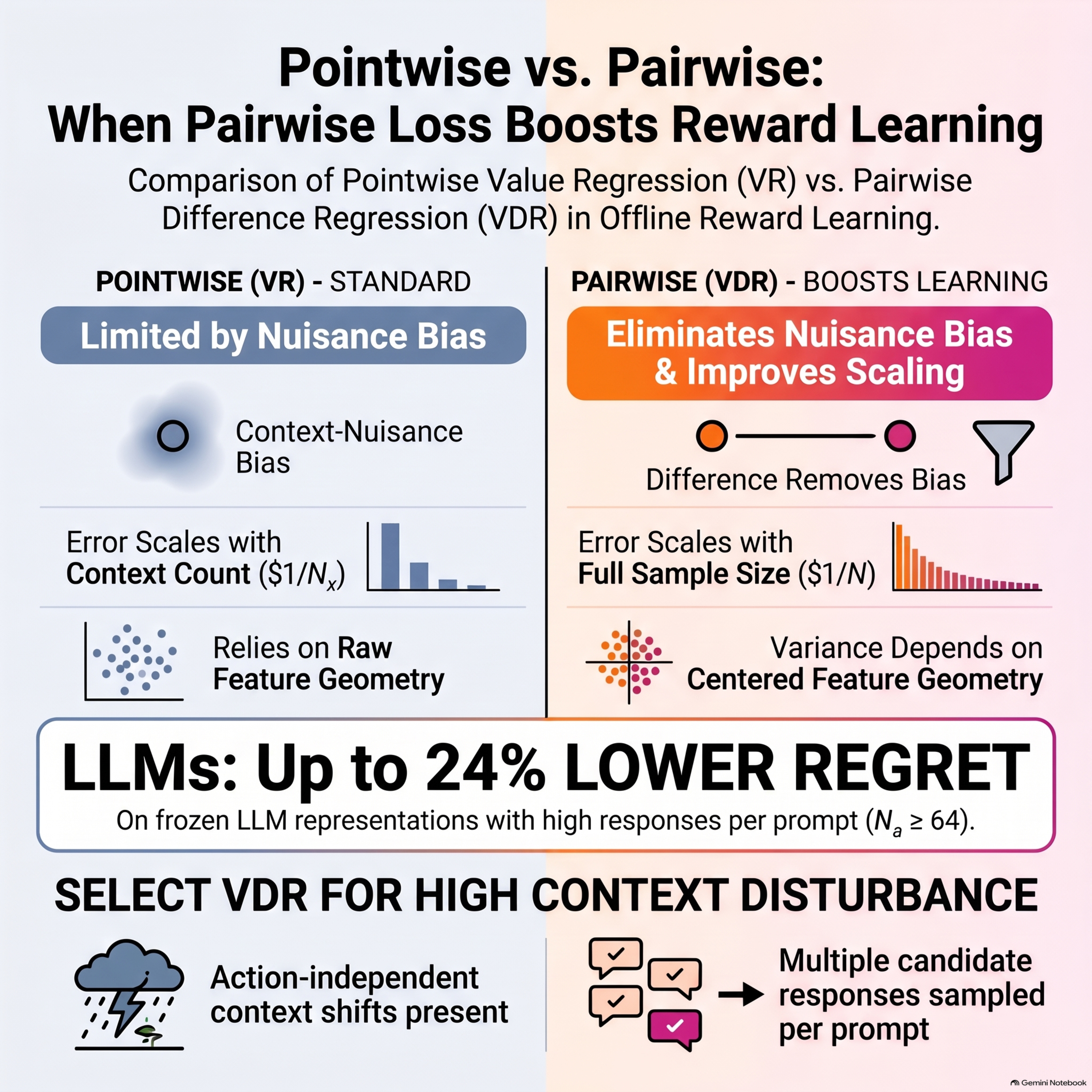
This research paper investigates when and why pairwise losses outperform pointwise losses for reward learning by analyzing both approaches within a grouped offline contextual-bandit framework. The authors compare Value Regression (VR), which directly fits absolute observed rewards, with Value Difference Regression (VDR), which models reward differences between action pairs sharing the same context. Through a localized mathematical analysis, the study establishes finite-sample prediction guarantees and offline-regret bounds for both finite and linear function classes. The theoretical findings reveal that VDR successfully eliminates nuisance-induced misspecification bias that disrupts pointwise regression, whereas VR can maintain lower estimation variance under correct specification depending on the underlying feature geometry. Consequently, the choice between these learning strategies introduces a fundamental bias-variance tradeoff, which is further validated through both synthetic simulations and real-world language model response-selection experiments.