Oct 30, 202618 minS2
Fowler J et al., Nature Genetics - Normal esophageal lining is a patchwork of mutant clones that compete for space as we age. This study asked whether cancer treatment changes which of those clones win. Normal esophagus...

Base by Base explores advances in genetics and genomics, with a focus on gene-disease associations, variant interpretation, protein structure, and insights from exome and genome sequencing. Each episode breaks down key studies and their clinical relevance—one base at a time.Powered by AI, Base by Base offers a new way to learn on the go. Special thanks to authors who publish under CC BY 4.0, making open-access science faster to share and easier to explore.
Required Pod Score for this podcast. PitchCentric checks your profile against host openness, topical fit, and audience signals before you generate a pitch.
Contact path
Verified email
Booking probability
38%
Guest openness
Selective
Sign up to generate a grounded pitch for Base by Base.
Signup to Generate a PitchBase by Base explores advances in genetics and genomics, with a focus on gene-disease associations, variant interpretation, protein structure, and insights from exome and genome sequencing. Each episode breaks down key studies and their clinical relevance, one base at a time. Powered by AI, Base by Base offers a new way to learn on the go.
Base by Base is hosted by Gustavo Barra. The show has published 468 episodes to date.
Recent episodes include "471: How cancer treatment picks winners among mutant clones in the normal esophagus" (30 October 2026, 18 minutes), "470: The hidden swaps CRISPR leaves between sister chromosomes" (29 October 2026, 17 minutes), and "469: What the shape of a face reveals about cleft risk" (27 October 2026, 18 minutes).
Base by Base publishes roughly a few times a week, with episodes averaging 23 minutes across 468 episodes.
Booking probability for Base by Base is 38%, and the host is rated Selective on guests. Base by Base requires a Pod Score of 80 or higher. Base by Base's contact route on record: verified email.
The strongest fits for Base by Base are Scientific Research & Development. Base by Base has a science audience.
Gustavo Barra hosts Base by Base, a science podcast with 468 episodes published.
Our AI reads these to draft pitches. Use them as grounding for a pitch that cites a real guest and a specific topic.
Fowler J et al., Nature Genetics - Normal esophageal lining is a patchwork of mutant clones that compete for space as we age. This study asked whether cancer treatment changes which of those clones win. Normal esophagus...
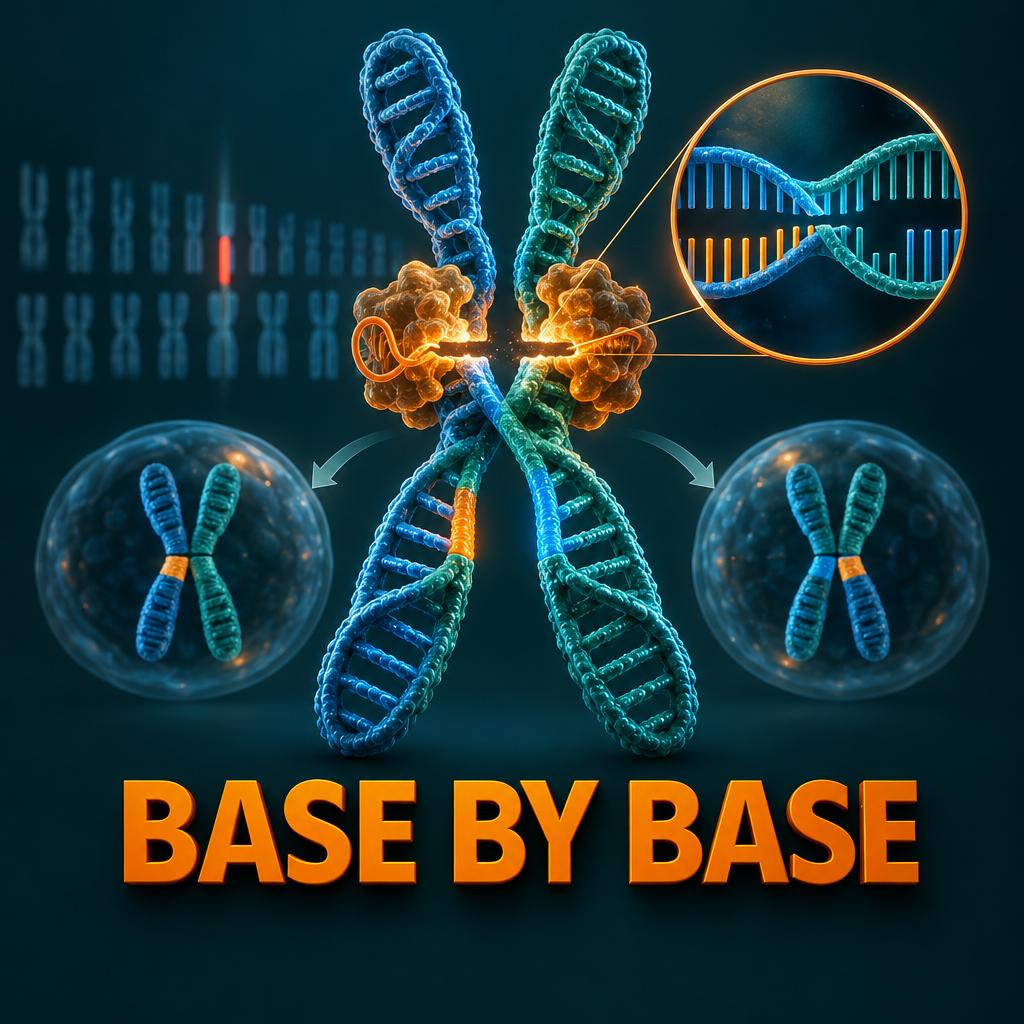
Chovanec P et al., eLife - When CRISPR/Cas9 cuts DNA, editing is usually judged by the small insertions and deletions left at the break. But a cut can also be repaired by swapping DNA between the two identical sister...
Herrick N et al., Human Genetics and Genomics Advances - Orofacial clefts are among the most common birth defects, affecting about 1 in 700 births, yet known genetic signals explain only a fraction of their...
Lisfeld J et al., The American Journal of Human Genetics - SRSF3 is an essential splicing factor, one of the serine/arginine-rich proteins that help cells cut and paste their RNA messages and send them out of the...
Jang Y et al., The American Journal of Human Genetics - Every cell in the body picks up its own small set of DNA changes over a lifetime, and many of these somatic mutations are carried by only a tiny fraction of cells...
Meyer-Schuman R et al., The American Journal of Human Genetics - Autism is diagnosed about four times more often in male individuals than in female individuals, and one explanation is mild variants in dosage-sensitive...
Thorne et al., Proceedings of the National Academy of Sciences - GLP-1 receptor agonists such as semaglutide produce large weight loss, but part of what is lost is lean mass, energy expenditure falls, and weight tends...

Zhu et al., Proceedings of the National Academy of Sciences - Genome-wide studies of schizophrenia and other psychiatric disorders find hundreds of hits, yet those hits barely clear the significance threshold and tend...

Cheng et al., Proceedings of the National Academy of Sciences - Genome-wide studies have found dozens of risk loci for age-related macular degeneration, but for many of them the gene doing the work is unknown. This...
Yoon et al., Proceedings of the National Academy of Sciences - ANK3, which encodes the scaffolding protein ankyrin-G, is a major risk gene for bipolar disorder and schizophrenia, yet what it does in adult neurons has...

Virolainen et al., The American Journal of Human Genetics - A lupus signal on chromosome 11p15 narrows to a coding haplotype in IRF7 that most people in the world carry. This study shows the risk form moves into the...

Arterbery et al., The American Journal of Human Genetics - Hundreds of genes have been reported as causes of cerebral palsy, yet there is no agreed model of what a pathogenic variant in a child with CP actually means...
MacGregor et al., The American Journal of Human Genetics - Pathogenic TP53 variants found in blood have long been read as inherited Li-Fraumeni alleles, but many turn out to be somatic clones that grew with age. Using...
Quenez O et al., The American Journal of Human Genetics - Rare copy-number variants were called from 22,319 exomes covering early-onset Alzheimer disease, late-onset disease and unaffected controls, then tested gene by...

Fuhrer J et al., The American Journal of Human Genetics - Across 34 complex traits and disorders, a MiXeR-based framework partitions SNP heritability over 74 functional annotations and finds that exons carry only a...
Ali T et al., JCI Insight - Um antirretroviral aprovado para HIV, dado por via oral em microdose, prolongou a sobrevida de camundongos que carregam a proteína priônica humana e foram infectados com príons de doença de...
Ali T et al., JCI Insight - Repurposed low-dose efavirenz slowed disease progression and extended survival in tg650 mice inoculated with MM1 sCJD prions by activating CYP46A1, raising 24S‑hydroxycholesterol and reducing...

Minikel EV et al., Nucleic Acids Research - Este estudo testa a redução da proteína priônica (PrP) por oligonucleotídeos antisense (ASOs) em camundongos, variando doses, esquemas de aplicação, linhagens de príon e...

Minikel EV et al., Nucleic Acids Research - This study uses antisense oligonucleotides (ASOs) to lower prion protein (PrP) RNA in mice and shows dose-dependent extension of survival, efficacy across multiple prion...

Raymond GJ et al., JCI Insight - This episode covers a 2019 study showing that sequence-specific antisense oligonucleotides (ASOs) targeting the prion protein (PrP) mRNA, delivered by bolus intracerebroventricular...
PitchCentric classifies Base by Base under these industries. Guests from them are the closest fit, and each links to the best podcasts in that industry.
Shows with the most semantically similar episode content. Pitch one, pitch all; producers cluster.
Is this podcast yours and you'd like to remove or correct details? Request removal or email privacy@pitchcentric.com.
Questions about the free trial? See the pricing FAQ