Automotive industry Quality and Engineering
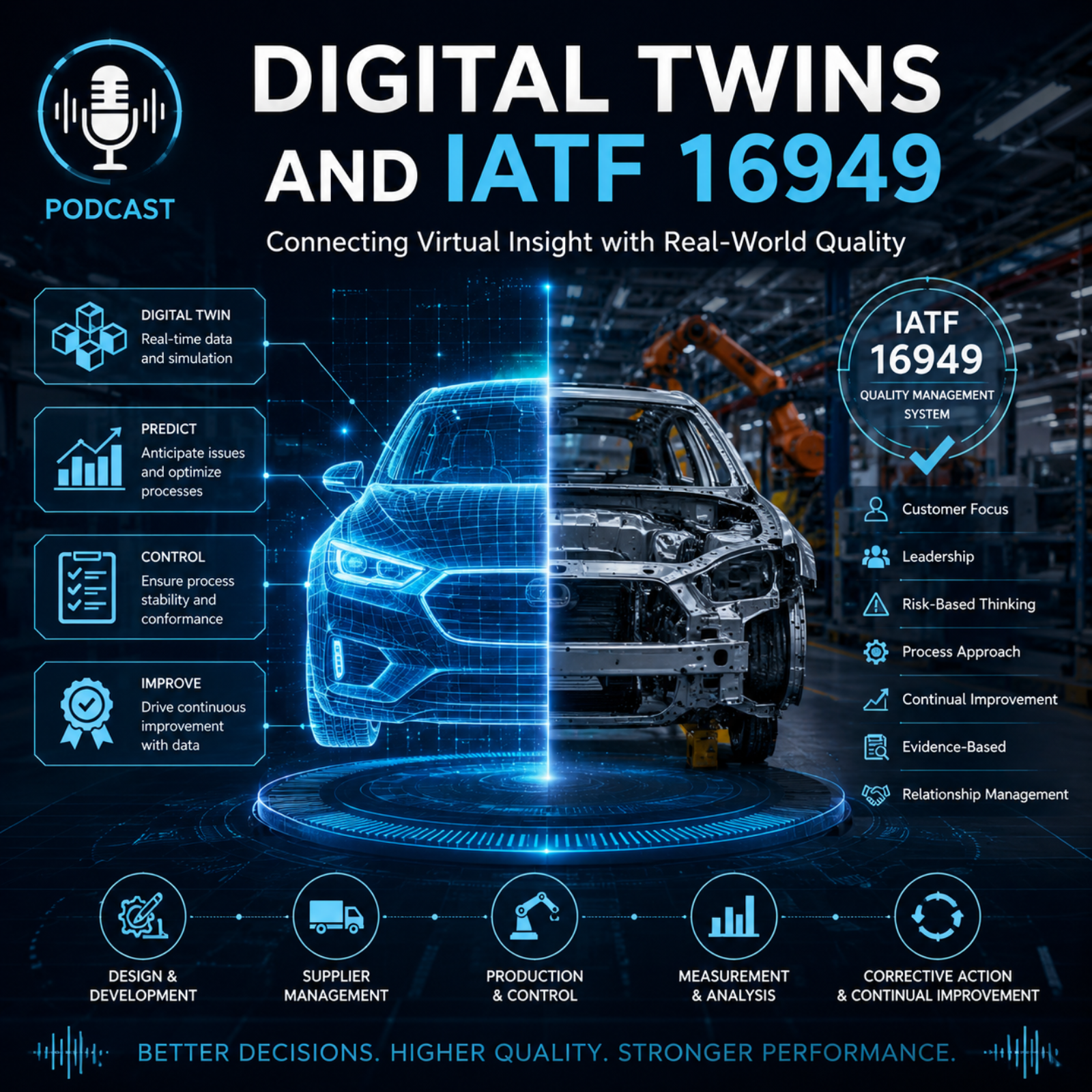
Digital Twins and impact on Quality Management (IATF 16949)
Automotive Core Tools Integration APQP: The DT is utilized for filling/solidification simulations and topological optimization. While it enables virtual pre-validation, this does not replace physical validation required by PPAP unless explicitly agreed upon by the customer. FMEA: Failure modes must be expanded to include "Digital Failure Modes, such as model drift, loss of synchronization between the physical and digital twin, and training data corruption. MSA: Model outputs must be validated using metrics borrowed from Machine Learning, such as confusion matrices and sensitivity/specificity, alongside traditional accuracy and precision. SPC: Introduces hybrid SPC, where control charts monitor variables predicted by the DT in parallel with real-world variables, requiring capability studies (Cp/Cpk) on the model’s predictive ability. Regulatory Compliance: AI Act and ISO/IEC 42001 The EU AI Act (Reg. 2024/1689) follows a risk-based approach applied to specific AI functionalities within the DT. Classification: Minimal/Limited Risk: DT used only for offline engineering simulation without direct impact on product release or worker safety. Potentially High Risk: AI used as a safety component for products governed by harmonization regulations (e.g., Machinery Regulation 2023/1230) or affecting worker safety decisions. High Risk (Labor Context): DT used to monitor or evaluate operator performance. High-Risk Obligations: If classified as high risk, the organization must implement risk management systems, data governance to prevent bias, technical documentation, automatic logging of decisions, human oversight (the ability to override the DT), and cybersecurity measuresISO/IEC 42001 serves as the High-Level Structure (HLS) framework for governing the AI life cycle. Adopting this standard provides structured evidence of "AI Governance" often requested during second-party OEM audits. Cybersecurity and Information Security (TISAX & ISO/IEC 27001) The Digital Twin processes sensitive OEM technical data, including CAD geometries for structural castings and protected process parameters. This extends the scope of security requirements: TISAX / VDA ISA: The DT platform (local servers, MES storage, or third-party cloud) must be included in the assessment perimeter. A DT hosted on a third-party cloud or accessible remotely for maintenance may require Assessment Level 3 (AL3) with on-site audits. ISO/IEC 27001: The DT expands the IT/OT convergence surface. Key controls include: Organisational: Policies for AI/DT use and asset classification. Technological: Network segmentation (IT/OT), SCADA/MES vulnerability management, and encryption.