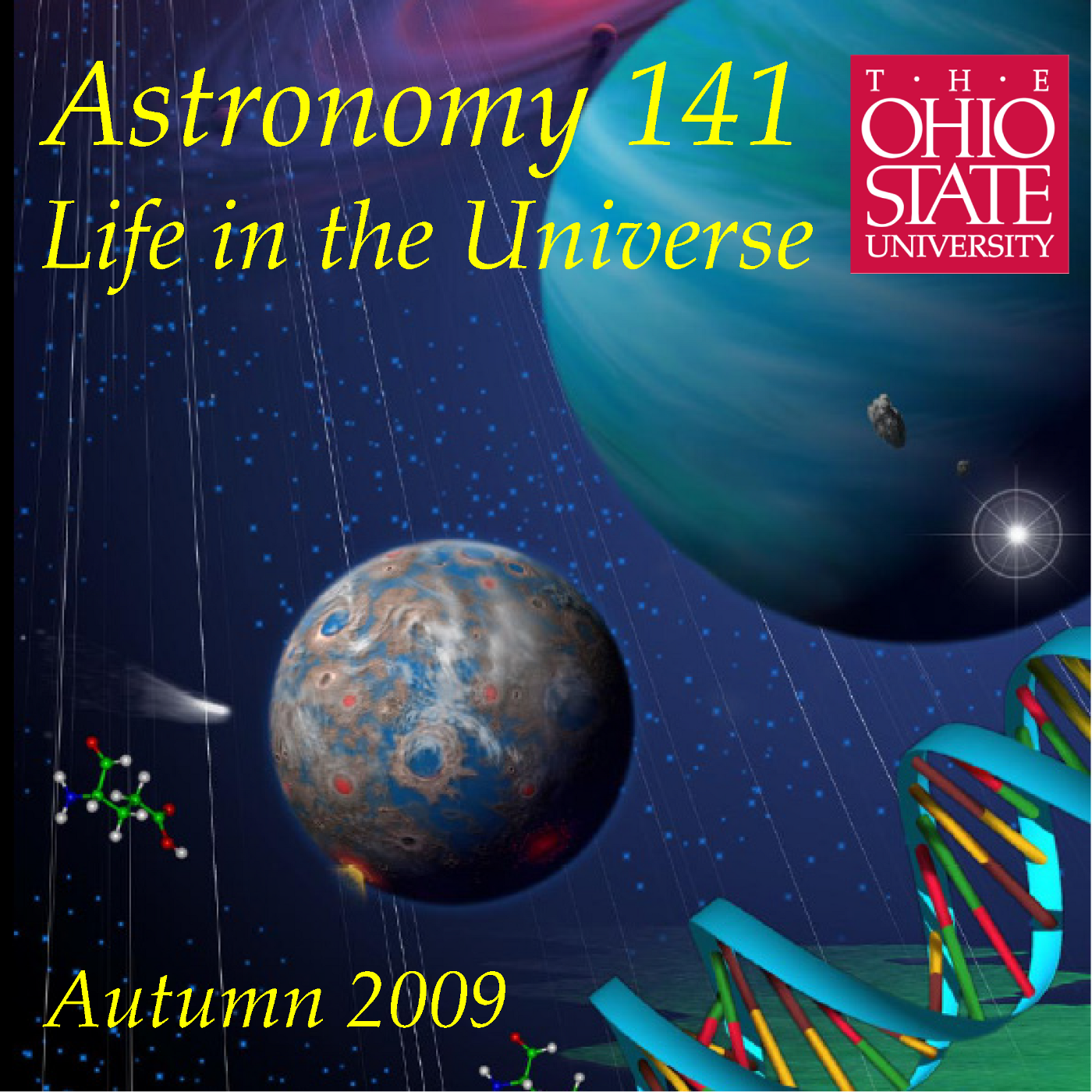
Astronomy 141 Podcast Teaser
Dec 6, 20090
A new podcast, Astronomy 141, Life in the Universe, is available for those interested in continuing an exploration of topics in modern astronomy.

Hosted by Richard Pogge · 🇺🇸 US · EN-US · 43 episodes
Established thought leaders with verified media credentials.
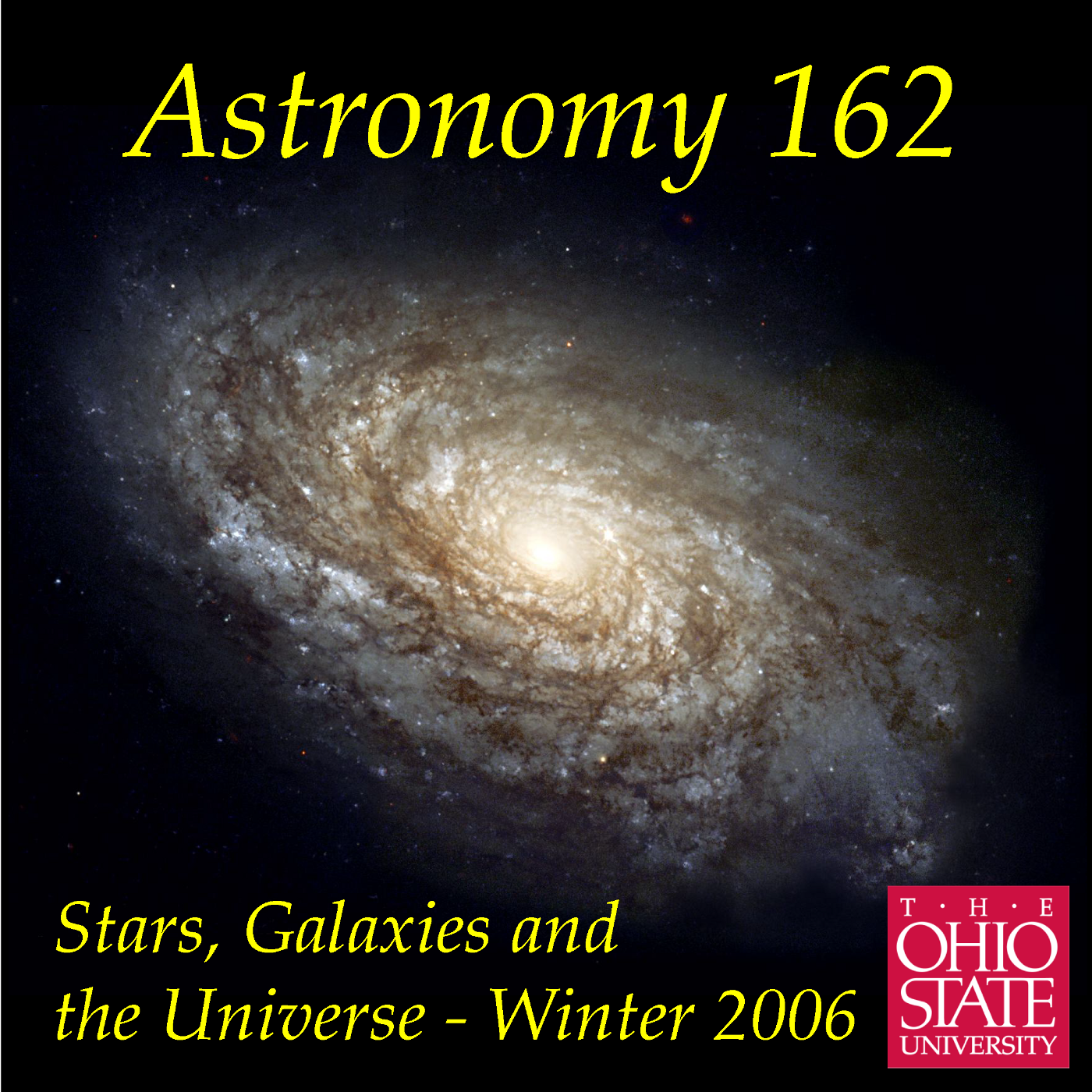
Astronomy 162, Stars, Galaxies, and the Universe, is part 2 of a 2-quarter introductory Astronomy for non-science majors taught at The Ohio State University. This podcast presents lecture audio from Professor Richard Pogge's Winter Quarter 2006 class. All of the lectures were recorded live in 1008 Evans Laboratory on the OSU Main Campus in Columbus, Ohio.
Richard Pogge hosts Astronomy 162 - Stars, Galaxies, & the Universe, a education show with 43 episodes published.
A new podcast, Astronomy 141, Life in the Universe, is available for those interested in continuing an exploration of topics in modern astronomy.
Where are Lectures 1-4? This is a good question, and one I've gotten from many listeners. Here's the answer. Recorded 2006 Nov 27 on the Columbus campus of The Ohio State University.
Welcome to the Astronomy 162 Lecture Podcasts! This is a brief message from me explaining the podcasts, and welcoming new and old listeners. Recorded 2006 Mar 10 on the Columbus campus of The Ohio State University.
How can we search for extraterrestrial intelligence, and what are we looking for? This second part of a 2-part lecture picks up where we left off yesterday by examining SETI, the Search for ExtraTerrestrial Intelligence,
Are we alone in the Universe? This is the first part of a 2-part lecture that will explore the question of life and the Universe. We will look at the conditions needed for life, and address the question of how often we e
Can we travel through time? This is not a frivilous, science-fiction kind of question. Certain restricted kinds of time travel are in fact allowed by classical General Relativity. This lectures takes up this question, an
We are not made of the same matter as most of the Universe! This surprising conclusion, that the ordinary matter we are made of (protons, neutrons, and electrons) constitute only 13% or so of the total matter in the Univ
How will the Sun evolve? The Sun is now a middle-aged, low-mass, Main Sequence star in a state of hydrostatic and thermal equilibrium that has consumed about half of the Hydrogen available for fusion in its core. What wi
What is the ultimate fate of the Universe? The ultimate fate of the Big Bang is either expansion to a maximum size followed by re-collapse (the Big Crunch) or eternal expansion into a cold, dark, disordered state (the Bi
What was the Universe like from the earliest phases immediately after the Big Bang to the present day? This lecture reviews the physics of matter, and follows the evolution of the expanding Universe from the first instan
Is there any evidence that the Universe was very hot and dense in the distant past as predicted by the Big Bang model of the expanding Universe? This lecture examines observational tests of the Big Bang Model. We have al
The Universe today is old, cold, low-density, and expanding. If we run the expansion backwards, we will eventually find a Universe where all the matter was in one place where the density and temperature are nearly infini
How do we measure distances on cosmic scales? This lecture describes the rungs in the cosmic distance ladder from measuring the AU in our own Solar System out into the Hubble expansion of the universe. These distances fo
How did we discover that the Universe is Expanding? What does it mean that it is expanding? This lecture introduces Hubble's Law, the observational evidence that the Universe is systematically expanding. As galaxies get
What are the implications of Relativity for the Universe? This lecture introduces the Cosmological Principle, which states that the Universe is Homogeneous and Isotropic on Large Scales. Applying this to his then-new Gen
What is gravity? Newton left that question unanswered when he formulated his inverse square law of the gravitational force, framing no hypothesis for what agency transmits gravity, only asserting it was an action at a di
What are space and time? To begin our exploration of the evolving Universe, we must first understand what we mean by space and time. This lecture contrasts the Newtonian view of the World, with its absolute space and abs
What are Active Galaxies and Quasars? We have good reason to think that buried deep in the hearts of nearly every (?) bright galaxy is a supermassive black hole with masses of millions or even billions of times the mass
What happens if two galaxies collide? The average distance between bright galaxies is only about 20 times their size, so over the history of the Universe (14 Billion years), we expect that most bright galaxies will have
Galaxies are found in groups and clusters, and these are only the start of a hierarchy of cosmic structures up to the largest scales observed. This lecture introduces the properties of groups and clusters of galaxies, su
Sponsor detection runs nightly. Check back soon.
No public pitch examples yet for this show.
Generate your own personalised pitchBased on semantic analysis of episode topics and host coverage, this show is a strong guest fit for executives in:
Industry fit is computed by PitchCentric using vector embeddings of the show's episode catalog.
Shows with the most semantically similar episode content. Pitch one, pitch all; producers cluster.



Astronomy 162 - Stars, Galaxies, & the Universe has a verified contact on file. Create a free PitchCentric account to access it and generate a personalised pitch in seconds. Research at least 3 recent episodes first and lead with a specific angle that serves their education audience.
Astronomy 162 - Stars, Galaxies, & the Universe is hosted by Richard Pogge. The show is categorised under Education (Courses) and has published 43 episodes.
Astronomy 162 - Stars, Galaxies, & the Universe has published 43 episodes.
Astronomy 162 - Stars, Galaxies, & the Universe regularly covers Education, Courses, Science, Astronomy, Natural. It sits in the Education category, with a Courses focus.
Astronomy 162 - Stars, Galaxies, & the Universe is accessible for guests with genuine education expertise. A personalised, episode-aware pitch will still outperform a generic one every time.
Astronomy 162 - Stars, Galaxies, & the Universe hasn't explicitly signalled guest openness in recent episodes. That doesn't rule out pitching. your hook just needs to be especially compelling and relevant to their recent content.
Our data rates Astronomy 162 - Stars, Galaxies, & the Universe's guest bar at 81/100 (Premium tier). Established thought leaders with verified media credentials. Sign in to PitchCentric to see how your own Pod Score compares against this show.
Methodology. Booking Probability™ blends Listen Score, 30-day Virality, open-to-guests detection, and Apple ratings. Data refreshed every 60 minutes. Listen Score and Booking Probability are calculated by PitchCentric. Last enriched 7 days ago.