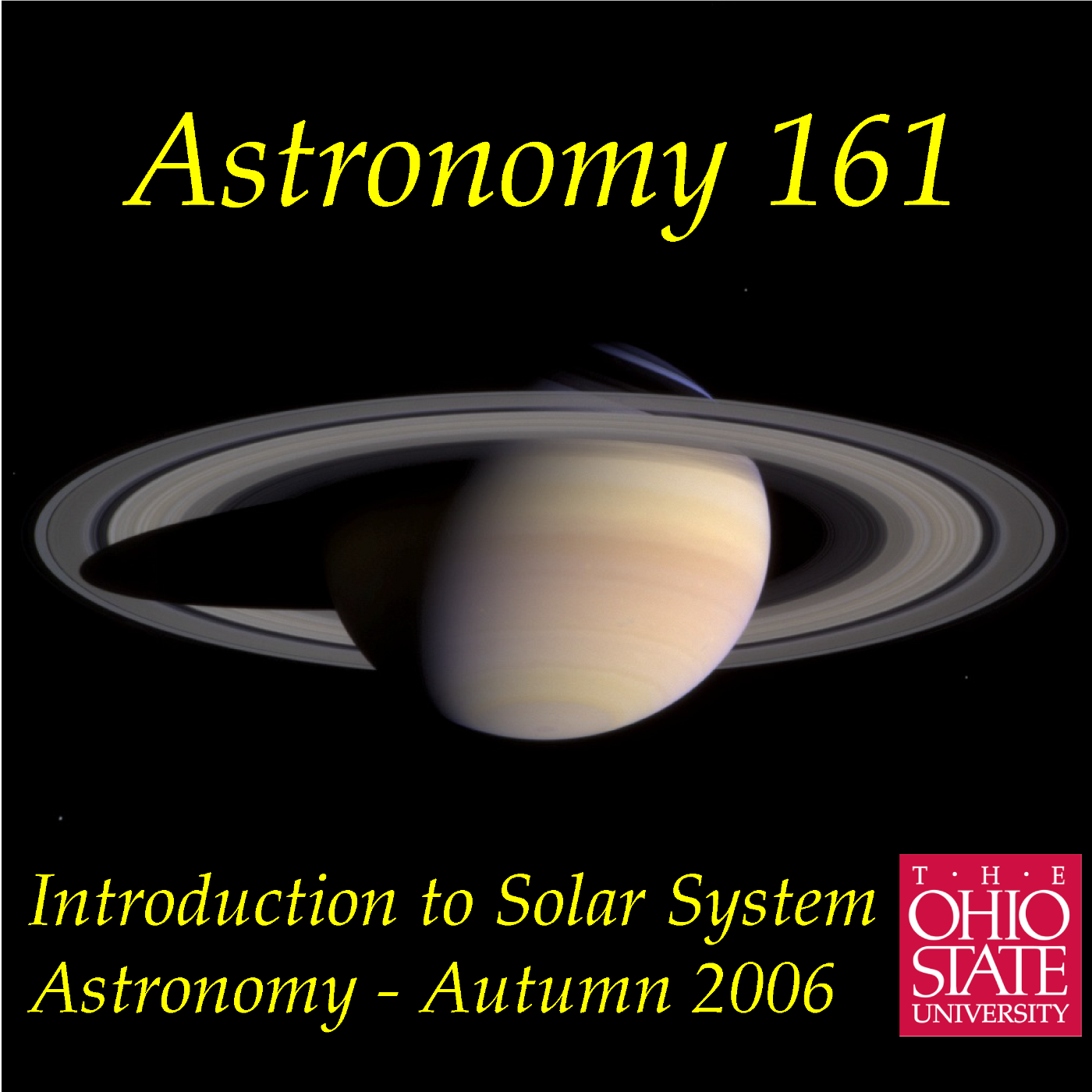
Astronomy 141 Podcast Teaser
Dec 6, 20090
A new podcast, Astronomy 141, Life in the Universe, is available for those interested in continuing an exploration of topics in modern astronomy.

Hosted by Richard Pogge · 🇺🇸 US · EN-US · 47 episodes
Established thought leaders with verified media credentials.
Astronomy 161, Introduction to the Solar System, is the first quarter of a 2-quarter introductory Astronomy for non-science majors taught at The Ohio State University. This podcast presents audio recordings of Professor Richard Pogge's lectures from his Autumn Quarter 2006 class. All of the lectures were recorded live in 100 Stillman Hall on the OSU Main Campus in Columbus, Ohio.
Richard Pogge hosts Astronomy 161 - Introduction to Solar System Astronomy, a education show with 47 episodes published.
A new podcast, Astronomy 141, Life in the Universe, is available for those interested in continuing an exploration of topics in modern astronomy.
Are there planets around other stars? Are there Earth-like planets around other stars? Do any of those harbor life? Intelligent life? We'd like to know the answers to all of these questions, and in recent years we've mad
What is a planet? Is Pluto a planet? This lecture traces the debate on the nature of what it means to be a planet by taking an historical approach, looking at how the question has arisen with the discovery of the asteroi
Comets are occasional visitors from the icy reaches of the outer Solar System. This lecture discusses the orbits, structure, and properties of comets, and introduces the "dirty snowball" model of a comet nucleus. The end
Beyond the orbit of Neptune is the realm of the icy worlds, ranging in size from Triton, the giant moon of Neptune, and the dwarf planets Pluto and Eris, all the way down to the nuclei of comets. This lecture discussed t
Asteroids are the leftover rocky materials from the formation of the Solar System that reside mainly in a broad belt between the orbits of Mars and Jupiter. Meteoroids are fragments of asteroids or bits of debris from pa
All Jovian planets have rings. We are most familiar with the bright, spectacular rings of Saturn, but the other Jovian planets have rings systems around them. This lecture describes the different ring systems and their p
Saturn is attended by a system of 56 known moons and bright, beautiful rings. The Moon system is the focus of our attention today. Saturn has one giant moon, Titan, which is the 2nd largest moon in the Solar System, and
Jupiter is surrounded by a solar system in miniature of 63 known moons. Most (59) are tiny, irregular bodies that are a combination of captured asteroids and comets. The 4 largest are the giant Galilean Moons: Io, Europa
Uranus and Neptune are the smallest and outermost of the 4 Jovian planets. While superficially similar to Jupiter and Saturn, there are substantial differences. Uranus and Neptune have smaller rocky cores surrounded by d
Jupiter and Saturn are the largest planets in the Solar System, and the prototype of the Jovian Gas Giant planets. This lecture focusses on the planets themselves, looking at their composition, atmospheres, and internal
Having completed our tour of the terrestrial planets, we want to step back and compare their properties. In particular, we want to look at the processes that drive the evolution of their surfaces, their interiors, and th
Mars, fourth planet from the Sun, is a cold desert planet with a thin, dry carbon-dioxide atmosphere. The geology of Mars, however, shows signs of an active past, with hot-spot volcanism, and tantalizing signs of ancient
Venus, the second planet from the Sun, is perpetually veiled behind opaque clouds of sulfuric acid droplets atop a hot, heavy, mostly carbon dioxide atmosphere. In size and apparent composition, however, it is a near twi
Mercury is the innermost of the planets, a hot, dead world that has been heavily battered by impacts. This lecture reviews the basic properties of Mercury, particularly its surface and interior. Recorded 2006 Nov 8 in 10
How did the Solar System form? This lecture examines the clues in the present-day dynamics (orbital and rotation motions) of the planets and planetary composition to the formation of the solar system. We will then descri
We start our exploration of the Solar System with a quick overview of its constituent parts. I will take as my starting point that Pluto, Eris, and Ceres are Dwarf Planets according to the 2006 IAU decision. This decisio
What is the structure of the Moon, and what physical processes have shaped its surface? In this lecture we turn to our nearest celestial neighbor, the Moon, to see a world quite different than the dynamic Earth. We will
What is the composition and structure of the Earth's atmosphere? Why is it as warm as it is, and how did it form? These are the questions for today's lecture. The Earth's atmosphere is a complex, dynamic, and evolving sy
What is the structure of the Earth? What better place to begin our exploration of the Solar System then with the best-studied planet, the Earth. This lecture discusses the interior structure of the Earth, introducing the
Sponsor detection runs nightly. Check back soon.
No public pitch examples yet for this show.
Generate your own personalised pitchBased on semantic analysis of episode topics and host coverage, this show is a strong guest fit for executives in:
Industry fit is computed by PitchCentric using vector embeddings of the show's episode catalog.
Shows with the most semantically similar episode content. Pitch one, pitch all; producers cluster.


Astronomy 161 - Introduction to Solar System Astronomy has a verified contact on file. Create a free PitchCentric account to access it and generate a personalised pitch in seconds. Research at least 3 recent episodes first and lead with a specific angle that serves their education audience.
Astronomy 161 - Introduction to Solar System Astronomy is hosted by Richard Pogge. The show is categorised under Education (Medicine) and has published 47 episodes.
Astronomy 161 - Introduction to Solar System Astronomy has published 47 episodes.
Astronomy 161 - Introduction to Solar System Astronomy regularly covers Education, Medicine, Science, Natural. It sits in the Education category, with a Medicine focus.
Astronomy 161 - Introduction to Solar System Astronomy is accessible for guests with genuine education expertise. A personalised, episode-aware pitch will still outperform a generic one every time.
Astronomy 161 - Introduction to Solar System Astronomy hasn't explicitly signalled guest openness in recent episodes. That doesn't rule out pitching. your hook just needs to be especially compelling and relevant to their recent content.
Our data rates Astronomy 161 - Introduction to Solar System Astronomy's guest bar at 81/100 (Premium tier). Established thought leaders with verified media credentials. Sign in to PitchCentric to see how your own Pod Score compares against this show.
Methodology. Booking Probability™ blends Listen Score, 30-day Virality, open-to-guests detection, and Apple ratings. Data refreshed every 60 minutes. Listen Score and Booking Probability are calculated by PitchCentric. Last enriched 6 days ago.