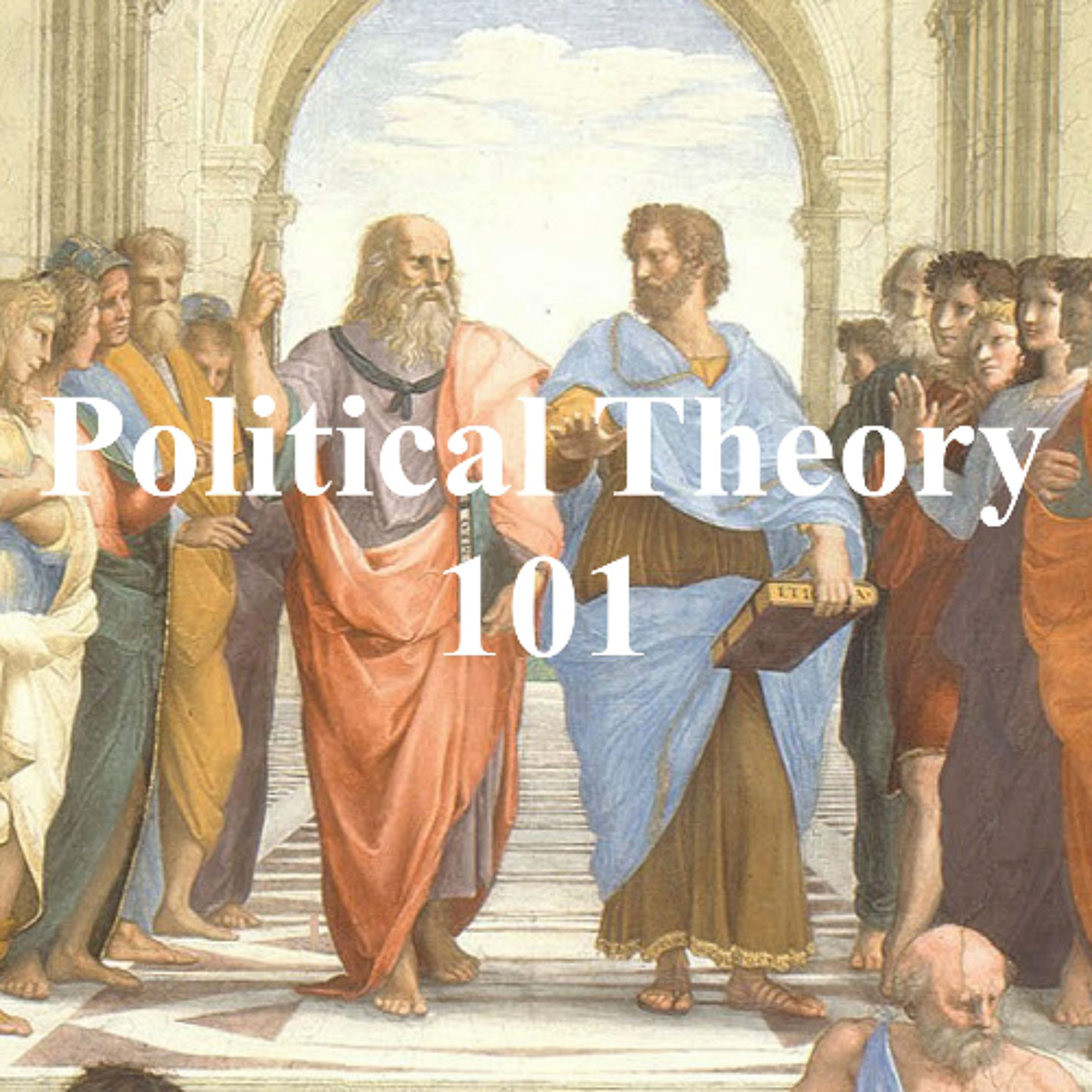
Kojève & the End of History
We talk about Alexandre Kojève, whose reading of Hegel gave rise to a theory of recognition and of an "end of history". We also discuss Kojève's influence on Francis Fukuyama and on contemporary liberalism.
Hosted by Unknown Host · 🇺🇸 US · EN · 96 episodes
Established thought leaders with verified media credentials.
A podcast about political theory. Freely available to all, but we'd love your support on Patreon:https://www.patreon.com/politicaltheory101Also available on iTunes, Spotify, and Google Play
Unknown Host hosts Political Theory 101, a government show with 96 episodes published.

We talk about Alexandre Kojève, whose reading of Hegel gave rise to a theory of recognition and of an "end of history". We also discuss Kojève's influence on Francis Fukuyama and on contemporary liberalism.

We discuss the work of American political scientist Murray Edelman, whose work on symbolic politics predates later French theory on the "spectacle".

We discuss Streit's 1939 proposal for a international federation of democracies to avoid a new world war. We explore the limits of argumentation and the difference between making an argument and doing politics.

We discuss Friedrich List's many careers, his struggle for a German customs union, his belief that nationalism would lead to the "uniting of all nations under a common law of right", what happened instead, and why.

We discuss Vico's theory of nature, his unorthodox mix of stereotypically ancient and modern approaches, and how his "new science" seems to be going so far.

A whole episode of Political Theory 101 devoted to Thomas Hobbes' Behemoth. We discuss Hobbes' historical narrative and his theory of education, both of which receive little attention in Leviathan.

Michael Downs joins Benjamin to discuss the political thought of Nick Land, its relationship to the work of Deleuze and Guattari, and the degree to which it has influenced the contemporary left and right.

We discuss how Plato used dialectical thinking to deal with objections to the theory of the forms. Then we discuss how this kind of thinking enriches our ability to make use of all sorts of political concepts and abstrac

We discuss the work of John Morley, a British viscount heavily involved in the government of Ireland and India during the late 19th and early 20th century. Morley was a liberal, but he was often in situations in which hi

Daniel joins Benjamin to discuss Plato's Philebus. We traverse the dialectic of limit and unlimit and discuss the difference between memory and recollection, connecting all of this to Plato's political thought.

Elizabeth Dearden-Williams, a former student of mine from Cambridge who is currently pursuing a masters, comes on to discuss the work of the Prussian general Carl von Clausewitz.

Chris Cutrone joins Benjamin for a discussion of political parties, focusing on the role pluralism plays in Chris' thinking about party structure.

John Milton isn't just the author of Paradise Lost! Raeffe Gibson makes a guest appearance to discuss his role in the English Civil War.

Alex and Benjamin discuss the work of Michael Pettis, putting him in conversation with older theorists of imperialism like J.A. Hobson and Vladimir Lenin.

Alex and Benjamin discuss Huntington's early emphasis on centralization and institutions, his turn toward civilizational thinking, and the position of religion - and particularly Catholicism - in his account.

Alex and Benjamin explore the history of political thought from the point of view of Bastiat - who threw many ancient and enlightenment thinkers together into the basket of plunderers. If we think we come from God whole

Alex and Benjamin discuss Terry Eagleton's work, focusing on interactions between religion and Marxism in the context of the "end of history" - the 1990s and beyond.

Alex and Benjamin discuss the Roman persecution of the Christians - why the Romans did it, how the Christians responded to it, and the ways the experience shaped Christian political thought going forward.

We explore the methodological contributions of the late historian of political thought, John Pocock. We talk about the role of language and context in interpreting texts, distinctions between "history" and "philosophy,"

Alex and Benjamin explore post-political themes in Haruki Murakami's rat tetralogy.
Sponsor detection runs nightly. Check back soon.
No public pitch examples yet for this show.
Generate your own personalised pitchBased on semantic analysis of episode topics and host coverage, this show is a strong guest fit for executives in:
Industry fit is computed by PitchCentric using vector embeddings of the show's episode catalog.
Shows with the most semantically similar episode content. Pitch one, pitch all; producers cluster.

![Government Explained [United States]](https://d3t3ozftmdmh3i.cloudfront.net/staging/podcast_uploaded_nologo/43406747/c19c2a213010e4f8.jpg)


Political Theory 101 has a verified contact on file. Create a free PitchCentric account to access it and generate a personalised pitch in seconds. Research at least 3 recent episodes first and lead with a specific angle that serves their government audience.
Political Theory 101 is hosted by Unknown Host. The show is categorised under government and has published 96 episodes.
Political Theory 101 has published 96 episodes.
Political Theory 101 regularly covers government. It sits in the government category.
Political Theory 101 is accessible for guests with genuine government expertise. A personalised, episode-aware pitch will still outperform a generic one every time.
Political Theory 101 hasn't explicitly signalled guest openness in recent episodes. That doesn't rule out pitching. your hook just needs to be especially compelling and relevant to their recent content.
Episodes of Political Theory 101 average 84 minutes, giving guests a long-form format with plenty of time to expand on their expertise.
Our data rates Political Theory 101's guest bar at 82/100 (Premium tier). Established thought leaders with verified media credentials. Sign in to PitchCentric to see how your own Pod Score compares against this show.
Methodology. Booking Probability™ blends Listen Score, 30-day Virality, open-to-guests detection, and Apple ratings. Data refreshed every 60 minutes. Listen Score and Booking Probability are calculated by PitchCentric. Last enriched yesterday.