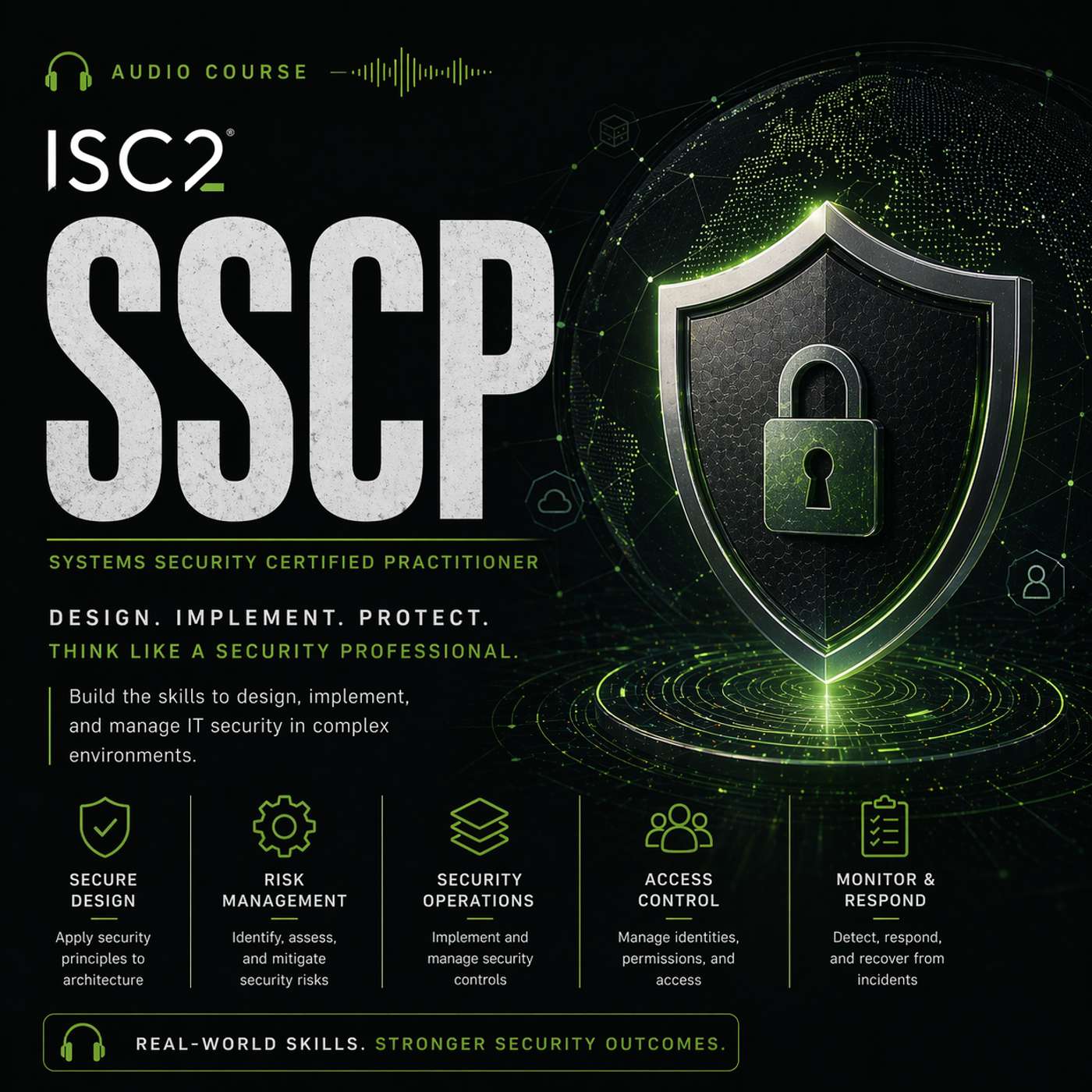
Welcome to the SSCP Course!
If you are preparing for the Systems Security Certified Practitioner certification, you already know the challenge. There is a lot of material to cover, and most professionals studying for SSCP are balancing that prepara
Hosted by Jason Edwards · 🇺🇸 US · EN · 72 episodes
Established thought leaders with verified media credentials.
The SSCP Audio Course from BareMetalCyber.com delivers a complete, exam-ready learning experience for cybersecurity professionals who prefer to learn on the go. Each episode breaks down complex security concepts into plain English, aligning directly with the official (ISC)² Systems Security Certified Practitioner domains. Listeners gain a clear understanding of the core principles—access controls, risk management, cryptography, network defense, and incident response—through real-world examples that tie theory to practice. Every topic is designed to reinforce what matters most on exam day: how to read questions, recognize control intent, and choose the most defensible answer under pressure.Across seventy tightly structured lessons, the course builds practical, lasting knowledge that goes beyond memorization. You’ll hear how working security analysts, assessors, and auditors apply each concept in live environments, turning standards and policies into daily decisions. With professional
Jason Edwards hosts Certified: The SSCP Audio Course, a technology show with 72 episodes published.

If you are preparing for the Systems Security Certified Practitioner certification, you already know the challenge. There is a lot of material to cover, and most professionals studying for SSCP are balancing that prepara
The SSCP’s adaptive format rewards steady decision-making and penalizes wasted time, so tactics matter as much as knowledge. We explain how adaptive scoring selects items near your current ability estimate, why early sta

Fast recall of precise meanings accelerates problem solving on exam day, so this episode presents a plain-language mini-glossary woven into context rather than alphabet soup. We clarify frequently tested pairs that candi

This capstone pulls together system and application safeguards into one coherent playbook, mirroring how exam scenarios blend layers. We connect configuration baselines, least privilege, patch management, and logging wit

Hypervisors and containers minimize overhead differently, which changes how isolation can fail and how you defend it. We distinguish threats to hypervisors—escape exploits, insecure device emulation, overprivileged manag

Virtualization concentrates risk and enables resilience, so the SSCP exam expects you to understand both the power and the pitfalls. This episode clarifies core concepts—hypervisors (type 1 vs. type 2), guests, snapshots

Protecting data in the cloud means aligning technical safeguards with service-level commitments and third-party risk oversight. We detail encryption at rest and in transit, tokenization and field-level controls, data los

Legal and contractual duties do not vanish in the cloud; they shift and require careful mapping. This episode explains shared responsibility: providers secure the infrastructure they run, while customers configure and go

Cloud topics appear across SSCP domains, and clarity on models is essential. We define deployment models—public, private, community, and hybrid—and service models—Infrastructure as a Service, Platform as a Service, and S

Modern fleets mix corporate-owned devices with bring-your-own-device (BYOD), demanding layered controls. We position Endpoint Detection and Response (EDR) as telemetry plus containment for suspicious behavior, Enterprise

Endpoint protection is strongest when encryption, application control, and policy enforcement work together. This episode clarifies where each control fits: full-disk encryption protects data at rest if a device is lost,

Host protections remain a last, critical line of defense, and the SSCP exam expects you to differentiate prevention, detection, and containment on endpoints. We position Host-based Intrusion Prevention Systems (HIPS) as

Social engineering exploits attention, trust, and time pressure, so defenses must combine technology, process, and human habits. We define major vectors—phishing, spear phishing, vishing, smishing, business email comprom

Malware analysis on the SSCP exam focuses on recognizing behaviors and artifacts rather than reverse-engineering internals. We define common classes—viruses, worms, Trojans, ransomware, rootkits, and fileless malware—and

Solid network fundamentals enable fast, confident choices under test pressure. This recap organizes key ideas you have used throughout earlier episodes: zoning and trust boundaries, default-deny routing with least-privil

Internet of Things (IoT) ecosystems expand the attack surface by introducing diverse, often constrained devices that run long-lived firmware and communicate over specialized protocols. This episode clarifies why standard

Wireless networks extend enterprise reach—and risk—and the SSCP exam stresses understanding their protections. This episode describes core wireless security standards: WPA3 with SAE authentication, enterprise 802.1X inte

Modern enterprises combine multiple protective systems, and the SSCP exam expects you to understand how these integrate without conflict. This episode defines Data Loss Prevention (DLP), Unified Threat Management (UTM),

Firewalls and related technologies enforce boundaries between zones, a fundamental competency for SSCP professionals. This episode explains packet-filtering, stateful, and next-generation firewalls, emphasizing rule eval

Segmentation limits blast radius, improves performance, and appears across multiple SSCP domains. This episode explains logical and physical segmentation methods—VLANs, subnets, virtual routing, and isolated management n
Sponsor detection runs nightly. Check back soon.
No public pitch examples yet for this show.
Generate your own personalised pitchBased on semantic analysis of episode topics and host coverage, this show is a strong guest fit for executives in:
Industry fit is computed by PitchCentric using vector embeddings of the show's episode catalog.
Shows with the most semantically similar episode content. Pitch one, pitch all; producers cluster.


Certified: The SSCP Audio Course has a verified contact on file. Create a free PitchCentric account to access it and generate a personalised pitch in seconds. Research at least 3 recent episodes first and lead with a specific angle that serves their technology audience.
Certified: The SSCP Audio Course is hosted by Jason Edwards. The show is categorised under technology (education) and has published 72 episodes.
Certified: The SSCP Audio Course has published 72 episodes.
Certified: The SSCP Audio Course regularly covers technology, education, courses. It sits in the technology category, with a education focus.
Certified: The SSCP Audio Course is accessible for guests with genuine technology expertise. A personalised, episode-aware pitch will still outperform a generic one every time.
Certified: The SSCP Audio Course hasn't explicitly signalled guest openness in recent episodes. That doesn't rule out pitching. your hook just needs to be especially compelling and relevant to their recent content.
Episodes of Certified: The SSCP Audio Course average 11 minutes. a focused format where a clear narrative arc and tight preparation matter most.
Our data rates Certified: The SSCP Audio Course's guest bar at 80/100 (Premium tier). Established thought leaders with verified media credentials. Sign in to PitchCentric to see how your own Pod Score compares against this show.
Methodology. Booking Probability™ blends Listen Score, 30-day Virality, open-to-guests detection, and Apple ratings. Data refreshed every 60 minutes. Listen Score and Booking Probability are calculated by PitchCentric. Last enriched 9 days ago.